[Han Dong-ha's Boncho Yeodam] Only Two Medicinal Herbs, Yet They Cleared the Cloudy Membrane Covering His Eyes
- Input
- 2026-09-26 06:00:00
- Updated
- 2026-09-26 06:00:00
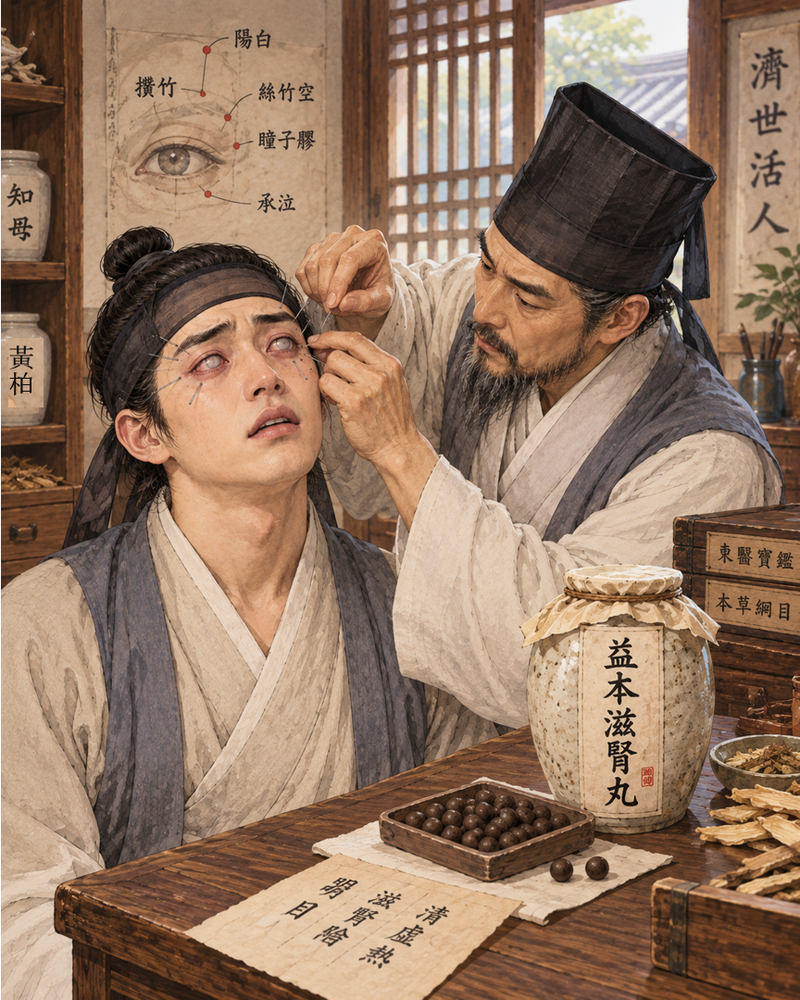
Long ago, there was a young man in a certain town. From an early age, he had indulged excessively in sexual relations. After years of exhausting his vital essence day and night, he began to experience blurred vision and found that objects looked indistinct.
At first, he dismissed it as fatigue and did not take it seriously. But his vision did not clear with time. His eyes often became dry and painful, tears flowed frequently, and a whitish membrane resembling a mist began to form over the black part of his eyes.
At a local apothecary, the young man was told, "The eyes become clear by receiving the essence and blood of the liver and kidneys. You have clearly exhausted too much of your vital essence, so you must be deficient in kidney water. Take medicine that replenishes kidney water and brightens the eyes." He followed the advice and took medicine said to replenish water qi and improve the eyes.
Yet the more medicine he took, the stranger things became. His eye disease did not improve, while his sexual vigor instead grew stronger. Eventually, both eyes became almost completely white.
His family members looked into his eyes with concern and said, "Are you really going to lose your sight at this rate?" By then, the young man could barely distinguish people's faces clearly.
In the end, he sought out a renowned physician. The physician seated him in a well-lit place and carefully examined both eyes. "A thick white membrane has formed over the black part of your eyes, particularly over the corneal area. Why did you leave it untreated for so long?" he asked. The traditional term refers to a white or cloudy opacity occurring over the black part of the eye, especially the cornea. It does not correspond exactly to a single modern disease, but may encompass conditions such as corneal opacity, corneal scarring, post-keratitis opacity, and leukoplakic lesions.
Although the physician was unsure of the outcome, he first began inserting needles into several acupuncture points thought to affect the area around the eyes and the cloudy membrane. These included Jingming, Zanzhu, Pupil Crevice, Tears Container, Fengchi, and several other points around the eyes and the back of the head. After several days of acupuncture treatment, a change appeared. The membrane, which had looked completely white, became slightly thinner, and faint red, thread-like blood vessels could be seen beneath it.
After examining the young man's eyes again, the physician said, "Now I can treat you." The membrane had responded to the acupuncture treatment, suggesting that there was a possibility of recovery.
The physician then prescribed medicine. The formula was remarkably simple: just two medicinal herbs, Anemarrhenae Rhizoma and Phellodendri Cortex. He added Angelica root as well.
The young man was puzzled when he received the prescription because it contained so few herbs compared with the medicines he had taken before. He said, "I took so many tonics said to be good for the eyes over the past several years, but I still did not get better."
The physician replied, "This formula is Ikbon Jasin-hwan. As its name suggests, Ikbon Jasin-hwan means 'helping the root and nourishing kidney yin.' Use equal amounts of these two herbs and Angelica root, process and roast them with salt water, grind them into a fine powder, make pills with water, and take them on an empty stomach with salt water."
The young man asked, "Are there really only three medicinal herbs?" The physician answered, "A formula does not become more effective simply because it contains more herbs. You must identify the cause of the disease correctly." Pointing to the young man's eyes, he continued, "You exhausted your vital essence excessively, which caused yin deficiency. As yin became deficient, deficient fire rose inside you. Therefore, you should not blindly replenish water qi; you must first bring down the fire that has risen upward."
Following the physician's instructions, the young man continued taking Ikbon Jasin-hwan with added Angelica root. After one month and then two, the white membrane over his eyes gradually faded. The dryness and pain also subsided, and his eyes watered less often. After taking the medicine for several months, his eye disease improved greatly.
The young man was delighted. "I never imagined that a disease that did not improve after taking so many medicines could get better with such a simple formula," he said. The physician smiled and replied, "It is not a matter of how many or how few herbs a medicine contains. What matters is whether it precisely matches the disease. Ikbon Jasin-hwan contains few herbs, but that allowed its therapeutic power to remain concentrated and produce an effect."
Sometimes, two herbs that precisely match a disease pattern can exert more power than ten. That is why the physicians of old considered it more important to determine how fully a formula's therapeutic power could be concentrated in one direction than to count the number of herbs it contained. A formula may contain few herbs. Above all, what matters is whether it accurately targets the root of the disease.
Source of today's Boncho Yeodam story
<Gyeongbo Sinpyeon>A young man developed an eye disease after excessive sexual activity. Although he took large amounts of medicine to strengthen water and brighten the eyes for several years, his condition worsened, and both eyes became completely white. He came to me seeking treatment. I feared that he might already be blind or that the membrane would be difficult to remove. However, after I carefully needled several acupuncture points that reduce the cloudy membrane, the white opacity became slightly thinner and faint red vessels appeared. After confirming that the condition could be treated, I prescribed Ikbon Jasin-hwan with added Angelica root. He continued taking it for several months and recovered quickly. This medicine contains few herbs, but its therapeutic power is concentrated, allowing it to produce an effect. This is a teaching left by Sun Simiao and deserves careful consideration. (A young man developed an eye disease because he excessively indulged in sexual relations. He took large amounts of medicine said to replenish water and brighten the eyes for several years, but his condition worsened until both eyes were completely covered by a white membrane. He came to me for treatment. I feared that he might already be blind or that the membrane would be difficult to remove, but after I carefully needled several acupuncture points with the ability to clear the membrane, the white opacity became slightly lighter and the blood vessels faintly emerged. After confirming that treatment was possible, I gave him Ikbon Jasin-hwan with added Angelica root. He continued taking it for several months and recovered completely. This medicine contains few herbs, but its therapeutic power is concentrated, enabling it to produce an effect. It is a principle left by Sun Simiao and should be examined carefully.)<Donguibogam>Ikbon Jasin-hwan. Treats a cloudy membrane forming over the black part of the eye, or enlarged pupils caused by yin deficiency. Phellodendri Cortex and Anemarrhenae Rhizoma, both washed in wine and stir-fried, in equal amounts. Grind the above ingredients into powder, add drops of water, and form pills the size of wutong seeds. Take 50 to 70 pills on an empty stomach with salt water. (Ikbon Jasin-hwan. It treats a cloudy membrane that forms over the black part of the eye or enlarged pupils caused by yin deficiency. Grind equal amounts of Phellodendri Cortex and Anemarrhenae Rhizoma into powder, adding water as needed, and form pills the size of wutong seeds. Take 50 to 70 pills on an empty stomach with boiled salt water.)/ Han Dong-ha, director of Han Dong-ha Korean Medicine Clinic
[email protected] Jeong Myeong-jin, medical specialist Reporter