National Assembly Processes Follow-Up Bills for New Criminal Justice System; Confirmation of Kim Seong-su as Supreme Court Justice Approved
- Input
- 2026-09-17 17:39:08
- Updated
- 2026-09-17 17:39:08
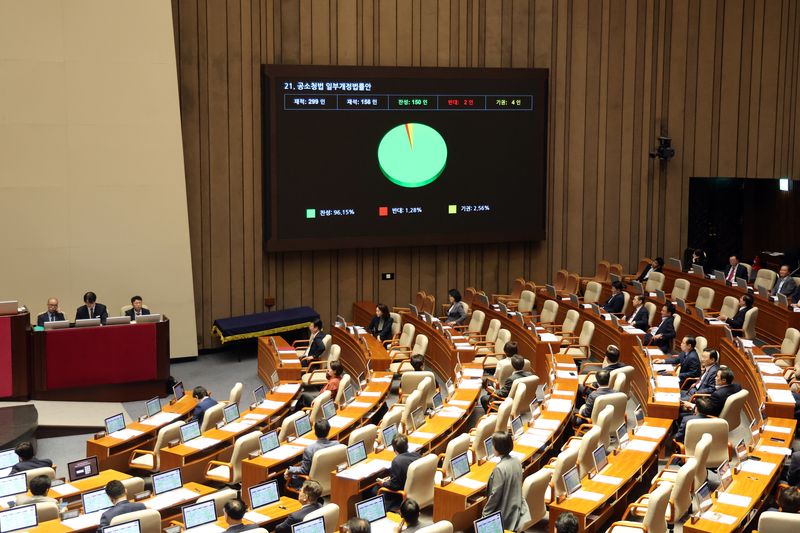
The National Assembly of the Republic of Korea held a plenary session that day and passed a total of 51 follow-up bills related to the launch of the Serious Crime Investigation Agency and the Public Prosecution Office, scheduled for October 2. The bills largely revise provisions of the former criminal justice system contained in existing laws to align them with the new system.
In addition, the plenary session processed bills intended to dispel concerns that the new criminal justice system could lead to inadequate investigations into crimes against socially vulnerable groups. An amendment to the Serious Crime Investigation Agency Act, proposed by Lee Hae-sik of the Democratic Party of Korea, allows the Serious Crime Investigation Agency to investigate not only serious crimes but also crimes against socially vulnerable groups when it receives a request for a supplementary investigation or reinvestigation. Bills requiring the police to refer every case involving crimes against socially vulnerable groups to prosecutors—including elder abuse, sexual crimes against children and adolescents, sexual violence, stalking, and abuse of people with disabilities—were also passed in a batch.
Before the National Assembly of the Republic of Korea processed the follow-up bills for the new criminal justice system, Park Hyung-soo, the People Power Party’s ranking member on the National Assembly Legislation and Judiciary Committee, spoke in opposition. Park said, "The new criminal justice system completely strips prosecutors even of their authority to conduct supplementary investigations, shaking the foundations of the criminal justice system to its core," and added, "I oppose all 51 follow-up bills tabled today (the 17th)."
He continued, "Can it really be considered genuine reform to overhaul a 70-year-old criminal justice system and then bundle together and rush through this flawed follow-up legislation just 15 days before the launch of the Serious Crime Investigation Agency and the Public Prosecution Office?" He added, "After defeating these bills, we must restore prosecutors’ authority to conduct supplementary investigations and restart genuine reform legislation that reflects the earnest wishes of the public and crime victims." However, his arguments were ultimately blocked by the ruling party’s overwhelming majority and were not accepted.
Meanwhile, the National Assembly of the Republic of Korea approved the confirmation motion for Supreme Court justice nominee Kim Seong-su with 227 votes in favor, 28 against, and 13 abstentions among 268 lawmakers present. Kim was nominated by Chief Justice Cho Hee-dae to President Lee Jae Myung on the 18th of last month to succeed Justice Lee Heung-gu of the Supreme Court of Korea. The National Assembly Personnel Hearing Special Committee held Kim’s confirmation hearing on the 14th and adopted the hearing report on the 16th with the agreement of both the ruling and opposition parties. The Democratic Party of Korea deemed Kim qualified, while the People Power Party declared him unqualified. However, it was confirmed that immediately before the plenary session, the People Power Party had decided to allow its lawmakers to vote freely on Kim. Kim is expected to become the first Supreme Court justice to take office since the current administration began.
In addition, 19 livelihood bills were passed that day with the agreement of the ruling and opposition parties. One major example is an amendment to the Large Retail Business Act. Its key provision requires large retailers such as Coupang to pay suppliers for goods purchased directly within 35 days of receiving the goods. This shortens the existing 60-day period by 25 days. For special contract purchasing and consignment transactions used by department stores and other retailers, the payment deadline will be reduced from 40 days to 20 days. The National Assembly of the Republic of Korea also passed an amendment extending the validity period of financial companies’ mandatory contributions to the Korea Inclusive Finance Agency from the current five years to 15 years. As a result, the obligation for financial companies to contribute to the Korea Inclusive Finance Agency will remain in effect through 2036.
[email protected] Kim Hyeong-gu Reporter