Jeju Governor Wi Seong-gon Meets Climate Minister Kim Seong-hwan, Requests Inclusion of 5 GW of Offshore Wind Power in National Electricity Plan
- Input
- 2026-09-17 15:55:38
- Updated
- 2026-09-17 15:55:38
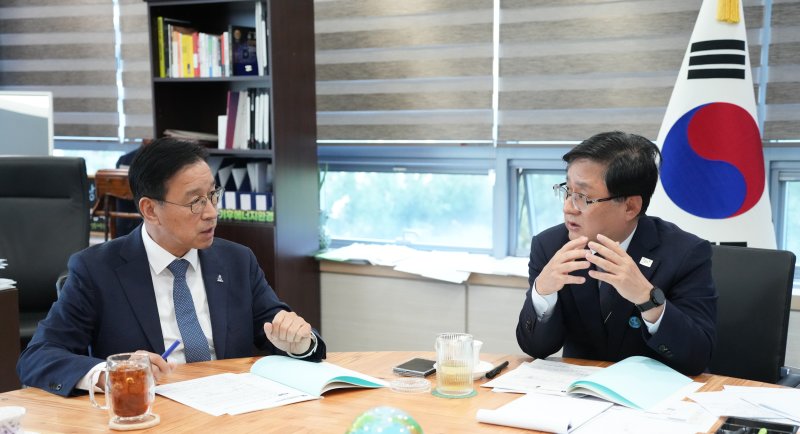
【Financial News Jeju—Reporter Jeong Yong-bok】Wi Seong-gon, governor of Jeju Special Self-Governing Province, asked Kim Seong-hwan, minister of the Ministry of Climate, Energy and Environment, to include 5 GW of offshore wind power in the Jeju region in the national electricity plan and expand the power grid so the electricity generated could be transmitted to the mainland. He also proposed institutional improvements needed to achieve carbon neutrality in Jeju by 2035, including regional electricity rates, network usage fees for energy storage systems and national funding for heat pumps.
Jeju Special Self-Governing Province said on the 17th that Governor Wi met Minister Kim at the Han River Flood Control Office in Seoul that day to discuss Jeju's energy issues, including offshore wind power, the electricity grid, electricity rates, electrification in daily life and carbon-reduction policies.
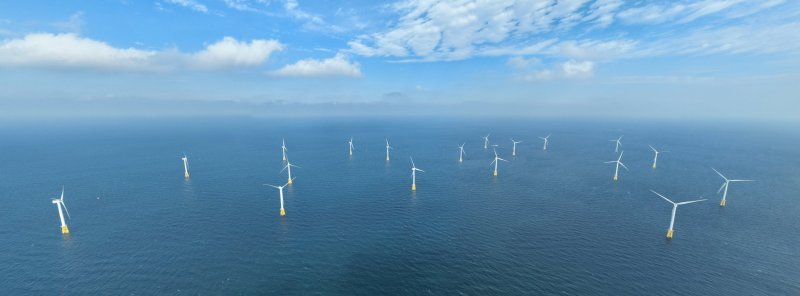
The key request was for the government to include 5 GW of offshore wind power in the Jeju region as a regional development allocation in the 12th Basic Plan for Electricity Supply and Demand, which is currently being drawn up.
The Basic Plan for Electricity Supply and Demand is the national electricity plan through which the government determines, over the medium to long term, the generation facilities, electricity demand and power-grid direction needed in the future. Because it serves as the basis for large-scale power projects and transmission-grid construction, the amount of Jeju offshore wind power included in the plan is crucial to expanding the industry.
The 5 GW requested by Jeju is equivalent to 5,000 MW. It refers to the capacity of the generation facilities—the output they can produce when operating at maximum capacity—not the amount of electricity generated over a given period. Actual generation will vary depending on wind conditions and operating hours.
Jeju asked the government to prioritize the 2.37 GW Chuja Offshore Wind Power Project as a key candidate development, with commercial operation targeted for 2035. The 12th Basic Plan for Electricity Supply and Demand is still being formulated, and Jeju formally requested its inclusion during this meeting.
Jeju emphasized the power grid alongside generation facilities. If wind and solar generation exceeds electricity demand in Jeju, curtailment—reducing the output of generators—may occur. Jeju asked the national government to build a power grid that would connect large-scale offshore wind farms to the national grid, allowing electricity generated in the province to be transmitted to the mainland rather than being handled solely within the Jeju system.
Jeju also proposed designating its waters as a national testbed for floating offshore wind power in preparation for expanding wind farms farther offshore. Unlike fixed-bottom offshore wind power, which directly anchors the foundations of turbines to the seabed, floating offshore wind power uses turbines installed on floating platforms and secured with mooring systems. This technology can expand development areas into deeper offshore waters.
Jeju also called for a system that provides electricity-rate benefits to regions that generate large amounts of power. Last month, the government unveiled a plan to divide the country into 11 regions based on power-grid conditions and balanced-growth factors and apply different industrial electricity rates. The plan includes lowering industrial electricity rates in areas outside the Seoul metropolitan region by up to 10%, depending on the region.
Jeju proposed either including the province in the regional electricity-rate system or calculating a separate adjusted rate that reflects the characteristics of electricity production and consumption in Jeju.
Jeju also called for waiving network usage fees imposed on electricity covered by direct power purchase agreements in distributed-energy special zones and on energy storage systems connected to distribution networks.
A power purchase agreement, or PPA, is a system in which companies and other entities purchase electricity directly from power generators. An energy storage system, or ESS, functions as a large battery that stores surplus electricity and supplies it again when needed. Network usage fees are charges for using the power grid to transmit and receive such electricity.
The government is also considering deferring network usage charges when ESS facilities are installed in areas where distribution networks have reached capacity.
Jeju requested support for electrifying daily life by replacing fossil fuel use with electricity in homes, buildings and transportation. It proposed raising the national funding share for the air-source heat pump deployment program from the current 40% to 50% and improving the electricity-rate structure in line with expanded heat pump use. Jeju is expanding heat pump deployment as a way to reduce carbon emissions from heating.
Jeju proposed introducing a Jeju regional electricity emissions factor so that the characteristics of the province's electricity, which has a high share of renewable energy such as wind and solar power, can be reflected in greenhouse gas emissions calculations. An electricity emissions factor is a standard used to calculate the amount of greenhouse gases emitted when 1 kWh of electricity is used. Recognizing separately the share of renewable energy in electricity consumed in Jeju could affect how companies and institutions calculate their carbon emissions.
Jeju also proposed jointly demonstrating with the government carbon-reduction projects tailored to the province, including blue carbon—the carbon absorbed and stored by the sea—and biochar, which is made by converting plant-based raw materials into a charcoal-like form that stores carbon for long periods. The province also called for amendments to resource-recycling laws so local governments can designate businesses subject to the single-use cup deposit system through ordinances.
Governor Wi said, "Jeju offshore wind power must be included in the 12th Basic Plan for Electricity Supply and Demand so it can be connected to the national grid and transmitted to the mainland, and the electricity-rate system must also be overhauled," adding, "I will consult with the government so that the benefits of expanding renewable energy can return to Jeju residents."
Minister Kim said, "We will review the proposals submitted by Jeju with the relevant departments and continue working-level consultations."
[email protected] Jeong Yong-bok Reporter