Small and Midsize Shipping Companies Shaken by Green Regulations... "Support Barriers Must Be Lowered First"
- Input
- 2026-09-17 16:08:31
- Updated
- 2026-09-17 16:08:31
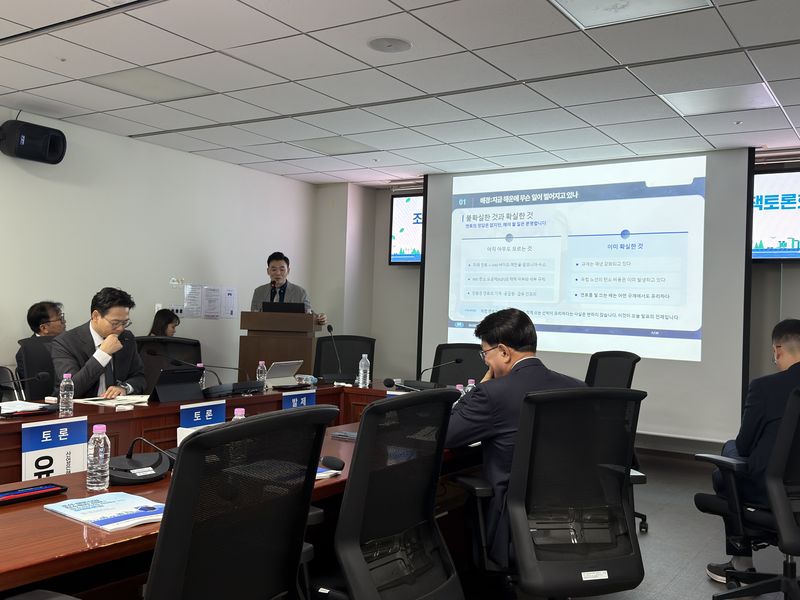
[Financial News] Global green regulations imposed by the International Maritime Organization (IMO) and other bodies are tightening. Calls are growing for a financing and certification support system tailored to domestic small and midsize shipping companies, which lack sufficient financial resources and personnel to respond. While there is broad agreement on the need to transition to eco-friendly vessels, uncertainty over fuels and technologies remains. Experts say the government and policy-finance institutions must share the initial risks so that small and midsize shipping companies can make actual investment decisions.
At the 'Policy Debate on the Carbon-Neutral Transition of the Shipbuilding and Shipping Industries and the Future of Small and Midsize Shipping Companies,' held at the National Assembly of the Republic of Korea on the 17th, Park Jun-seong, a senior researcher at Korean Register (KR), said, "Regulations are tightening every year, and carbon costs are already being incurred on European routes. Regardless of which fuel is used, vessels that consume less fuel have an advantage under every regulation." He added, "What shipowners want is not an immediate answer about which fuel is the right one, but sufficient government support and the freedom to choose."
In particular, analysts said the current eco-friendly vessel certification system acts as a high barrier to entry for small and midsize vessels. According to a simulation presented by KR, a small or midsize vessel using hybrid energy would receive approximately 36 points, falling short of the 40-point threshold for Grade 3, which is the basis for government support. Applying liquefied natural gas (LNG) at 100% would bring the score to approximately 44 points, barely exceeding Grade 3, while battery-electric propulsion would score approximately 71 points, placing the vessel in the Grade 1 range.
The problem is that Grade 3 or higher is the common threshold for major support programs, including subsidies for eco-friendly vessels operating on domestic and international routes, acquisition tax reductions, and green finance. Park pointed out that the current scoring system places too much weight on the use of eco-friendly fuels and fails to adequately reflect the technical conditions of small and midsize vessels. He proposed introducing a separate efficiency index and a tailored certification system, saying, "If certification requirements suited to small and midsize vessels are established, the door to government support could be opened."
The shipping industry also called for a shift in the direction of financial support. Lee Cheol-jung, an executive director of the Korea Shipowners' Association, said, "Support for small and midsize shipping companies should focus not on how much the government provides, but on how to create an environment in which companies can actually make investment decisions." He said risk-sharing finance is needed to comprehensively assess long-term transport contracts, expected freight rates, and the potential savings in fuel and carbon costs. He also called for broad support for phased transitions, including not only newbuilds but also the retrofitting of existing vessels and the installation of energy-saving devices.
Policy-finance institutions also emphasized the need to expand safeguards to attract private capital. Yoo Jin-seok, head of the Maritime Finance Office at Korea Development Bank (KDB), said, "Financial support for small and midsize shipping companies is provided almost entirely by policy-finance institutions." KDB currently holds approximately KRW 16 trillion in assets in the shipping industry and approximately KRW 33 trillion in the maritime sector, which combines shipbuilding and shipping. Since policy-finance institutions already account for a substantial share of lending and investment in the shipbuilding and shipping industries, greater participation from private finance is needed.
Yoo explained that demand among small and midsize shipping companies to replace aging vessels with newer ones has recently increased, but uncertainty over market conditions has led them to strongly favor purchasing secondhand vessels over ordering newbuilds. As secondhand vessel prices have also risen, he noted that both the companies' equity-funding burden and the scale of financial support required from institutions have increased. He said, "Private financial institutions still take a conservative approach to small and midsize shipping companies, so policy-finance institutions have no choice but to enter the market first and serve as a catalyst."
He also explained that small and midsize shipping companies with long-term transport contracts can obtain financing based on the creditworthiness of their cargo owners. When a company has secured a long-term contract with a highly creditworthy global cargo owner, Yoo said, "The source of repayment for ship financing is ultimately the freight paid by the cargo owner," adding that financing can be provided based on the cargo owner's credit. He also announced that programs using subordinated funds alongside senior financing are being operated to help shipping companies facing a greater equity-funding burden due to rising vessel prices.
[email protected] Jung Won-il Reporter