From Public-Enterprise Bonds to Corporate Bonds... Next Year's Bond Market Faces a 'Supply-and-Demand Battle' [FN Market Watch]
- Input
- 2026-09-17 15:45:01
- Updated
- 2026-09-17 15:45:01
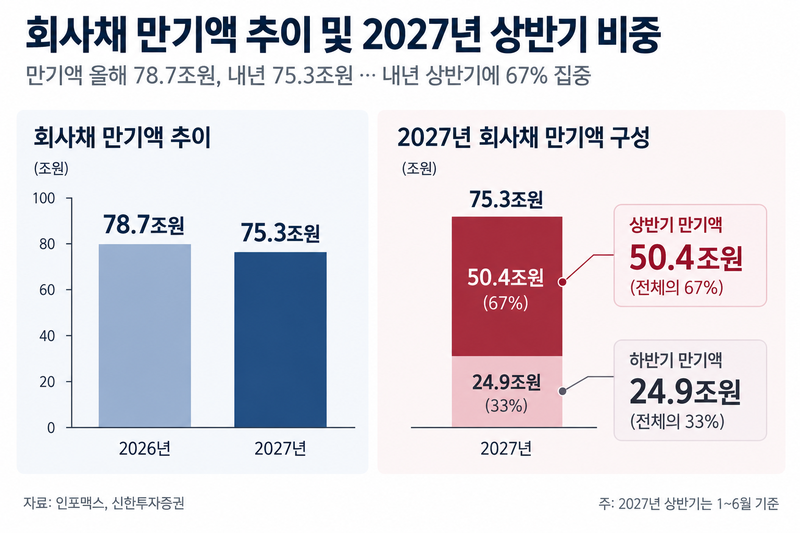
[Financial News] South Korea's bond market is expected to face a "supply-and-demand battle" next year. Corporate bond maturities will exceed 75 trillion won, while companies that relied on bank loans and short-term borrowing this year may return to the corporate bond market to meet their funding needs. With public enterprises also expected to increase bond issuance, the key issue in next year's credit market will be whether it can absorb the large volume of bonds hitting the market at once, alongside concerns over credit risk.■ Corporate bond maturities to reach 75 trillion won next year, with 67% concentrated in the first halfAccording to the financial investment industry and Shinhan Investment & Securities on the 17th, corporate bond maturities next year will total 75.3 trillion won, approaching this year's 78.7 trillion won. Of that amount, 50.4 trillion won will mature in the first half. In other words, approximately 67% of next year's total maturities will come due during the first half.
The sharp increase in short-term borrowings this year could also drive up corporate bond supply next year. An analysis by Shinhan Investment & Securities of 286 nonfinancial companies with credit ratings found that their borrowings and bonds increased by 75.2 trillion won this year. Short-term borrowings, in particular, led the increase in debt, rising by a net 37.2 trillion won in the first quarter and 31.8 trillion won in the second quarter.
Kim Sang-in, a researcher at Shinhan Investment & Securities, analyzed that companies shifted from long-term corporate bonds to shorter-maturity funding, such as bank loans, as sharply higher interest rates reduced the appeal of corporate bond financing. As corporate bond issuance declined, funding demand moved toward short-term bank borrowing, shortening the duration of companies' debt, he explained.
The concern is that the refinancing schedule for funds borrowed on a short-term basis this year could coincide with the maturities of existing corporate bonds next year. Companies could roll over the funds through further short-term borrowing or switch to long-term bank loans. However, if market interest rates stabilize, they may return to long-term funding through corporate bonds.
Kim Sang-man, a researcher at Hana Securities, said, "Although companies' market-based funding declined this year, their underlying demand for external funding did not decrease." He forecast that, as the general loans raised this year mature sequentially next year, companies could use corporate bond issuance to refinance not only existing corporate bond maturities but also the maturing general loans if market interest rates stabilize.
Bond market experts analyzed that "with overall refinancing demand increasing, companies are likely to become more active in issuing corporate bonds next year as interest-rate volatility eases."■ Public-enterprise bonds join the competition... 'Who gets the money?'The supply-and-demand pressure will not be limited to corporate bonds. Major public enterprises are also expected to increase their issuance of public-sector bonds next year. This could create a situation in which corporate bonds and public-enterprise bonds compete simultaneously for institutional funds.
Investment banking industry officials identified supply and demand as the most important point to monitor in the credit market from next year onward. They noted that supply pressure could intensify if corporate bond issuance increases while public-sector bond issuance accelerates, particularly among major public enterprises that regularly issue bonds.
As a result, the key question for next year's bond market is expected to be how much of the bonds flooding the market at the same time it can absorb, rather than the repayment capacity of individual companies. If this year's deferred demand for long-term funding is added to the 75.3 trillion won in existing corporate bond maturities, and public-enterprise bond supply also expands, issuers could face even fiercer competition for limited institutional funds.
Kim Sang-in said, "Backed by financial buffers and improved demand at the beginning of the year, companies are likely to absorb most refinancing volumes smoothly. However, caution is warranted because volatility in supply and demand in the primary market could increase."
[email protected] Kim Hyun-jung Reporter