'Constitutional Court vs. Courts' Constitutional Complaint Case Escalates into a War of Nerves—What Was the Outcome?
- Input
- 2026-09-18 06:23:00
- Updated
- 2026-09-18 06:23:00
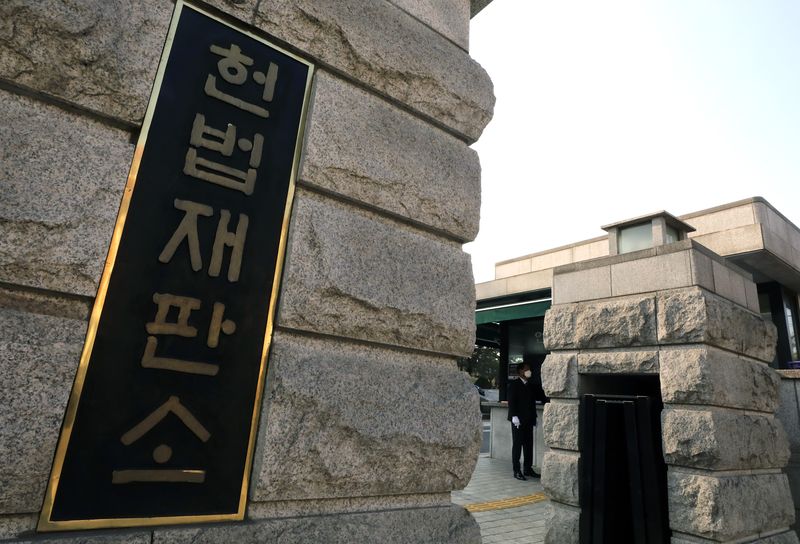
[Financial News] The Constitutional Court issued a decision upholding the constitutionality of a constitutional complaint case in which it had been criticized by a court for infringing a defendant's basic rights by failing to issue a ruling for four years.
On the 17th, the Constitutional Court ruled, by the opinion of eight of its nine justices, that Articles 13(1) and 27(1)(3) of the Inter-Korean Exchange and Cooperation Act, challenged by Jin Cheon-gyu, president of Tongil TV, "do not conflict with the Constitution."
The provisions require anyone seeking to bring goods into South Korea from North Korea to obtain the Minister of Unification's approval for the items, the form of transaction and the method of payment. Anyone who violates the provisions by importing goods without approval is subject to up to three years in prison or a fine of up to 30 million won.
The Constitutional Court stated, "Even when a person returning from a trip to North Korea acquires goods that were not planned in advance, it is difficult to supervise retroactively the arbitrary importation of goods from North Korea without approval."
It further determined, "Considering the sensitive and special relationship between the two Koreas and the complexity of international relations, it is difficult to conclude that regulating the importation of unauthorized goods through criminal penalties exceeds the legislature's discretion."
The Court also took into consideration that goods travelers need to carry, as well as ordinary souvenirs, can receive blanket approval. Even goods not covered by blanket approval can be brought into the country after approval is obtained upon the traveler's return.
The Constitutional Court found it difficult to conclude that the general freedom of action restricted by the inability to import unauthorized goods is more significant than the public interest in ensuring that inter-Korean exchange and cooperation are pursued consistently. It therefore concluded that the provisions neither violate the principle of proportionality nor infringe on the general freedom of action.
It also rejected the argument that the provisions violate the Constitution, which stipulates peaceful reunification.
The Constitutional Court determined, "The government needs to adjust and regulate material exchanges between the two Koreas according to certain standards in order to contribute to international agreements aimed at maintaining international peace and security and to respond to North Korean provocations during the armistice." It found that the system requiring the Minister of Unification to review and approve the items, form of transaction and method of payment does not violate the preamble to the Constitution or Article 4, which sets out the principle of peaceful reunification.
However, Justice Jeong Gye-seon issued a dissenting opinion, arguing that criminally punishing the importation of unauthorized goods is excessive. Justice Jeong pointed out that, unlike regular and commercial trade, it is practically difficult to prepare the documents needed to apply for approval in advance when importing goods on a one-off basis or acquiring goods that could not have been anticipated during a trip.
Justice Jeong also objected to the fact that a person may face criminal punishment solely for failing to obtain approval, regardless of whether the goods themselves are harmful, such as by posing a threat to national security or public health.
Justice Jeong determined that criminal punishment was excessive, stating, "The provisions at issue ultimately take issue with the fact that approval was not obtained." The justice added, "They infringe on the general freedom of action because they fail to satisfy the requirements of minimal infringement and the balance of legal interests."
Jin was previously indicted on charges of bringing a total of 146 items into South Korea through Incheon International Airport in October 2020, including 18 books purchased in North Korea and 14 video materials (CDs). Investigators found that Jin had not obtained the Minister of Unification's approval to bring in the goods.
Jin was summarily indicted and fined 3 million won, and the court issued a summary order imposing the same fine. Jin challenged the order and requested a formal trial. In June 2022, the trial court sentenced Jin to a fine of 3 million won and ordered the confiscation of the seized goods. It also rejected Jin's application to request a referral for constitutional review of the statute.
After filing an appeal against the trial court's ruling, Jin filed a constitutional complaint with the Constitutional Court challenging Article 13(1) and other provisions of the Inter-Korean Exchange and Cooperation Act. The appellate panel, considering the outcome of the constitutional complaint a prerequisite for resolving the criminal case, waited for the decision. The Constitutional Court, however, had been considering the case for four years.
In June, Criminal Appeals Division 50 of the Seoul Central District Court, the appellate court, sent the Constitutional Court a request for its opinion on the reasons for the delay in the constitutional adjudication, judging that Jin's constitutional basic rights were being infringed.
The court also stated in explanatory materials that the Constitutional Court's delay constituted an omission—meaning a failure to act despite having a duty to do so—and that it would begin reviewing whether the delay had infringed basic rights. However, the Constitutional Court did not submit an opinion to the court.
Some in legal circles have interpreted the situation as a war of nerves between the courts and the Constitutional Court in connection with the introduction of constitutional complaints against court rulings. Jin's appeal trial is expected to reach a conclusion soon following the Constitutional Court's decision.
[email protected] Yoo Seon-jun Reporter