"K-Beauty Next, K-Medical"—Cosmetics Rank First and Medical Services Third in Foreign Consumer Perception Survey
- Input
- 2026-09-17 15:00:00
- Updated
- 2026-09-17 15:00:00
[Financial News] Overseas consumers' favorability toward and awareness of South Korean medical services have both increased. South Korea was also named the most preferred country among consumers seeking medical services abroad.
The Korea Health Industry Development Institute announced the results of the 2025 Survey of Overseas Perceptions of Korean Medical Services on the 17th. The institute has conducted the survey annually since 2021 to support domestic medical institutions and companies in developing overseas expansion and foreign patient attraction strategies.
The online survey was conducted from November 28 to December 23 last year among 7,100 consumers aged 18 or older living in 25 cities across 16 countries, including the United States, China, Japan and Vietnam.
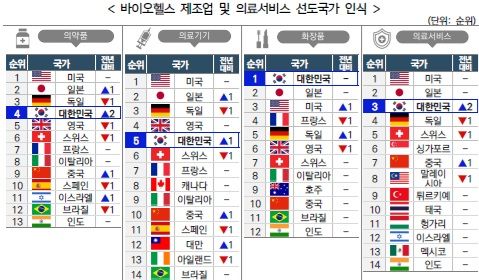
In a survey of overseas consumers' perceptions of leading countries in biohealth manufacturing and medical services, South Korea ranked first in cosmetics, third in medical services, fourth in pharmaceuticals and fifth in medical devices. Cosmetics retained the top spot from the previous year, while medical services and pharmaceuticals each climbed two places and medical devices rose one place, putting South Korea among the top five in every biohealth sector.
Overall favorability toward South Korea stood at 66.4 points, up 4.6 points from 61.8 points the previous year. South Korea's ranking rose six places, from 10th to fourth among the 19 countries evaluated. By country, favorability was highest in Indonesia at 81.6 points, followed by Mongolia at 77.3, Vietnam at 75.4, Saudi Arabia at 74.5 and Thailand at 74.2. Saudi Arabia recorded the largest increase, rising 16.1 points from the previous year. The main reasons respondents preferred South Korea were that it is 'recognized as a technology powerhouse' (38.5%) and has a 'high level of medical services and medical technology' (31.8%).
Awareness of the quality of South Korean medical services reached 70.1%, up 2.0 percentage points from the previous year. The figure was highest in Indonesia at 90.3%, followed by Vietnam at 88.3%, China at 85.3% and Saudi Arabia at 84.5%. The share of respondents who said South Korea's national brand power in medical services had 'strengthened' from the previous year was 56.4%, far exceeding the 6.8% who said it had 'weakened.'
Among 5,858 respondents who were willing to use medical services abroad, South Korea was the most preferred country at 37.3%. The United States followed at 33.4%, with Japan at 30.7%. The main reasons for choosing South Korea included 'because its medical services are considered superior to those in one's home country' (41.2%) and 'because the country and its hospitals are highly trusted' (35.4%). Preference for South Korea was particularly high in Mongolia at 78.8%, Vietnam at 58.3% and Russia at 53.3%.
The share of respondents willing to visit South Korea for medical tourism rose 1.4 percentage points from the previous year to 61.2%. Intentions to visit increased sharply in the United States by 19.0 percentage points, Saudi Arabia by 12.5 percentage points and Thailand by 12.0 percentage points. Meanwhile, 62.9% said South Korean culture influences their decision to use medical services, with particularly high shares recorded in Kazakhstan at 85.3% and Saudi Arabia at 80.3%.
Users of South Korean medical institutions operating abroad gave them a satisfaction score of 75.3 points, 5.8 points higher than their satisfaction with medical services in their home countries, which stood at 69.5 points. South Korean institutions received higher evaluations across various categories, including waiting time at 14.7 points and price and cost at 10.0 points.
Online channels were the source of medical service information for 86.3% of respondents, 31.0 percentage points higher than offline channels at 55.3%. In countries other than China, YouTube at 56.9% and Google at 46.7% were widely used. In China, however, the use of domestic platforms such as Douyin at 50.4% and Xiaohongshu at 37.8% stood out.
Dong-woo Han, director of international medical affairs at the Korea Health Industry Development Institute, said, "The survey shows that South Korean medical services ranked third in perceptions of global leaders and were chosen as the most preferred country for overseas medical services. This reflects overseas consumers' positive evaluations of the quality and reliability of South Korean healthcare." He added, "We will promote the excellence of South Korean medical services through specific evidence, including treatment outcomes and specialized medical fields, while strengthening tailored publicity that takes the characteristics of each national market into account."
[email protected] Medical Correspondent Myeong-jin Jung Reporter