K9 Thunder and K239 Chunmoo to Go Unmanned; Hanwha Aerospace to Build Six UGV Types by 2030
- Input
- 2026-09-17 14:35:22
- Updated
- 2026-09-17 14:35:22
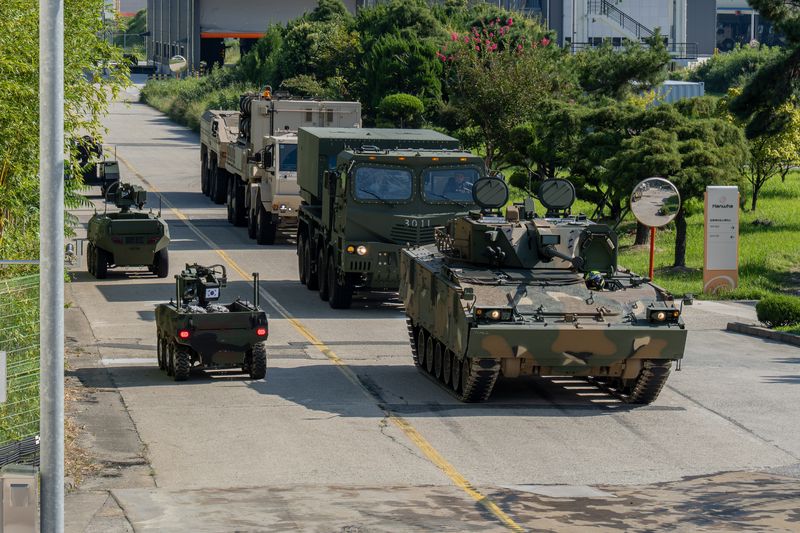
[Financial News] Hanwha Aerospace is working to secure the technology needed to convert existing manned weapons systems, including the K9 Thunder self-propelled howitzer and K239 Chunmoo multiple rocket launcher system, into AI-based manned-unmanned teaming combat systems. The company plans to establish a lineup of six unmanned ground vehicles (UGVs), ranging from small to large, by 2030 and accelerate its push into the future unmanned ground warfare market.
On the 17th, Hanwha Aerospace unveiled its plan to establish and operate a production system for Arion-SMET, the first multipurpose unmanned vehicle to be adopted by the South Korean military. It also announced a roadmap for innovation in unmanned ground defense systems.
Arion-SMET signed a mass-production contract with the Defense Acquisition Program Administration (DAPA) on the 4th of this month and is scheduled to be supplied sequentially to infantry units of the Army and Marine Corps starting next year. Production will take place at Hanwha Aerospace's Changwon facility, which manufactures major defense products such as K239 Chunmoo, Cheongung-II and Long-range Surface-to-Air Missile (L-SAM) launchers.
To ensure stable mass production, Hanwha Aerospace has established a supply chain with approximately 40 partner companies supplying structures, batteries, navigation systems, lidar, remote-control components and other parts. By localizing most major components, the company has raised the vehicle's domestic content rate to more than 98%. Hanwha Aerospace said this will accelerate follow-up military support and maintenance services.
Starting with Arion-SMET, the company plans to secure six common platforms for small, medium and large UGVs by 2030. The lineup will include multipurpose unmanned vehicles weighing less than 10 tons, medium tracked robot combat vehicles (T-RCVs) weighing less than 20 tons, and 30-ton-class heavy unmanned ground vehicles (H-UGVs).
South Korea's first defense robot, a bomb detection and disposal robot, is currently in mass production. Hanwha Aerospace is also participating in the development of additional unmanned systems, including unmanned reconnaissance vehicles, AI-based Korean-type combat engineering vehicles (K-CEVs) equipped with drones and robots, and manned-unmanned teaming chemical, biological, radiological and nuclear reconnaissance vehicles.
Hanwha Aerospace is also pursuing overseas exports of Arion-SMET. According to the company, Romania, Finland and Canada have expressed interest, while the related market is expected to grow to a multitrillion-won scale around the 2030s.
The company is also stepping up efforts to convert existing manned weapons systems to unmanned operation. Hanwha Aerospace aims to secure by 2029 the technology to apply optionally manned fighting vehicle (OMFV) systems, which can be operated in either manned or unmanned modes as needed, to the K9 Thunder, K239 Chunmoo and next-generation infantry fighting armored vehicles. It also plans to gradually apply manned-unmanned teaming technology to firepower and mobility platforms, including 120-millimeter self-propelled mortars, Korean Amphibious Assault Vehicles (KAAVs) and Korean-type combat engineering vehicles (K-CEVs).
Hanwha is linking this unmanned-systems strategy to Hanwha Group's defense AI investments. Hanwha Group recently announced plans to invest 2 trillion won by 2040 in Defense OS, a defense AI model that learns from and makes inferences based on battlefield data.
Kim Dong-hyun, head of Hanwha Aerospace's LS Business Division, said, "By establishing the best production system, we will support the stable supply of unmanned vehicles needed by the South Korean military and allied countries. We will also actively work to secure the technology needed to become a leading defense unmanned-systems company that proactively prepares for future battlefields."
Arion-SMET has undergone continuous performance improvements since its first-generation model was developed in 2016 as a civil-military cooperation project. At the end of 2023, the second-generation model underwent the U.S. Foreign Comparative Testing (FCT) program. The version being introduced by the military is the third-generation model, which incorporates feedback from those tests. It features a payload capacity of approximately 450 kilograms, continuous operating capability, extended range, AI-based remote fire control and autonomous off-road driving.
[email protected] Jung Won-il Reporter