Seoul Metropolitan Government Also Loses on Appeal Over 'Namsan Gondola'... Court Upholds Revocation of Use-Zone Change
- Input
- 2026-09-17 14:47:25
- Updated
- 2026-09-17 14:47:25
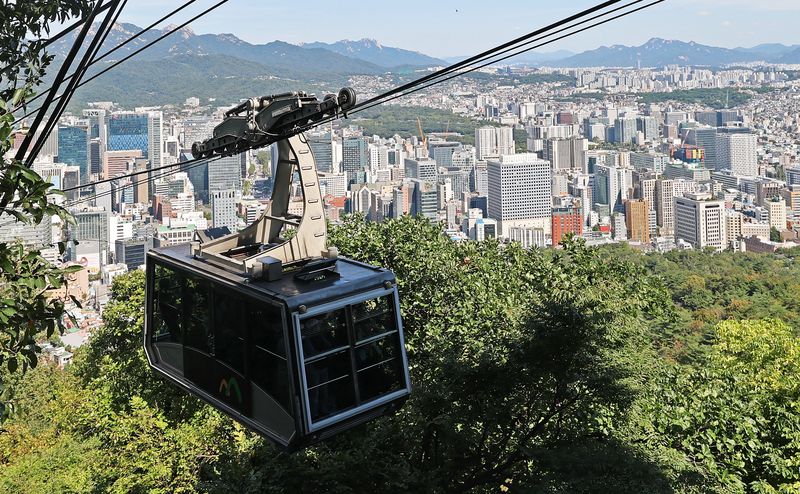
[Financial News] The appellate court also ruled to revoke the disposition changing the use zone for the site of the Seoul Metropolitan Government's planned 'Namsan Gondola' project. Korea Ropeway Industry, the operator of the currently running 'Namsan Cable Car,' won the case, leaving the gondola project unable to resume after being halted.
The Seoul High Court's Administrative Division 7, presided over by Judge Kwon Soon-hyung, ruled in favor of the plaintiffs on the 17th, as the lower court did, in a lawsuit filed by Korea Ropeway Industry and others against the Seoul Metropolitan Government seeking revocation of a disposition concerning an urban management plan decision.
The appellate court did not explain the specific reasons for its ruling in court. It also ordered the Seoul Metropolitan Government, the defendant, to bear the costs of the appeal.
The aerial route up Namsan has been operated exclusively by Korea Ropeway Industry for 64 years. The Seoul Metropolitan Government drew up plans for the 'Namsan Gondola,' a transportation system that would run approximately 832 meters from near Myeong-dong Station to the summit of Namsan, and held a groundbreaking ceremony in September 2024.
The Seoul Metropolitan Government maintains that it will minimize damage to nature and the impact on the landscape by changing the support-pole height to 35 to 35.5 meters and designing the poles in a cylindrical form. However, the government's change to the site's use zone became an issue in the process.
Korea Ropeway Industry filed the lawsuit, claiming that the Seoul Metropolitan Government failed to comply with the criteria for lifting the designation when it changed the site's use zone from an urban natural park zone to an urban planning facility park in order to install intermediate supports at least 30 meters high, or reinforced-concrete pillars, needed to operate the gondola on Namsan.
On December 19 last year, the lower court ruled partially in favor of the plaintiffs, finding the Seoul Metropolitan Government's change to the use zone unlawful. The court also accepted a motion for suspension of execution filed again by Korea Ropeway Industry, bringing construction to a halt.
An urban natural park zone may be lifted only for areas where damage to green spaces has significantly reduced their function of preserving the natural environment or caused them to lose their function as leisure and rest areas. The Seoul Metropolitan Government argued that changing the designation to a facility park was not subject to the relevant provision, but the argument was rejected.
The court pointed out that urban natural park zones and facility parks are clearly distinct, including because they are governed by different legal provisions. It therefore found that a disposition changing an urban natural park zone into a facility park is also subject to the 'criteria for changing or lifting an urban natural park zone.'
The court noted, "It is difficult to readily accept the argument that an urban natural park zone may be changed into a facility park at any time in order to achieve an administrative objective."
Construction of the Namsan Gondola has remained halted at 15% completion for two years since the court accepted a motion for suspension of execution filed by Korea Ropeway Industry and others in October 2024. Separately from the lawsuit, the Seoul Metropolitan Government is pursuing an amendment to the Enforcement Decree of the Act on Urban Parks, Green Areas, Etc., to allow gondola-related facilities exceeding 12 meters in height to be installed even within urban natural park zones. This could make it possible to install the gondola without following the park-zone change procedure that directly led to the lawsuit.
[email protected] Lee Chang-hoon Reporter