First public-service route operations just over 100 days away... KOMSA reviews 229 tasks
- Input
- 2026-09-17 14:30:47
- Updated
- 2026-09-17 14:30:47
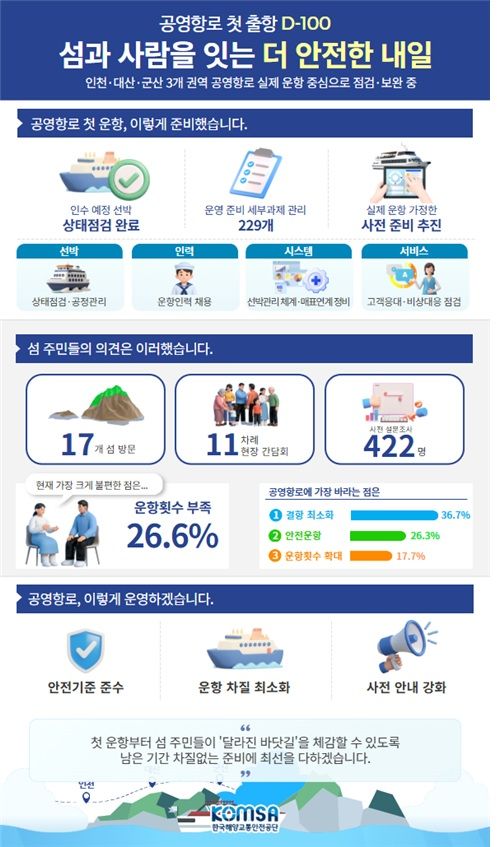
[Financial News] With the launch of public operations on public-service routes in January next year just over 100 days away, Korea Maritime Transportation Safety Authority (KOMSA) is reviewing 229 detailed tasks according to schedule. The tasks cover vessels and crews, operating systems and customer service. Island residents identified increasing sailing frequency and minimizing cancellations as the most urgent priorities.
Korea Maritime Transportation Safety Authority (KOMSA) said on the 17th that it is accelerating preparations for actual operations in three regions: Incheon, Daesan and Gunsan. A public-service route is a system under which the state supports operations to provide island residents with stable maritime transport services, even when the routes are not profitable. Since establishing a dedicated organization in June, KOMSA has divided its preparations into 229 tasks covering vessels and crews, systems and budgets, operations and safety, operational infrastructure, and customer service.
The focus of the preparations is currently a 'pre-operation simulation' based on actual sailing conditions. By November, KOMSA plans to inspect the entire passenger-ferry experience, including vessels and port facilities, ticketing and sailing information, boarding and disembarkation routes, and customer assistance. Any problems identified will be addressed before the first sailing.
Inspections of vessels scheduled for handover were completed in the three regions from the 31st of last month through the 7th of this month. Ship inspectors and operations managers examined the hulls and engines, safety equipment, and passenger and crew amenities. They also gathered the views of the captains and crew members currently operating the vessels. Based on the inspection results, KOMSA plans to establish maintenance and management plans for each vessel. It will also incorporate the route knowledge and operating experience accumulated by existing ferry operators and their personnel into the public operation system.
Newly built government-funded passenger ferries are being managed from the construction stage. Through a 'drawing approval and construction process management service' that uses expertise in drawing approval and ship inspections, KOMSA checks in advance for delays in the submission and approval of drawings by shipyards and design offices, as well as problems during design and construction. Seom Sarang No. 7, which received the service this year, was launched on the 11th.
KOMSA is also preparing tasks directly related to operations, including crew employment transitions and working conditions, route-specific operating plans, electronic ticketing, port-of-call operations, customer assistance and emergency response. It is establishing the operational foundations by preparing conditions of carriage, operating management regulations, and accounting and settlement systems. It is also linking the electronic ticketing system with its internal business systems and improving ticketing conditions at ports of call.
The views of island residents, the users of the service, were adopted as a key basis for the preparations. From the 24th of last month through the 2nd of this month, KOMSA held 11 on-site meetings on 17 islands in the Incheon, Daesan and Gunsan areas, gathering opinions from more than 400 residents, local government officials and others. Residents in several areas called for more frequent sailings and schedules adjusted to their daily routines. They also offered suggestions on improving passenger facilities, giving island residents priority when loading vehicles, cargo fares and onboard amenities.
In an earlier survey of 422 island residents, an insufficient number of sailings was cited as the biggest inconvenience when using existing state-subsidized routes, at 26.6%. When asked what mattered most in the operation of public-service routes, minimizing cancellations ranked first at 36.7%, followed by safe operations at 26.3% and increased sailing frequency at 17.7%. Satisfaction with existing state-subsidized routes remained average. KOMSA plans to implement first the improvements it can make directly, while fare support, connections with land transportation and improvements to port-of-call facilities will be pursued as medium- and long-term tasks requiring consultations with relevant agencies.
KOMSA is applying strict safety principles. Services will not operate when weather or sea conditions fail to meet safety standards. However, it plans to minimize disruptions caused by manageable factors such as vessel breakdowns and maintenance through stronger preventive maintenance and alternative-operation systems. When cancellations are unavoidable, KOMSA will notify passengers of the possibility as early as possible rather than merely announcing the cancellation. It will also explain the reason operations are difficult and provide an outlook for future service.
KOMSA President Ahn Young-chul said, "Public-service routes are not a business intended to generate profits but a public service designed to improve island residents' transportation welfare and provide stable support for their daily lives." He added, "We will do our utmost to ensure thorough preparations during the remaining period so that island residents can feel the difference in their sea routes from the very first sailing."
[email protected] Lee Yu-beom Reporter