NAVER Cloud Invests KRW 40 Billion Annually in Security, Bringing 'Security AI' to the World
- Input
- 2026-09-17 14:47:33
- Updated
- 2026-09-17 14:47:33
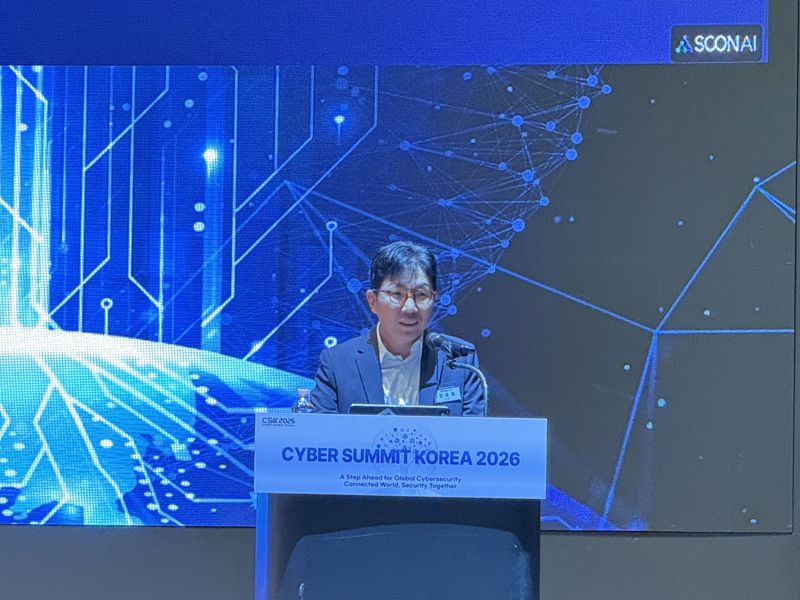
[Financial News] NAVER Cloud plans to link the Korean-developed cybersecurity artificial intelligence (AI) it is developing through a government project with AI Factories around the world, expanding them into global hubs for cybersecurity cooperation. The company envisions jointly operating security-focused AI models at AI Factories worldwide and using them as hubs for countries to respond collectively to cyber threats. To support this effort, it will also increase its security investments, which already exceed KRW 40 billion annually.
Yuwon Kim, CEO of NAVER Cloud, said in a keynote speech at Cyber Summit Korea 2026 at the COEX Convention & Exhibition Center in Seoul on the 17th, "We aim to expand security-specialized foundation models beyond South Korea into global markets." He added, "We will make AI security models operate together at AI Factories around the world and connect each site as a hub for cybersecurity cooperation."
In July, NAVER announced plans to jointly build global AI Factories with NVIDIA and expand the business beyond Asia into Europe and the Middle East. The company now plans to connect the security-focused AI being developed through the government project and develop it into a global cybersecurity business.
This month, NAVER Cloud was finally selected as a developer for the government's "Cybersecurity-Specialized AI Foundation Model Development" project. The consortium will use HyperCLOVA X and EXAONE from LG AI Research to develop two 700B-class security AI models, one designed to strengthen defensive capabilities and the other offensive capabilities.
The models will be tested in seven key sectors: power, finance, science and technology, telecommunications, semiconductors, defense, and aerospace. Given the importance of national critical infrastructure, they will be developed to operate on closed networks and are planned for release as open-source software for future commercial use.
Kim stressed the need for security AI that understands the environments and contexts of different industries. "We need security models that deeply understand industrial sites," he said. "Only then can they go beyond simply detecting an attack and determine what that attack actually means in a real-world industrial setting."
The company will also expand its own security investments. "We currently have more than 100 security specialists, and we invest over KRW 40 billion annually in security," Kim said. "We plan to continue increasing that investment."
The protection provided by security-focused AI will extend beyond large corporations to small and medium-sized enterprises that make up the supply chains of critical industries. The company explained that national cybersecurity capabilities should be used to prevent gaps from emerging across an entire supply chain because individual companies have different capacities for security investment. "Critical industries such as semiconductors, defense, and aerospace are connected to numerous small and medium-sized enterprises," Kim said. "It is not realistically easy for all of those companies to make sufficient security investments, so national cybersecurity capabilities must be used to protect not only large corporations but also small and medium-sized enterprises."
Kim also emphasized the need to strengthen cooperation among countries to ensure cybersecurity in the AI era. "Just as attacks have no borders, defense must have no borders either," he said. "Building a structure in which multiple countries protect one another, rather than each country simply protecting itself, is solidarity that transcends borders."
Lee Jong-suk, chief of the National Intelligence Service (NIS), also stressed the need for international cooperation against cyber threats in his opening remarks that day. "Cybersecurity has now become a shared and open challenge directly linked to people's daily lives, corporate survival, national security, and trust in the international community," he said. "We will build a closely connected network of cooperation with international organizations, global companies, and domestic industries."
[email protected] Hyerim Choi Reporter