"If Throwing a Tantrum and Crying Leads to Paralysis in the Arms and Legs"... Don't Miss These Signs of Pediatric Stroke: Moyamoya Disease [Doctor Talk]
- Input
- 2026-09-18 15:54:05
- Updated
- 2026-09-18 15:54:05

[Financial News] Experts have advised parents to exercise particular caution if a child develops paralysis in one arm or leg or becomes unable to speak after crying and throwing a tantrum or blowing hard on hot food, as these could be signs of pediatric stroke.
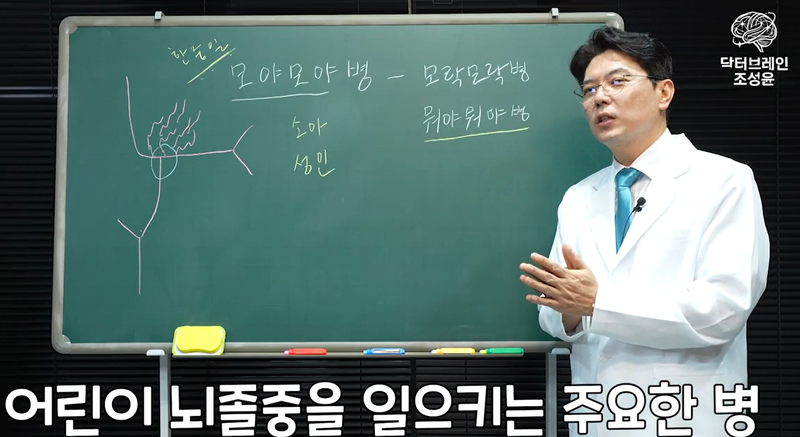
Neurosurgeon Dr. Jo Seong-yun recently introduced the symptoms and proper treatment of moyamoya disease, one of the major underlying causes of stroke in children and adults, through his YouTube channel, "Doctor Brain."
When Blood Vessels in the Brain Are Blocked, Abnormal Vessels Rise Like Smoke... Unusually Common in South Korea, China and Japan
'Moyamoya' is a Japanese word describing wisps of smoke rising. The disease occurs when the terminal portion of the internal carotid artery, the main vessel supplying blood to the brain, narrows or becomes blocked for unknown reasons. To compensate for the reduced blood flow, the brain develops tiny, abnormal blood vessels that resemble wisps of rising smoke.
The condition occurs far more often in East Asians, including people in South Korea, China and Japan, than in Westerners. It has two incidence peaks: childhood and adulthood. Dr. Jo explained, "Children cannot clearly express their physical condition, so caregivers need to closely watch for situations that may trigger an episode. It is also one of the conditions most frequently encountered in pediatric neurosurgery."
"When Children Cry, Throw Tantrums or Blow on Hot Ramen," Hyperventilation Can Trigger Cerebral Infarction
Hyperventilation is a typical trigger for episodes in children with moyamoya disease. It can occur when a child cries, throws a tantrum and screams intensely; blows on hot ramen or soup before eating it; or plays a wind instrument such as a recorder or danso.
As the carbon dioxide level in the blood falls, the cerebral blood vessels constrict. The brain of a child with moyamoya disease, which already has insufficient blood flow, can then enter a state of cerebral ischemia. This may cause sudden weakness or paralysis in one arm or leg, an inability to speak, headaches or dizziness—symptoms of a transient ischemic attack (TIA).
By contrast, adults with moyamoya disease are often brought to the hospital with intracranial hemorrhage after abnormally weak tiny blood vessels rupture because they cannot withstand the pressure.
Doctor Talk: "So It Can Be Widely Known and Treated Early"... We Asked Dr. Jo Seong-yun Directly
What should people watch out for in daily life in connection with moyamoya disease? The reporter asked Dr. Jo Seong-yun directly on the 17th.Q. If a parent or relative has moyamoya disease, is a child more likely to inherit it, and is genetic testing necessary?A. Genetic factors do play a role in moyamoya disease, but it is not a single-gene disorder in which inheriting a variant inevitably leads to the disease. Even among people with a variant in the RNF213 (Ring Finger Protein 213) gene, the actual incidence is only about one in every 150 to 300 people. A family history does increase the risk compared with that of the general population, but the theoretical 50% chance that a parent's gene variant will be passed on to a child is entirely different from the actual disease incidence. Rather than undergoing genetic testing indiscriminately, it is advisable to first seek specialist care and undergo brain MRI and MRA scans if neurological symptoms such as paralysis in one arm or leg, slurred speech or recurring headaches appear.Q. If a child temporarily develops paralysis after crying and then recovers, it may be mistaken for growing pains or a tantrum. How can the two be distinguished?A. Unlike growing pains, which are mainly characterized by pain, moyamoya disease causes repeated focal neurological symptoms after crying or running triggers hyperventilation. These may include a sudden loss of strength or reduced sensation in one arm or leg, slurred speech or visual disturbances. Even if the child returns to normal after a few minutes, leaving the condition untreated can lead to an actual cerebral infarction and permanent aftereffects such as motor impairment, language difficulties and cognitive decline. Therefore, even temporary paralysis should prompt immediate detailed testing, with pediatric cerebral ischemia considered as a possibility.Q. Can adult moyamoya disease be detected in advance through health-screening MRI and MRA before a patient is brought to the hospital with intracranial hemorrhage?A. If brain MRI and MRA are performed together during a health screening, there is a chance of detecting the disease incidentally, even in its early stages, by identifying narrowing of the cerebral blood vessels and abnormal tiny blood vessels. Adults may also experience warning signs such as numbness in one arm or leg, temporary speech difficulties or headaches before an intracranial hemorrhage, but not every patient has prodromal symptoms. Because weakened tiny blood vessels can suddenly rupture and make intracranial hemorrhage the first symptom, people with a family history or recurring episodes of temporary paralysis are advised to undergo brain MRI and MRA in advance, even if they have no symptoms.
Dr. Jo added, "It breaks my heart to see parents arrive at the hospital in tears only after mistaking their child's transient ischemic attack symptoms for a mere tantrum, missing the window for diagnosis and coming in after a cerebral infarction has developed and paralysis has occurred. I hope moyamoya disease becomes widely known so that it can be treated at an early stage."
"I Saw This on YouTube—Is It Really True?"Amid the flood of health information, we have gathered useful medical knowledge personally verified and shared by real 'doctors.' A health solution for making informed choices, consuming products properly and managing your health correctly,[Doctor Talk]presents it to you.
[email protected] Kim Hee-sun Reporter