Korea Customs Service Intensifies Crackdown on Imports of Counterfeit Obesity Drugs... 5,000 Cases Detected by August
- Input
- 2026-09-17 14:13:45
- Updated
- 2026-09-17 14:13:45
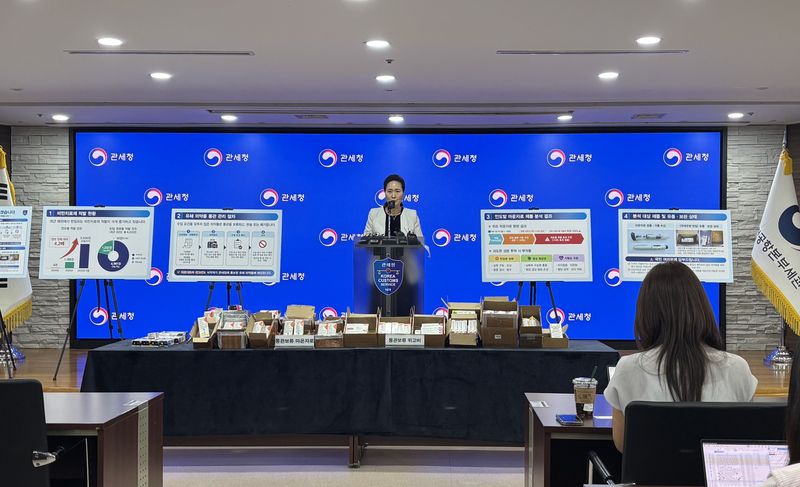
The Korea Customs Service announced on the 19th that it has significantly strengthened customs inspections on major entry routes, such as travelers' personal belongings, international mail, and express cargo, as attempts to illegally import harmful medicines, including obesity treatments, are increasing.
According to the Korea Customs Service, the number of seizures of obesity treatment drugs increased from 4 in 2024 to 1,189 in 2025, and as of August this year, 5,030 cases were detected, surging to 4.2 times the total number of cases detected last year. Of the total 6,223 cases detected over the past three years, international mail (4,961 cases) accounted for the vast majority, followed by travelers' personal belongings (1,232 cases) and express cargo (30 cases).
A joint precision analysis of Mounjaro products from India intercepted at customs by the Central Customs Laboratory and Scientific Service and researchers from the College of Pharmacy at Chung-Ang University confirmed serious quality defects. There was a very large variation in the content of the active ingredient (tirzepatide) among the products, and numerous unidentified impurities were also detected. Evidence was also found that the products were imported without a cold chain, which, in principle, should be maintained at 2 to 8 degrees Celsius. Based on an assessment by the trademark rights holder, the products were ultimately determined to be counterfeit.
Professor Na Dong-hee of the College of Pharmacy at Chung-Ang University warned, "Strict quality control, including ensuring sterility as well as managing active ingredients, is essential for injectables," adding, "It is very dangerous to arbitrarily administer medicines purchased directly from overseas whose source and quality have not been verified."
Lee Jin-hee, Director General of the Customs Clearance Bureau at the Korea Customs Service, stated, "We will thoroughly block the entry of illegal pharmaceuticals that threaten public health across the border by linking on-site inspections with scientific component analysis."
Meanwhile, the medical community is warning that the administration of counterfeit injectables distributed through online communities or overseas direct purchase agencies can lead to serious side effects. If unverified ingredients or contaminated impurities are directly injected into the body, it can result not only in severe allergic reactions (anaphylaxis) but also in sepsis or local tissue necrosis at the injection site.
[email protected] Kim Won-jun Reporter