President Lee’s Press Conference One Day Away; He Is Expected to Address Key Issues Directly, Including a Possible Deployment to the Strait of Hormuz
- Input
- 2026-09-17 14:26:14
- Updated
- 2026-09-17 14:26:14
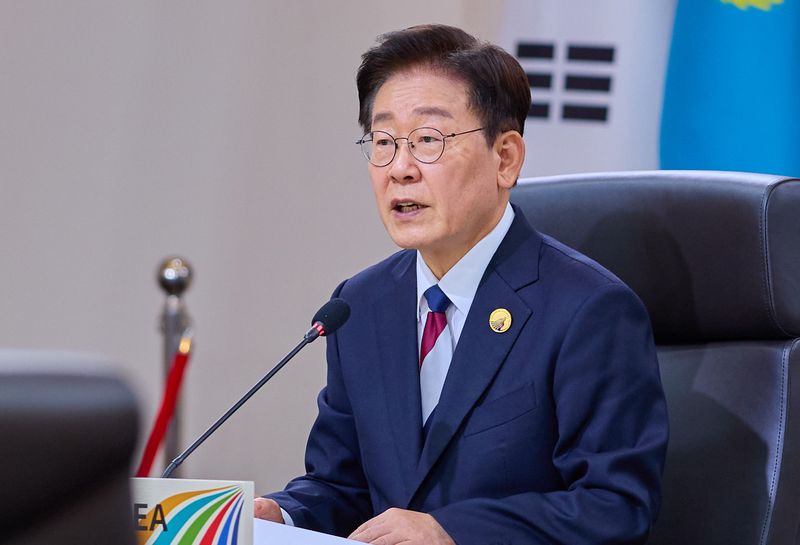
[Financial News] President Lee Jae Myung will directly present his position on key issues at a press conference on the 18th. Although President Lee has communicated directly with the media several times since taking office, this press conference is drawing particular attention because it comes as his approval rating has fallen into the 30 percent range and controversies over personnel appointments have coincided with diplomatic and security issues.
According to Cheong Wa Dae on the 17th, President Lee is scheduled to receive Fatih Birol, executive director of the International Energy Agency, as part of his official schedule that day. He is also expected to spend the rest of the day preparing answers for the press conference while holding internal meetings. President Lee will hold a 90-minute press conference for the public at the Cheong Wa Dae State Guest House starting at 10 a.m. on the 18th.
The press conference is expected to go beyond stating positions on individual issues and serve as an opportunity for President Lee to explain the direction of his administration directly. This is also why Cheong Wa Dae has announced a broad question-and-answer session rather than limiting questions to specific areas. Key points to watch include whether the president will personally state his judgment on controversial issues and how he will present his administration’s policy direction and response going forward.
Among external issues, the Strait of Hormuz is the most sensitive. Possible demands from the United States for South Korea to share the burden, Iran’s opposition, and domestic public sentiment against deploying troops are all intertwined. The government has maintained that no specific conclusion has been reached, but questions are expected at the press conference about the criteria for deciding whether to deploy troops and the priority given to the national interest.
Questions are also expected about the progress of negotiations on investment in the United States. A report to the National Assembly on the government’s first project under the planned $350 billion investment in the United States, originally scheduled for that day, has been postponed.
Meanwhile, Foreign Minister Cho Hyun met reporters at Incheon International Airport on the morning of the 17th as he departed for Washington, D.C., to attend a South Korea–United States foreign ministers’ meeting. Regarding the deployment of troops to the Strait of Hormuz requested by the United States, he reaffirmed the government’s previous position, saying, “Nothing has been decided yet, and we are reviewing the matter while taking various factors into account.” He also said the delay in announcing the investment in the United States was “not because there are differences between South Korea and the United States, but because I understand that we need to clarify domestic procedural issues.”
In people’s livelihoods and the economy, rising housing prices centered in Seoul and confusion over real estate policy have been cited as burdens on the administration. Although the government has moved to expand supply and revise the tax system, market anxiety has not been completely eased. Questions may therefore arise about additional measures and the administration’s policy direction. The issue of single-stock leveraged exchange-traded funds, which have recently increased stock-market volatility, is also unlikely to be left out.
In political circles, the withdrawal of an indictment is one of the hottest issues. The opposition has continued its offensive since Kim Seung-won, a Democratic Party of Korea lawmaker who led calls for the withdrawal of the indictment in the president’s case, was nominated as a candidate for justice minister. Regarding a constitutional amendment allowing consecutive presidential terms, President Lee recently made remarks during an overseas trip to the effect that his term is limited under the current Constitution, but debate continues in political circles.
Personnel issues are also a burden. The resignation of Yong Hye-in, a candidate for minister of the Ministry of Gender Equality and Family, and the re-screening of Kim Ji-yong, a candidate to head the Serious Crime Investigation Agency, have led to controversy over Cheong Wa Dae’s personnel system.
Tensions between Cheong Wa Dae and the judiciary over the renomination of a Supreme Court justice candidate may also be raised in questions. With falling approval ratings coinciding with economic and diplomatic issues, attention is focused on what message and direction for governing President Lee will present.
[email protected] Choi Jong-geun Reporter