“Absolutely Opposed to Deployment”... Ruling Party and Government Divided Over the Strait of Hormuz
- Input
- 2026-09-17 14:17:15
- Updated
- 2026-09-17 14:17:15
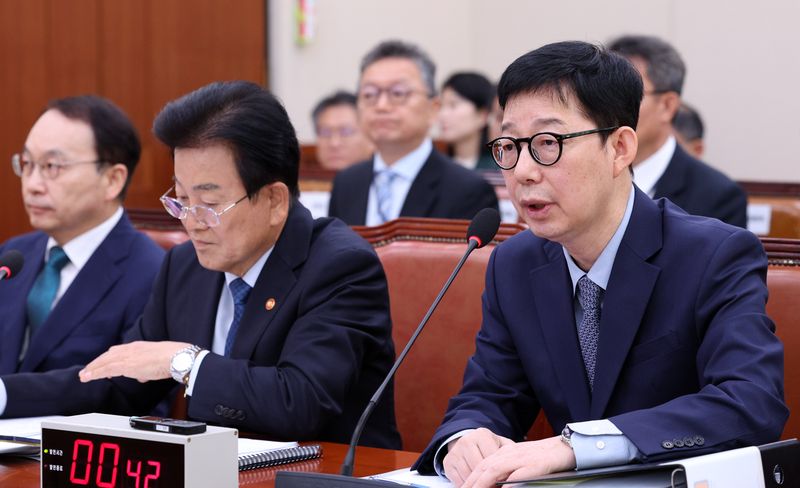
[Financial News] As the government considers deploying troops to the Strait of Hormuz, a request the United States has made, lawmakers from the ruling Democratic Party of Korea have publicly voiced strong opposition, saying they are “absolutely opposed to deployment.” While the government has left the possibility open by using the term “contribution” instead of deployment, Democratic Party lawmakers drew a line against direct military involvement.
At a full meeting of the National Assembly’s Foreign Affairs and Unification Committee on the 17th, Democratic Party lawmaker Woo Won-shik emphasized, “This time, it is instead a war invaded by the United States,” adding, “We could be driven into a situation in which the lives and safety of young people may be harmed. We must respond based on principles.”
Fellow Democratic Party lawmaker Lee Ki-heon also said, “I am absolutely opposed to directly participating in the war,” adding, “There are about 2,000 Korean nationals living abroad in Qatar, near the Strait of Hormuz. Considering the national interest and the safety of Korean nationals abroad, I cannot possibly agree to the deployment itself.” Instead, he proposed having South Korean companies participate in restoring oil, oil pipeline, and shipbuilding facilities after the war, arguing, “We should contribute by participating in postwar reconstruction. We must not neglect relations with Iran and make a decision to deploy troops directly.”
Democratic Party lawmaker Cha Ji-ho also raised the possibility that Iran could regard even the dispatch of noncombat personnel as military intervention. Cha asked, “What happens if Iran considers the noncombat personnel to be military intervention and attacks the groups we have deployed?”
The Rebuilding Korea Party (RKP) raised suspicions that the government had already decided to pursue troop deployment. Lawmaker Kim Jun-hyung said, “It feels as though they have already decided to deploy troops and are leaking information to gauge public opinion.” Criticizing Foreign Minister Cho Hyun’s visit to the United States, he also said, “We are making the investments in the United States and sending the troops, so why are we being summoned to the principal’s office—the United States?”
Democratic Party lawmaker Park Sung-joon, however, took a cautious stance, saying, “Diplomacy involves relations with other countries, so this is not something that can be decided in a one-dimensional way.” He added, “It must be judged in terms of national security, the national interest, and protecting the lives of the people.”
The government maintained that no decision had yet been made on whether to deploy troops. Park Yunju, First Vice Minister of Foreign Affairs, explained, “Basically, we are viewing this issue not so much from the perspective of South Korea–United States relations as from the standpoint of the stability of navigation, the safety of energy supply routes, and the safety of Korean nationals and citizens in the region.” In particular, Park stated, “What we are basically discussing with the international community is ‘contribution,’” adding, “We have been reviewing what contribution we can make to restoring stability.”
People Power Party lawmaker Kim Dae-sik pointed out, “Today, the general view among Democratic Party lawmakers, the ruling party of the Lee Jae-myung administration, is ‘opposition.’” He added, “If the ruling party and the government have such completely different views, how can the people trust them?”
Foreign Minister Cho Hyun will visit the United States and hold talks with United States Secretary of State Marco Rubio on the 18th.
[email protected] Kim Kyung-min Reporter