Three Ministries Jointly Recognize Outstanding Rural ESG Companies... Ministry of Trade, Industry and Energy Joins This Year
- Input
- 2026-09-17 14:05:30
- Updated
- 2026-09-17 14:05:30
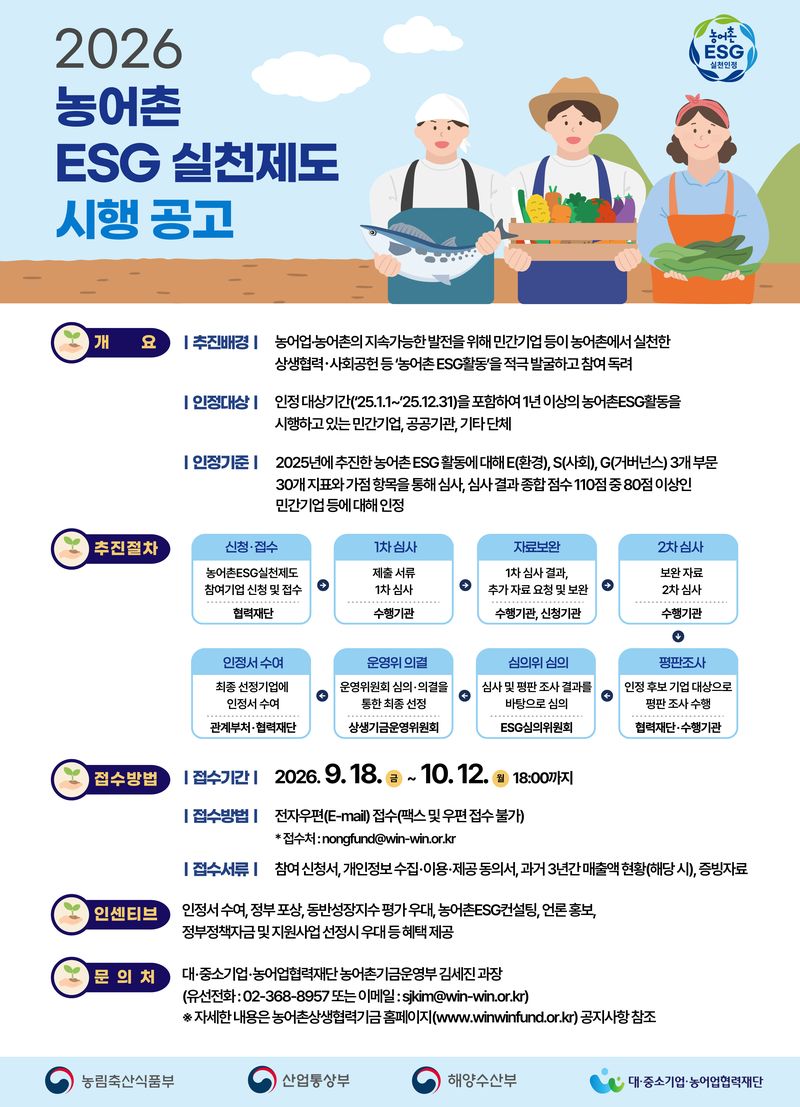
[Financial News] The Ministry of Oceans and Fisheries (MOF), the Ministry of Agriculture, Food and Rural Affairs (MAFRA), and the Ministry of Trade and Industry will jointly identify and recognize outstanding companies and institutions that have contributed to rural communities and agriculture through ESG (environmental, social, and governance) activities, such as rural coexistence and cooperation and social contribution. This is the first time the Ministry of Trade and Industry has participated since the system was introduced in 2022.
The MOF, MAFRA, the Ministry of Trade and Industry, and the Korea Foundation for Cooperation between Large, Medium, and Small Enterprises and Agriculture and Fisheries announced on the 17th that they will recruit and select companies and institutions for recognition in 2026 under the 'Rural ESG Practice System.'
The Rural ESG Practice System is a system that recognizes outstanding companies and institutions by comprehensively assessing their rural coexistence and cooperation, social contribution, and ESG activities. Starting with 23 companies (4 private and 19 public) in 2022, the number has increased every year, reaching 41 in 2023, 52 in 2024, and 68 last year (17 private and 51 public).
This year, the assessment system was revised to more thoroughly evaluate the extent to which companies' and institutions' ESG activities have actually contributed to rural communities and agriculture. The assessment indicators for the three areas of environment (E), society (S), and governance (G) were consolidated from 33 to 30, while the 'activity-status indicators,' which merely assess whether activities were carried out, were reduced from 15 to 5. The aim is to better reflect actual activity levels and performance in the evaluation.
The score totals 100 points: 25 points for environment (6 indicators), 50 points for society (16 indicators), and 25 points for governance (8 indicators). An additional 10 points are awarded for contributions to the Rural Coexistence and Cooperation Fund, bringing the maximum total to 110 points. Companies and institutions scoring 80 points or more receive final recognition.
Recognized companies and institutions receive a plaque of recognition, awards including ministerial commendations from the three ministries, preferential treatment in the Shared Growth Index evaluation, preferential policy-fund support limits and interest rates, comprehensive ESG consulting linked to rural communities, identification of best practices, and media promotion. Follow-up support, including assessment consulting and awards for best practices, will also continue.
Companies and institutions wishing to participate can submit applications to the Korea Foundation for Cooperation between Large, Medium, and Small Enterprises and Agriculture and Fisheries from the 18th through the 12th of next month. Further details are available in the notices section of the Rural Coexistence and Cooperation Fund website.
Yang Young-jin, Fisheries Policy Director at the MOF, said, "Rural and fishing communities are where our people live and an important foundation of the regional economy," adding, "I hope the Rural ESG Practice System will serve as a bridge connecting corporate ESG activities with the sustainable development of rural and fishing communities."
Park Geun-oh, Director for Trade Agreement Policy at the Ministry of Trade and Industry, said, "With the Ministry of Trade and Industry newly participating from this year, we will work to further expand corporate ESG management and coexistence and cooperation with rural communities."
[email protected] Lee Yu-beom Reporter