Third-quarter earnings season looks ominous: a 'new triple whammy' of costs, oil prices and exchange rates hits manufacturers
- Input
- 2026-09-17 15:27:24
- Updated
- 2026-09-17 15:27:24

[Financial News] Dark clouds have gathered over the third-quarter earnings of major Korean exporting manufacturers. As chipflation and high oil prices increase cost burdens, the decline in the won-dollar exchange rate is also reducing the won value of export proceeds. Operating-profit forecasts for Samsung Electronics, SK hynix and Hyundai Motor have all been lowered, raising a red flag over efforts to defend profitability through a weak won.
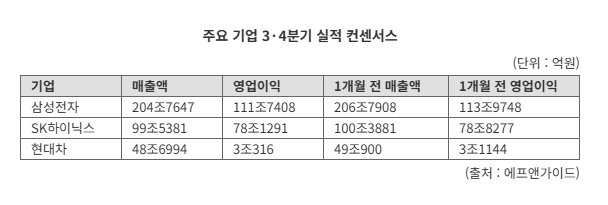
According to FnGuide, a financial information provider, on the 17th, Samsung Electronics' third-quarter operating-profit consensus—the average of securities firms' forecasts—stood at 111.7408 trillion won, down 2.0% from 113.9748 trillion won a month earlier. Over the same period, SK hynix's estimate fell 0.9%, from 78.8277 trillion won to 78.1291 trillion won, while Hyundai Motor's declined 2.7%, from 3.1144 trillion won to 3.0316 trillion won.
The burden on manufacturers lies in the time lag between costs and sales. If they produce goods using raw materials purchased when the exchange rate is high and then receive export proceeds after the exchange rate falls, the cost burden remains while won-denominated revenue declines. Although a stronger won lowers the cost of importing new raw materials, it takes time for the benefit to be reflected in earnings. Rising oil prices are adding to production and transportation costs.
Rising semiconductor prices are also affecting industries differently. For memory-chip manufacturers, they provide an opportunity to raise selling prices, but for smartphone and laptop makers, they translate into higher component costs. Raising finished-product prices could weaken demand, while keeping prices unchanged would reduce profit margins—a dilemma for manufacturers. DB Securities estimated that Samsung Electronics' Mobile eXperience (MX) division would post an operating loss of 1.8 trillion won in the third quarter because of rising component costs and other factors.
Semiconductor exports are not immune to exchange-rate effects either. JPMorgan Chase lowered its third-quarter exchange-rate assumption for SK hynix from 1,460 won per dollar to 1,400 won, cutting its forecasts for the company's won-denominated revenue and operating profit by 2% to 7%. Since more than 90% of its revenue is dollar-based, the analysis said, a stronger won would have a significant impact on its earnings.
Automakers are facing concerns about weaker profitability on exports of vehicles produced domestically. Yuanta Securities Korea estimated that if the average exchange rate in September is 1,350 won, the third-quarter average would be 1,415 won, or 87 won lower than in the previous quarter. A decline in the won value of quality-warranty expenses paid in dollars would provide some cushion, but pressure on export profitability is expected to continue. Yongmin Kim, an analyst at Yuanta Securities Korea, projected, "The decline in the profitability of export volumes caused by the stronger won will be fully reflected in the fourth quarter."
The display industry is also being squeezed by exchange-rate effects and slowing demand. Daishin Securities lowered its third-quarter operating-profit forecast for LG Display from 436 billion won to 325.3 billion won, a 25.4% reduction. As demand for information-technology (IT) devices slows amid rising semiconductor and raw-material prices, manufacturers are also struggling to fully pass higher costs on to supply prices. Profitability across the manufacturing sector is therefore being put to the test.
[email protected] Dong-ho Kim Reporter