Capital Finance Companies, the Financial Sector's 'Weak Link': 161 Trillion Won Capital-Company Bond Market Faces Test as Rates Rise [fn Market Watch]
- Input
- 2026-09-17 14:50:41
- Updated
- 2026-09-17 14:50:41
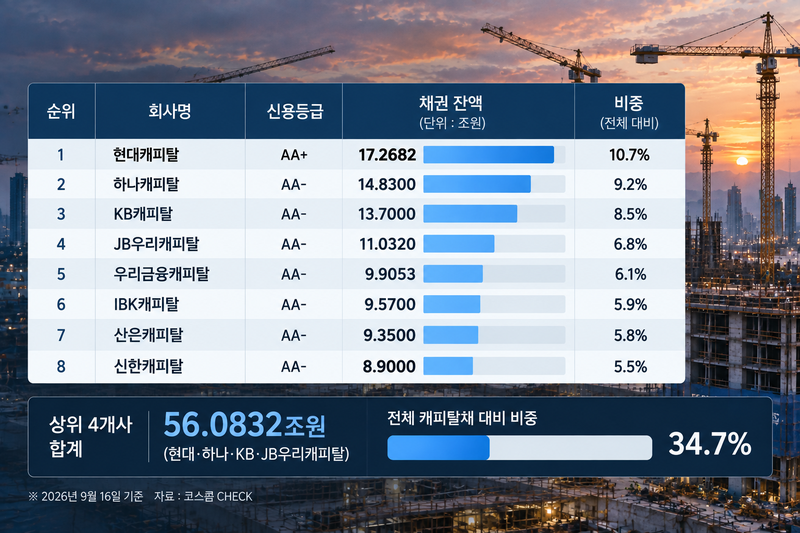
By company, large AA-rated capital finance companies account for a substantial portion of the market. Hyundai Capital Services (AA+) has the largest bond balance at 17.2682 trillion won, followed by Hana Capital (AA-) at 14.8300 trillion won, KB Capital (AA-) at 13.7000 trillion won, and JB Woori Capital (AA-) at 11.0320 trillion won.
Woori Financial Capital (AA-) has 9.9053 trillion won in outstanding bonds, followed by IBK Capital (AA-) with 9.5700 trillion won, San-eun Capital (AA-) with 9.3500 trillion won, and Shinhan Capital (AA-) with 8.9000 trillion won. The top four—Hyundai Capital Services, Hana Capital, KB Capital, and JB Woori Capital—together account for 56.0832 trillion won, or 34.7% of all capital-company bonds.
As the high-interest-rate new normal takes hold, market attention is turning to refinancing capacity by credit rating. AA-rated major companies have relatively strong capital bases and a wide range of funding options. By contrast, A-rated-and-below capital finance companies could feel the impact of rising market rates sooner because of their shorter funding maturities and limited alternative funding sources.■ Half of A-rated-and-below borrowings mature within one year: Refinancing emergencyThe interest-rate environment is also deteriorating. At its FOMC meeting on the 16th local time, the Fed raised its benchmark rate by 25 basis points. It was the first increase in about three years and two months, since July 2023. If the prolonged period of high U.S. interest rates puts upward pressure on domestic market rates, refinancing burdens could also grow for capital finance companies that rely heavily on market-based funding.
According to NICE Credit Rating, the share of specialized credit finance company bonds in the capital finance sector's total borrowing liabilities rose from 72.6% in 2022 to 83.6% at the end of June this year. For AA-rated specialized credit finance company bonds, rates on newly issued bonds began exceeding rates on bonds being repaid at maturity from the second quarter of this year. For A-rated-and-below bonds, the same occurred in July and August. This means the market has entered a period in which low-rate bonds must be refinanced at higher rates.
Park Jong-il, chief researcher at NICE Credit Rating's Financial SF Evaluation Division, explained, "As the impact of rising market rates is reflected sequentially in refinanced bonds, funding costs are expected to rise again and profitability to deteriorate in the future."
The maturity structure of A-rated-and-below companies is particularly vulnerable. Among outstanding specialized credit finance company bonds, the share maturing within one year is 35.7% for AA-rated companies and 42.1% for A-rated-and-below companies. Based on total borrowing liabilities, the share maturing within one year is 37.3% for AA-rated companies, compared with 50.5% for A-rated-and-below companies. This means that half of their borrowings must be refinanced within a year.
The burden from project finance also remains. Capital finance companies' PF loans declined from 27.2 trillion won at the end of 2022 to 18.4 trillion won at the end of June this year, but the delinquency rate stands at 5.6%. PF loans maturing within one year amount to 7.6 trillion won, or 41% of the total.
The 161 trillion won capital-company bond market is therefore considered to be facing a major test as rising interest rates and PF burdens converge. For A-rated-and-below companies in particular, their short funding maturities will cause the impact of higher rates to be reflected quickly, and the credit differentiation from AA-rated companies is expected to become more pronounced.
[email protected] Kim Hyun-jung Reporter