Chang In-hwa: "Rapid execution is the key to survival"...POSCO accelerates its 'Triple-Core' strategy
- Input
- 2026-09-17 13:39:24
- Updated
- 2026-09-17 13:39:24
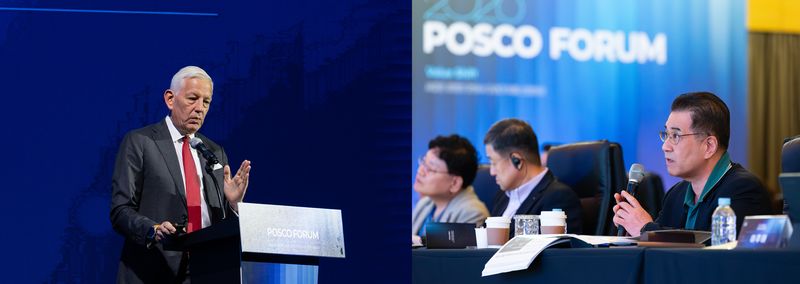
[Financial News] Chang In-hwa, chairman of POSCO Group, called for the execution of the 'Triple-Core' strategy, which places steel, lithium and energy at the center, saying, "Rapid execution is the key to survival." After unveiling a blueprint in July to reorganize the group's growth engines around resources, POSCO Group has now begun fleshing out business-specific execution strategies, including steel localization, early moves in the lithium and rare-earth markets, and a stronger role for its energy business.
POSCO Group will hold the '2026 POSCO Forum' for two days starting on the 17th at the POSCO Global R&D Center in Songdo International City, with all group executives in attendance, to discuss ways to implement the Triple-Core strategy. This year's theme is 'Seize Future Value in the New Competitive Landscape.'
Triple-Core is a strategy to develop steel as an industrial resource; lithium, cathode materials, anode materials and rare earths as strategic resources; and liquefied natural gas (LNG) and renewable energy as energy resources into the group's core growth engines. POSCO Group first unveiled the strategy at its CEO Investor Day in July, outlining plans to expand its business portfolio around resources beyond steel to include lithium and energy.
At the forum, Chang said, "In this period of great transformation, when the competitive landscape is changing due to geopolitical realignment and shifts in technological paradigms, rapid execution is the key to survival." He stressed, "To complete the Triple-Core strategy and successfully expand our business centered on resources, we must first read the direction of change and find clear answers about what to prepare and how quickly to change." He added, "Let us open a new path to growth with bold goals and decisive execution."
Chang identified three key priorities by business: a steel localization strategy, gaining an early foothold in major lithium and rare-earth markets, and giving the energy business a buffering role. Because steel, strategic resources and energy face different market conditions and are at different stages of growth, the group plans to pursue differentiated strategies rather than apply the same growth model to every business.
To support its Triple-Core transition, POSCO Group plans to invest 16.7 trillion won in future growth areas from 2026 through 2028. Based on this investment, it also set a goal of achieving combined revenue of 187 trillion won and operating profit of 13.1 trillion won in 2035. The group plans to build annual lithium production capacity of 173,000 tons by 2033 and develop lithium into a core strategic-resource business.
The forum also focuses on translating this mid- to long-term strategy into concrete business plans. It consists of three sessions: how the competitive landscape is changing; where and how the group will compete and grow; and how it will complete the transition. Lectures and discussions with experts in various fields, along with panel discussions, will examine market changes and business-specific responses.
The keynote address will be delivered by Dominic Barton, chairman of the Rio Tinto board. He will analyze the impact of geopolitical and technological changes on corporate value and present strategic implications for POSCO Group based on examples of global companies reshaping their portfolios and investing through selection and concentration.
The forum will also analyze cases of leading companies responding to the restructuring of the global industrial order. Participants will discuss the potential applications of embodied AI-based autonomous manufacturing technology and ways to enhance corporate value.
Based on the discussions at the forum, POSCO Group plans to identify specific execution tasks for the group. It aims to accelerate implementation of the Triple-Core strategy through a resource-centered business portfolio transition, stronger supply chains and technological innovation.
[email protected] Mihui Kim Reporter