Ruling Party: "Public Rental Housing Should Account for at Least 20% of the Entire Rental Market"
- Input
- 2026-09-17 12:41:25
- Updated
- 2026-09-17 12:41:25
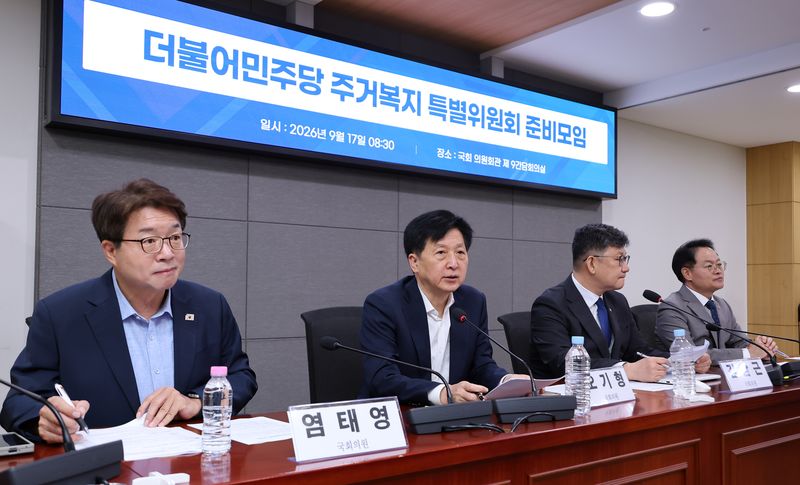
The Democratic Party of Korea's Special Committee on Housing Welfare held a preparatory meeting at the National Assembly of the Republic of Korea that day to discuss its key tasks and direction of activities going forward.
Oh Ki-hyung, a lawmaker from the Democratic Party of Korea, said, "In the long term, public rental housing must account for at least 20% of the entire rental market. We need to develop a supply plan necessary to achieve this and secure the corresponding funding." Oh emphasized that these measures should be taken into account and reflected in the government's budget proposal.
He added, "There is a youth category in the Future Response Fund, and we need to continue discussing how much funding should be allocated to determine how many homes for young people and newlyweds can be supplied."
Heo Young, the Democratic Party of Korea's deputy floor leader for policy affairs, said, "Housing welfare is a core policy that embodies the philosophy and values underlying housing policy. While meticulous planning is needed for each generation, government-funded housing supply is especially urgent for homes for young people and senior housing where people can pursue a second life after retirement."
Kim Nam-geun, a lawmaker from the Democratic Party of Korea, expressed regret over the order in which the government has recently pursued its real estate policies. Kim said, "I wish the government had first announced what types of housing would be supplied for housing-vulnerable groups, including young people, newlyweds and seniors who are struggling with housing. Unfortunately, because tax and tax-system reform measures were announced first, an inaccurate frame and misunderstanding emerged that the government was trying to address the real estate problem through taxation."
Yeom Taeyeong, a lawmaker from the Democratic Party of Korea, said, "It would also be meaningful to establish a housing welfare tax, assign dedicated housing welfare personnel to local governments and pursue budgetary support."
As public anger over real estate has recently affected the government's approval ratings, the government and ruling party are scrambling to find a breakthrough. Against this backdrop, the party's Special Committee on Housing Welfare has stepped forward to call for expanding public rental housing and establishing a housing welfare tax to secure the necessary funding. This is interpreted as an indication of the direction of real estate policy. Whether the committee's proposals are realized through future discussions between the ruling party and the government is expected to influence public sentiment over real estate.
[email protected] Kim Hyeong-gu Reporter