Wide Forehead, Surgical Scars... Hair Transplantation Helps Address Issues Left After a Facelift [Kim Jin-oh’s Hair Loss Escape]
- Input
- 2026-09-17 13:46:47
- Updated
- 2026-09-17 13:46:47
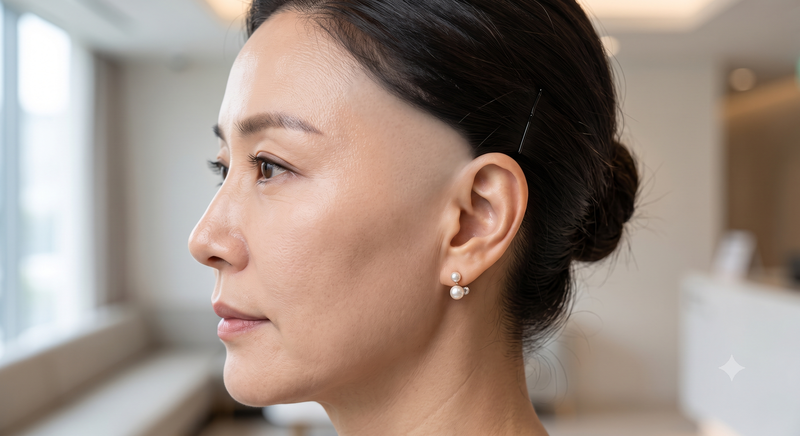
When the sideburns disappear after a facelift, it is usually because pulling the facial skin upward has raised the sideburns or reduced their front portion. Sideburns are not usually noticeable. Their role becomes apparent only after they are gone. In women, the skin in front of the ears may become more broadly exposed, making the face appear wider from side to side and flatter than before. If the face looks awkward despite appearing younger after surgery, the sideburns are often the reason.
In such cases, hair transplantation can recreate the sideburns. Sideburn transplantation requires greater attention to the angle and direction of the hair than a standard hairline transplant. Hair in this area does not grow upward like scalp hair; it lies flat against the skin. Although the area is only a few centimeters wide, it can make a considerable difference to the contours of the face.
The hairline can also become a concern after a forehead lift. Depending on the surgical method, the hairline may move upward, making the forehead appear wider than before. Some patients are satisfied with the position of their eyebrows but are bothered by the enlarged forehead. In such cases, hair transplantation can lower the hairline and restore the proportions of the face.
People who naturally have a wide forehead may also want to discuss in advance whether forehead reduction can be performed together with a forehead lift. This procedure removes part of the forehead skin and pulls the scalp forward to shorten the forehead. The goal is to raise the eyebrows without moving the hairline too far back. However, combining the procedures can place greater tension around the hairline. There is also a somewhat higher possibility of temporary hair loss around the incision or postoperative hair loss. Extra caution is needed if the hair along the original hairline is already thin or hair loss is progressing.
Some people undergo hair transplantation later even though the forehead reduction itself was successful. The reason is a surgical scar left along the hairline. It may not be visible when the bangs are worn down, but it becomes apparent when the hair is swept back or tied up. In such cases, hair can be transplanted over and around the scar to make it less noticeable. Scar tissue differs from normal scalp tissue, so hair transplantation requires a somewhat different approach. Still, if the scar is in suitable condition, it can be an effective corrective option. Ultimately, after a forehead lift or forehead reduction, hair transplantation can either reduce the appearance of an enlarged forehead or conceal a hairline scar.
Hair transplantation may also be needed for incision scars inside the scalp. During an endoscopic forehead lift, several small incisions may be made in the hair-bearing scalp, and fixation devices such as Endotine may be inserted. In most cases, the incisions are hidden by the hair and are difficult to see. However, the situation changes if the hair around the incision thins or the scar remains somewhat wide. A small scar is especially noticeable if it lies along the person’s usual hair part. This is another reason some people seek hair transplantation.
These incision scars within the scalp can also be corrected with hair transplantation. Hair is placed over the scar so that it blends naturally with the surrounding hair. The same principle can be used to improve scars from Endotine insertion or small scalp scars created during a forehead lift. However, scar tissue differs from normal scalp tissue. The skin may be hard or thin, and blood flow may be uneven. Therefore, the transplantation density and direction must be determined after assessing the scar’s width, thickness, and tissue condition. It is not always best to implant hair as densely as possible, as one would on normal scalp tissue.
After seeing many such patients, I began telling people preparing for a forehead lift one thing: show the surgeon in advance where they normally part their hair. Of course, the incision location is determined by the surgical method, so it cannot always be moved as desired. Even so, it makes a difference whether the surgeon knows which area is usually exposed. It is a point that can be discussed briefly before surgery, but it is difficult to change afterward.
The final issue is not a specific scar but a general reduction in hair density. Lifting surgery is performed on the face, but it can also affect the scalp. Tension is placed around the incisions, and the scalp may be affected as the tissue is moved. The physical stress caused by the surgery and recovery process also plays a role. This is why some people experience substantial hair shedding for a while after surgery or feel that certain areas have become noticeably thinner.
Hair transplantation is not performed hastily in such cases. Some of the hair lost due to postoperative stress may grow back over time. It is necessary to wait and see whether recovery occurs first. If the density in a particular area does not return even after sufficient time has passed, or if permanent hair loss around a scar is confirmed, hair transplantation can then be used to restore density.
I have performed hair transplantation for many years, but I never expected to encounter lifting surgery so often. When you think about it, however, it is not unusual. When the forehead is lifted, the hairline lies immediately above it; when the skin at the sides of the face is pulled, the sideburns are at the end of that area. If an incision is made inside the scalp, that site can later become a hair-related concern. Therefore, if you are planning a lifting procedure, do not look only at the face beforehand. It is also worth checking where the sideburns begin, whether the forehead is naturally wide, and where you usually part your hair.
Even if changes have already occurred after surgery, there are still options. Hair transplantation can recreate missing sideburns, lower an enlarged hairline, and conceal not only scars along the hairline but also incision scars inside the scalp where Endotine was inserted. That is what I think when I see people coming in for hair transplantation after lifting procedures these days. When planning surgery to pull up the face, it is important to consider not only the face but also where the hair begins and where it parts.

/Kim Jin-oh, director of New Hair Hair Plastic Surgery Clinic
[email protected] Kim Hyun-sun Reporter