Chief Justice Cho Hee-dae: "Judicial Independence Must Be Protected No Matter What Challenges We Face"
- Input
- 2026-09-17 11:56:21
- Updated
- 2026-09-17 11:56:21
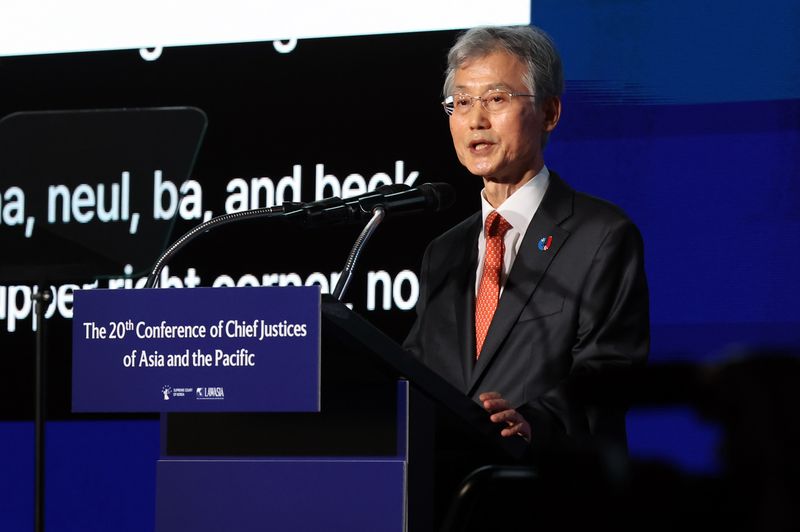
At the opening ceremony of the 20th Conference of Chief Justices of Asia and the Pacific, held at Grand Hyatt Seoul in Yongsan-gu, Seoul, on the 17th, Chief Justice Cho said, "No matter what challenges we face, judicial independence must be protected." He added, "This is necessary for the judiciary to safeguard democracy and the rule of law and fulfill its essential role."
He said, "In many countries, complex political and social disputes are increasingly being brought before the courts, and the public is placing ever greater expectations on the judiciary." He continued, "The more challenging the circumstances, the more firmly courts must uphold the law and principles. Every judge must have the courage to adjudicate without fear, relying solely on the law and principles, no matter what difficulties they face."
He also addressed relations among the three branches of government. Chief Justice Cho stated, "For the judiciary to perform its functions effectively, mutual respect and cooperation among the judiciary, legislature, and executive are necessary." However, he emphasized, "Such cooperation must take place while respecting each institution's distinct responsibilities and guaranteeing the independence of the judiciary." He added, "Maintaining a balance between judicial independence and cooperation among the three branches while earning the public's trust is a difficult task."■ "What Is Law?"—Opening Remarks Drawing on HobbesChief Justice Cho devoted a substantial portion of his opening remarks to explaining why law exists. He displayed the four Korean words for 'I,' 'you,' 'food,' and 'law' on a screen and used them to explain why law is necessary.
He said, "If only 'I' existed in the world, all that would be needed would be 'food'; 'law' would not be necessary." He continued, "But because 'you,' meaning other people, exist, 'law' is necessary. That is why people also say that wherever there is society, there is law." Drawing on Karl Marx's terminology, he also explained that 'food' symbolizes the base and 'law' the superstructure.
He then cited the ideas of Thomas Hobbes. Chief Justice Cho said that someone might pursue exclusive personal gain at the expense of others or demand that only others, not themselves, obey the law. He warned, "If such conduct is tolerated, it could lead to what Thomas Hobbes called 'the war of all against all.'" He added, "Morality and various social norms may play some role in restraining such conduct, but they are not enough on their own. That is why 'law' is absolutely necessary."
Concluding his opening remarks, Chief Justice Cho said, "The answers may differ in every legal system, but the principles underlying them are all the same." He added, "Courts must protect their independence. Judges must adjudicate according to the law."■ More Than Two Weeks of Silence on Request for RenominationChief Justice Cho's remarks came as he continued not to respond to Cheong Wa Dae's request to renominate a candidate for the Supreme Court. On the 18th of last month, he nominated Judge Son Bong-gi of the Daegu District Court from among the four candidates recommended by the Committee of Recommendation of Supreme Court Justice Candidates to replace former Supreme Court Justice Rho Tae-ak. Ten days later, Cheong Wa Dae requested a new nomination, calling the original written nomination a unilateral decision made without substantive consultation.
Chief Justice Cho had been expected to quickly state his position, but he has remained silent for more than two weeks as he continues to deliberate. Since the Conference of Chief Justices of Asia and the Pacific runs through the 19th, his announcement is expected to be delayed further. In a commemorative speech marking Court Day on the 11th, Chief Justice Cho also said that courts must not be subject to undue interference from other state institutions or political powers.
Meanwhile, the Conference of Chief Justices of Asia and the Pacific is being hosted by the Supreme Court of Korea for the third time, following the eighth conference in 1999 and the 14th in 2011. Representatives of 13 international organizations attended.
[email protected] Kim Dong-gyu Reporter