2024 Life-Cycle Deficit at KRW 220.1 Trillion; 45-Year-Olds Post a KRW 46.51 Million Surplus, Deficits Resume at 61
- Input
- 2026-09-17 12:00:00
- Updated
- 2026-09-17 12:00:00
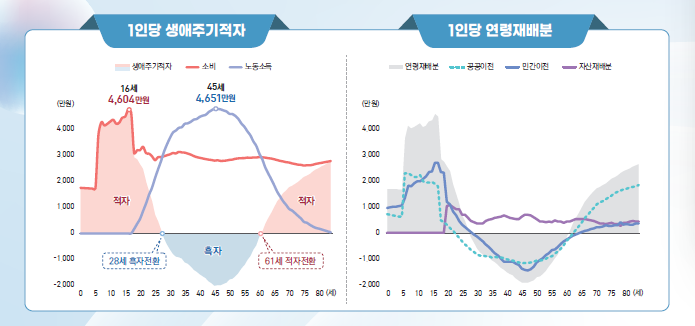
[Financial News] Koreans begin earning more in labor income than they spend on consumption at age 28, turning to a surplus, but return to a deficit at age 61.
According to the 2024 National Transfer Accounts released by the Ministry of Data and Statistics on the 17th, the life-cycle deficit last year stood at KRW 220.1 trillion, down KRW 7.3 trillion from the previous year. The life-cycle deficit is the amount of consumption minus labor income and serves as an indicator of economic activity by age and the movement of resources between generations.
Total consumption rose 3.4% year on year to KRW 1,509.8 trillion. Labor income increased 4.6% to KRW 1,289.7 trillion, growing faster than consumption. As a result, the life-cycle deficit narrowed from the previous year.
By age group, the working-age population (ages 15–64) recorded a surplus of KRW 155 trillion. Consumption increased 2.7% year on year to KRW 1,059.8 trillion, but labor income exceeded it at KRW 1,214.9 trillion.
Children (ages 0–14) recorded a deficit of KRW 186.2 trillion, while older adults (ages 65 and over) posted a deficit of KRW 188.9 trillion. Children’s consumption rose 1.0% despite generating no labor income. Among older adults, labor income amounted to just KRW 74.8 trillion, while consumption increased 8.1% to KRW 263.7 trillion.
On a per-person life-cycle basis, consumption exceeded labor income from birth through age 27, resulting in a deficit. People turned to a surplus at age 28, which continued through age 60, before returning to a deficit at age 61 as labor income declined. The largest per-person deficit occurred at age 16, at KRW 46.04 million, while the largest surplus was recorded at age 45, at KRW 46.51 million.
Intergenerational deficits were financed through transfers and asset reallocations. The total amount of age reallocations was KRW 220.1 trillion, consisting of a net outflow of KRW 10.7 trillion through transfers and a net inflow of KRW 230.8 trillion through asset reallocations.
Transfers primarily involved resources moving from the working-age population to children and older adults. Both public and private transfers recorded net outflows from the working-age population and net inflows for children and older adults. On a per-person basis, public transfers recorded their largest net inflow at age 7 and their largest net outflow at age 46. Private transfers peaked at ages 17 and 47, respectively.
The working-age population recorded the largest net inflow through asset reallocations. Total asset reallocations amounted to KRW 230.8 trillion, comprising net inflows of KRW 189.8 trillion for the working-age population, KRW 40.7 trillion for older adults, and KRW 300 billion for children. Of this total, private asset reallocations generated net inflows of KRW 172.1 trillion for the working-age population and KRW 38.4 trillion for older adults.
[email protected] Kim Chan-mi Reporter