Hanwha Ocean Unveils LNG Tank with Three Times the Pressure and Begins Developing Bunkering Vessel
- Input
- 2026-09-17 10:07:59
- Updated
- 2026-09-17 10:07:59
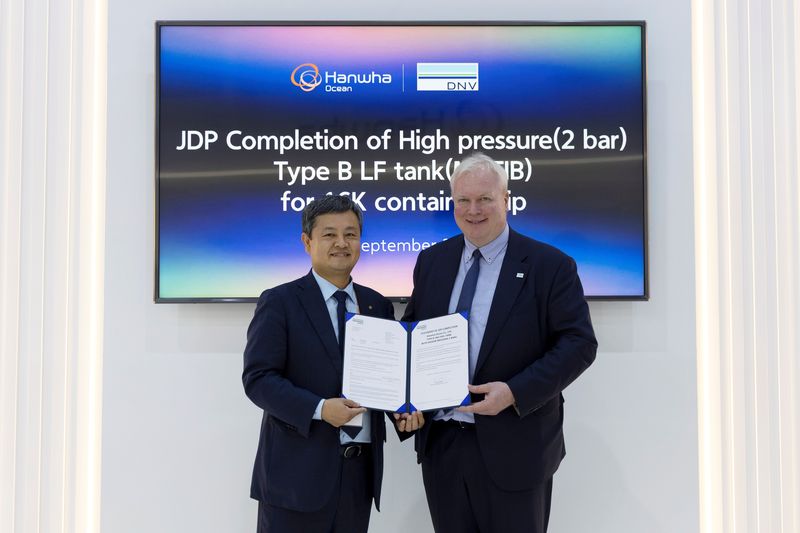
[Financial News] Hanwha Ocean has completed the development of technology that triples the pressure capacity of LNG (liquefied natural gas) fuel tanks and will begin developing LNG bunkering vessels, for which demand is surging.
On the 17th, Hanwha Ocean received certification for its future-vessel technologies from global classification societies at Gastech, held in Bangkok, Thailand. In addition to the previously announced design of Floating Liquefied Natural Gas (FLNG) facilities, the company unveiled the results of its high-pressure LNG fuel-tank technology development and announced plans to develop LNG bunkering vessels.
Hanwha Ocean first announced that it had completed the development of next-generation high-pressure LNG fuel-tank technology. The project was launched jointly with Det Norske Veritas (DNV) last May. Under the IGF Code (International Code of Safety for Ships Using Gases or Other Low-Flashpoint Fuels), the allowable pressure for Type B tanks used as fuel tanks on LNG-powered container ships is currently 0.7 barg. Applying the jointly developed technology will safely raise the pressure to as much as 2 barg, or three times the current level. The technology is expected to extend the storage period for boil-off gas, improving operational flexibility and fuel-management efficiency.
Hanwha Ocean is also pursuing the development of LNG bunkering vessels. DNV recently forecast that up to 208 such vessels will be needed by 2030 as the number of LNG-powered ships grows amid tighter environmental regulations from the International Maritime Organization (IMO). Bunkering vessels supply fuel to powered ships at sea. Hanwha Ocean signed a memorandum of understanding (MOU) with the Korean Register of Shipping (KR) to jointly develop an 18,000-cubic-meter-class bunkering vessel. It also presented a specific LNG bunkering-vessel development concept. The plan calls for applying the high-manganese-steel-based cargo containment system “Mactiv,” used in an ethanol carrier (VLEC) that received approval in principle (AiP) from Lloyd’s Register (LR), along with Type C independent tanks.
Hanwha Ocean also signed an MOU with LR to jointly develop an extension of the inspection interval for LNG carrier cargo tanks. The goal is to extend the existing five-year interval to 7.5 years by developing condition-based monitoring technology for cargo tanks and a risk-based safety assessment framework.
As announced before Gastech, Hanwha Ocean also obtained approval in principle (AiP) for its FLNG design from American Bureau of Shipping (ABS) and DNV.
[email protected] Kim Yoon-ho Reporter