Lee Chan-jin Says "There Is Still a Long Way to Go on Consumer Protection" at Public Briefing on Financial Consumer Protection Achievements
- Input
- 2026-09-17 14:00:00
- Updated
- 2026-09-17 14:00:00
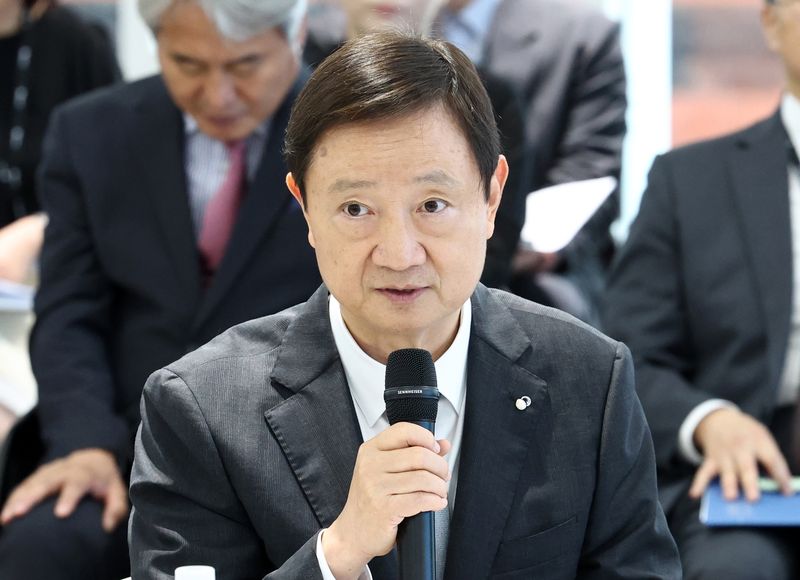
The public briefing on financial consumer protection achievements was held on the second-floor auditorium of the Financial Supervisory Service’s headquarters in Yeouido, Seoul, on the 17th. The event was attended by 250 people, including Lee Chan-jin, financial consumers, employees of financial companies and related institutions, and outside experts. It featured a report on the Financial Supervisory Service’s achievements, presentations on improvements made in the field by financial companies, presentations by outside experts, a panel discussion, and questions and answers from the audience.
Lee Chan-jin: "Financial complaints and disputes are rising... Financial companies still have work to do on consumer protection"
In his opening remarks, Lee said, "This event was organized to report to the public on our efforts to advance financial consumer protection and to hear the public’s views on the direction we should take." He added, "Although we have pursued consumer protection through an organization centered on consumers, a shift to a preventive supervisory system, a firm response to livelihood-related financial crimes, and efforts to strengthen the foundations of inclusive finance and welfare, complaints and disputes continue to increase, while sales practices focused on short-term performance persist in the market." He continued, "Consumer protection has not yet been sufficiently embedded in the operations and management culture of financial companies," adding, "The true measure of success is change that consumers can feel in the financial marketplace."
As for its achievements, the Financial Supervisory Service first reorganized its structure to link supervision, inspections, and dispute mediation more closely. It also made consumer protection a core task for executives and employees. The agency established consumer-centered governance by operating the Financial Consumer Protection Advisory Committee and the Consumer Risk Response Council. It also made meetings of the Dispute Mediation Committee regular and expanded the relevant department and staffing. From July 2025 through August 2026, a total of 94 issues identified through complaints and disputes were linked to measures such as institutional improvements.
The agency also established a preventive supervisory system covering the life cycle of financial products. The aim is to prevent the risk of defective products being launched at the source, rather than relying solely on compensation or punitive supervision after a financial accident. It introduced guidelines for designing and manufacturing financial products and strengthened design requirements for high-risk products. Following discussions by sector-specific task forces, the Financial Supervisory Service plans to finalize the guidelines in the fourth quarter. It also tightened reviews of insurance products, which generate the most disputes. To this end, it required internal rules to reflect the Chief Customer Protection Officer’s exclusive right to reach a prior agreement, including the right to reject.
At the sales stage, measures included preparing guidelines for explaining investment products, simplifying subscription procedures, implementing guidelines to prevent dark patterns, and improving advertising review procedures. During post-sale management, consumer guidance was strengthened through an early-warning system for complex equity-linked securities (ELS), notices on points to consider when reinvesting, notifications of changes to insurance claim review standards, and guidance on previous-month card spending requirements. The agency strengthened supervision throughout the entire product cycle, from design and sales to post-sale management.
AI Platform for Combating Livelihood-Related Financial Crimes Prevents 66.36 Billion Won in Losses
The Financial Supervisory Service also established ASAP, an AI-based voice-phishing information-sharing and analysis platform, to combat livelihood-related financial crimes. Using the platform, it prevented 66.36 billion won in losses from October 2025 through July 2026.
The agency also established a one-stop support system for illegal private lending, pursued the introduction of special judicial police dedicated to livelihood-related financial crimes, and worked to build an integrated platform to prevent insurance fraud. To support low-income and vulnerable groups, it pursued measures including expanding the supply of Saehuimang Holssi loans, launching loan products for borrowers with low to mid-level credit, promoting livelihood expense accounts, and expanding customized financial education.
In terms of supervisory systems, the agency launched FIRST, an integrated supervisory control system; established ORBIT, a virtual-asset market monitoring system; and introduced a comprehensive AI-based portal for handling complaints and disputes. To improve consumer convenience, it also pursued institutional improvements, including integrated payments for small inheritance deposits, one-stop linkage for customer information changes, measures to ease consumer inconvenience caused by branch closures, stronger notices on changes in loan interest rates, and greater convenience in canceling cards.
Financial companies also presented their cases at the event. Shinhan Bank presented its efforts to enhance board-centered consumer-protection governance. Other examples of improvements in the field were shared, including KB Insurance’s use of customer data to develop products, NH Investment & Securities’ efforts to strengthen the independence of its Chief Customer Protection Officer, and Hyundai Card’s inclusion of consumer-protection indicators in performance evaluations.
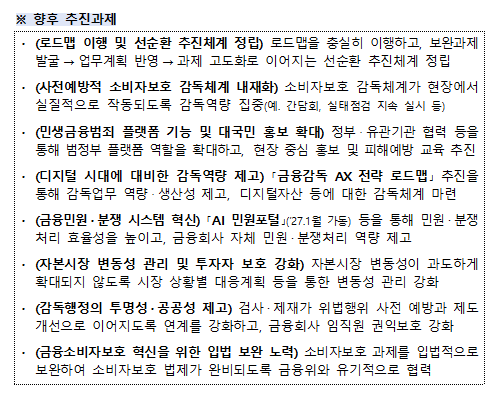
Going forward, the Financial Supervisory Service plans to continue implementing the tasks in its Financial Consumer Protection Improvement Roadmap and identifying additional measures through performance evaluations. It will also work to embed a preventive consumer-protection supervisory system, strengthen the functions of its livelihood-related financial crime platform, enhance supervisory capabilities for the digital era, innovate complaint and dispute systems, manage capital-market volatility, improve transparency in supervisory administration, and pursue legislative improvements.
Park Sang-hyuk of the Democratic Party of Korea, the ruling party’s floor secretary on the National Assembly’s Political Affairs Committee, said in a congratulatory address, "As financial products become increasingly complex and non-face-to-face sales expand, consumer risks are also becoming more diverse." He emphasized, "A financial supervisory system that prevents harm before it occurs is important."
Seo Il-jun of the People Power Party, the opposition party’s floor secretary, said, "Because finance directly affects people’s daily lives and assets, protecting financial consumers means protecting the public’s lives and trust." He added, "Although it is important to provide relief to consumers who have suffered harm, a preventive financial supervisory system that identifies and prevents risk factors before harm occurs is more important than anything else."
[email protected] Park Moon-soo Reporter