Jeju Province ranks second nationwide with a Korean score of 99.9 on the CSAT... The gap between schools' average Korean and mathematics scores is the smallest in the country
- Input
- 2026-09-17 09:09:32
- Updated
- 2026-09-17 09:09:32
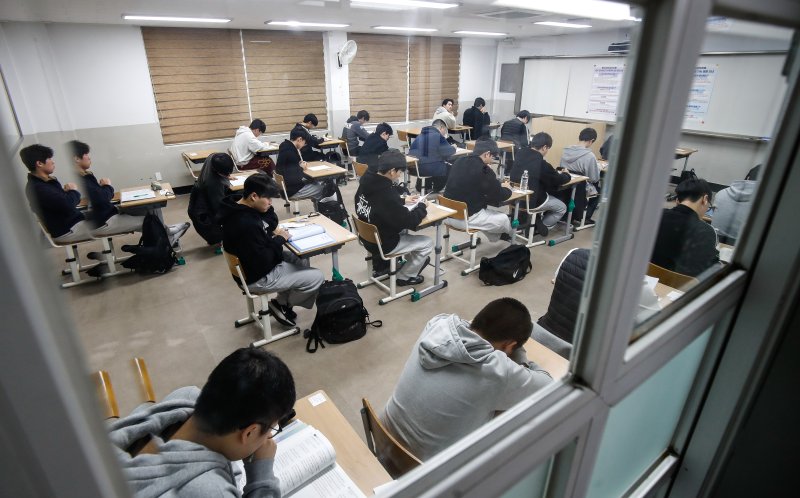
[Financial News Jeju Province = Reporter Jeong Yong-bok] The average Korean standard score of high school students enrolled in schools in Jeju Province on the 2026 CSAT was the second highest among the 17 cities and provinces nationwide. In both Korean and mathematics, the gap between the highest and lowest school averages within the province was the smallest in the country.
According to KICE's "Analysis Results of 2026 College Scholastic Ability Test Scores" released on the 17th, the average Korean standard score among analyzed students enrolled in schools in Jeju Province was 99.9 points, second nationwide after Seoul's 102.4 points.
This was 3.2 points higher than the overall average of 96.7 points for all regions analyzed. Jeju Province was followed by Sejong City at 98.4 points, Daegu at 98.2 points, and Busan at 98.0 points.
Jeju Province's average mathematics score was 98.1 points, 1.1 points above the overall average of 97.0 points. Seoul ranked first at 102.3 points, followed by Daegu at 98.4 points and Busan and Sejong City at 98.2 points each. Jeju Province ranked fifth.
Standard scores are calculated by converting raw scores to reflect test difficulty. In Korean and mathematics, they are calculated so that the average score of all test takers is 100 and the standard deviation is 20. They are an indicator intended to address the difficulty of comparing raw scores alone across tests with different levels of difficulty.
What stood out most about Jeju Province in these results was the gap between schools' average scores.
KICE compared the highest and lowest school-level average standard scores among schools in each city and province with at least 30 enrolled students taking the test.
In Korean in Jeju Province, the highest-scoring school recorded 108.7 points and the lowest-scoring school 79.0 points, a gap of 29.7 points. This was the smallest among the 17 cities and provinces nationwide. Jeju Province was followed by Sejong City at 31.7 points, Gwangju at 34.1 points, and North Chungcheong Province at 35.5 points.
The same was true in mathematics: Jeju Province recorded a gap of 33.2 points, with a high of 109.0 and a low of 75.8. This was the smallest gap nationwide. It was followed by Gwangju at 34.8 points, Ulsan at 36.0 points, and North Chungcheong Province at 37.0 points.
The characteristics of Korean scores in Jeju Province were also evident in the grade distribution. Grade 8 accounted for 5.4% and Grade 9 for 2.6%, for a combined 8.0%. This was the lowest among the 17 cities and provinces nationwide. Compared with the 12.7% combined share of Grades 8 and 9 among all regions analyzed, this was 4.7 percentage points lower.
Conversely, the proportion of top-performing students was not particularly high. In Jeju Province, Grade 1 accounted for 3.0% and Grade 2 for 5.2%, putting the combined share of Grades 1 and 2 at 8.2%. This was 0.2 percentage points lower than the overall figure of 8.4%. Instead, 83.7% of students enrolled in schools in Jeju Province were distributed across Grades 3 through 7, 4.8 percentage points higher than the overall figure of 78.9%.
The second-place national ranking in average Korean scores therefore did not mean that Jeju Province had an unusually large number of top-performing students. Rather, it reflected a score distribution with a low proportion of lower-performing students and a relatively broad middle tier.
A similar pattern was partly evident in mathematics. The combined share of Grades 1 and 2 in Jeju Province was 8.7%, lower than the overall figure of 9.8%, while the combined share of Grades 8 and 9 was also below the overall figure, at 9.1%.
In English, the combined share of Grades 1 and 2 in Jeju Province was 13.0%, lower than the overall figure of 14.7%. Grades 8 and 9 accounted for 3.9%, 1.9 percentage points below the overall figure of 5.8%.
This comparison by city and province did not cover all CSAT test takers in Jeju Province. KICE included only students enrolled in general, specialized, and autonomous high schools in its regional analysis. In Jeju Province, 4,758 students from 24 schools were included. The nationwide analysis covered 320,882 students from 1,829 schools. Graduates and GED test takers were excluded from the comparison.
The total number of CSAT test takers in 2026 was 493,896, an increase of 30,410 from 463,486 the previous year. There were 333,102 students currently enrolled in schools, 141,539 graduates, and 19,255 GED test takers.
When all test takers were divided by enrollment status, graduates had an average Korean standard score of 109.4 points, 13.3 points higher than the 96.1 points recorded by currently enrolled students. In mathematics, graduates scored 108.6 points and currently enrolled students 96.5 points, a gap of 12.1 points.
The key point of the Jeju Province results is not simply the second-place national ranking in Korean. Among the analyzed students currently enrolled in schools, Jeju Province had the smallest nationwide gap between the highest and lowest school-level average scores in Korean and mathematics, as well as the lowest proportion of students in Grades 8 and 9 in Korean.
[email protected] Jeong Yong-bok Reporter