DDP Area to Be Transformed into a K-Pop and Tourism Hub... Seoul Metropolitan Government Approves Revised Redevelopment Plan
- Input
- 2026-09-17 10:00:00
- Updated
- 2026-09-17 10:00:00
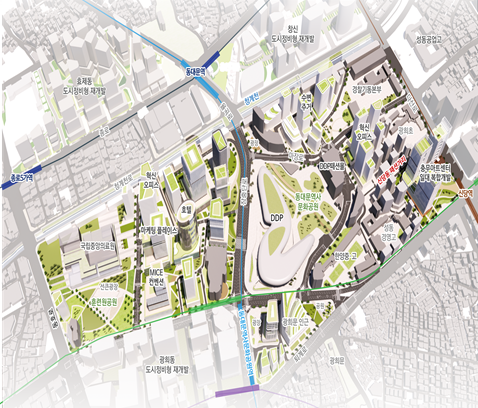
[Financial News] The fashion district around Dongdaemun Design Plaza (DDP) will be transformed into a K-culture and tourism hub featuring entertainment companies, hotels and performance venues.
According to the Seoul Metropolitan Government on the 17th, the 15th Urban Planning Committee, held on the 16th, approved with modifications the “Designation of the Redevelopment District and Decision on the Redevelopment Plan for the DDP 1, 2 and 3 Urban Redevelopment Projects.”
The DDP area once grew as a center of the fashion industry. However, its commercial district has continued to decline as consumption has shifted online and competition with Chinese e-commerce companies has intensified.
Vacancies have increased, particularly in modern retail malls, and vacancy rates at some fashion malls have exceeded 70%. Most stores are separately owned units, making it difficult to reorganize their tenant mix and spaces in response to market changes. The area also faces growth limitations as fewer young consumers visit.
By contrast, DDP, located at the center of the target area, is a major tourist destination that attracted 17 million visitors in 2024. Various programs, including Seoul Light, are being operated there. The area also has strong potential because it can be linked with nearby natural and cultural heritage sites such as Cheonggyecheon Stream, Heunginjimun Gate and Naksan.
Through the revised redevelopment plan, the Seoul Metropolitan Government plans to turn the DDP area into a K-culture hub centered on the entertainment industry and a stay-oriented tourist destination where visitors can spend time. It will also revitalize the stagnant fashion and beauty industries while expanding green areas and pedestrian spaces.
First, projects that bring in entertainment-related companies will receive incentives of up to 200% of the permitted floor-area ratio. The measure is intended to cluster entertainment companies through private redevelopment and create a related industry cluster. Projects that secure beauty and fashion businesses will receive an additional permitted floor-area ratio of up to 50%.
The plan will also expand the area’s insufficient tourist accommodations. Introducing a three-star or higher hotel will allow the permitted floor-area ratio to increase by up to 150%, depending on the scale, or provide a maximum floor-area ratio of up to 240%. Installing a tourist information center and a luggage center will qualify projects for incentives of up to 100% of the permitted floor-area ratio.
The city will encourage the installation of cultural infrastructure where people can directly experience K-culture. Creating an experiential entertainment space like the K-Culture Station installed between City Hall Station and Euljiro 1-ga Station will qualify projects for floor-area-ratio incentives of up to 100%. The city also plans to encourage open-air observation decks on the top floors of redevelopment districts with views of DDP and the Seoul City Wall. Building-height restrictions will be relaxed by up to 20 meters when registered performance venues are installed.
Buildings along Jangchungdan-ro will be encouraged to install media façades, creating a nighttime landmark. Projects that introduce media façades will also receive permitted floor-area-ratio incentives.
Green areas and pedestrian spaces will also be expanded. An east-west green corridor 30 meters wide will be created from Seun District to DDP, connecting with the north-south green corridor from Jongmyo to Namsan. Parks and open green spaces will be used to connect open spaces around DDP, with rest facilities such as shade structures and benches installed.
In addition, separate guidelines were established to create a shaded pedestrian network around DDP and promote the nighttime economy. The guidelines will be reflected when redevelopment plans are drawn up for individual districts in the future.
This redevelopment plan serves as a master plan that will provide the framework for private developers when they pursue redevelopment projects in the future. Specific project plans will be finalized through resident proposals and related procedures.
Kim Chang-gyu, head of the Urban Space Division, said, “The decision on this redevelopment plan has established guidelines that will enable the stagnant DDP area to be restructured. We expect the DDP area to be transformed into a world-class cultural space that attracts a steady stream of tourists by creating a multifaceted city where K-culture, including K-pop, cultural and tourism hubs, and green spaces come together.”
[email protected] Choi A-young Reporter