Ministry of Science and ICT’s AI Budget Tops 5 Trillion Won, but Hacking Response Gets 79 Billion Won—Just 1.6%
- Input
- 2026-09-17 10:49:00
- Updated
- 2026-09-17 10:49:00

According to data submitted by the Ministry of Science and ICT to Lee Hoon-gi, a lawmaker of the Democratic Party of Korea on the National Assembly’s Science, ICT, Broadcasting, and Communications Committee, the ministry’s AI-related budget totaled 5.0938 trillion won this year. During the same period, the budget for responding to and preventing hacking stood at 79.062 billion won, or 1.6% of the AI budget.
The Ministry of Science and ICT’s AI budget has risen sharply over the past three years. It increased from 1.1424 trillion won in 2024 to 3.414747 trillion won last year and then expanded to 5.0938 trillion won this year. Compared with 2024, that represents a 345.9% increase in just two years.
By contrast, the budget for responding to and preventing hacking rose from 63.438 billion won in 2024 to 79.485 billion won last year, before reaching 79.062 billion won this year. The increase from 2024 was 24.6%. This year’s budget, in particular, fell by 423 million won, or 0.5%, from last year.
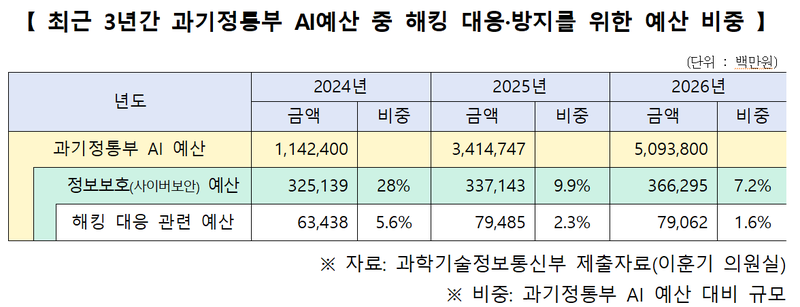
As a result, the hacking-response budget’s share of the AI budget has also declined rapidly. It stood at 5.6% of the AI budget in 2024, fell to 2.3% last year, and dropped to 1.6% this year. While government investment in AI has expanded sharply, spending on hacking response has grown relatively slowly.
A similar trend emerged when the scope was broadened to include information security and cybersecurity. The Ministry of Science and ICT’s budget for information security and cybersecurity rose 12.7%, from 325.139 billion won in 2024 to 366.295 billion won this year. Over the same period, information-security and cybersecurity spending as a share of the AI budget fell from 28% to 7.2%.
The Ministry of Science and ICT is responsible for fostering the AI industry, as well as information security and responses to hacking and cyber incidents in the private sector. In its work plan for the second half of this year, the ministry also identified investigations into hacking incidents in the private sector, implementation of comprehensive information-security measures, development of security-focused AI models, and vulnerability assessments as key priorities.
As AI use expands across industries and public and private services, the need for security investment to counter cyber threats targeting AI is also growing. Critics, however, say that spending on responding to and preventing hacking has failed to keep pace with the rapid expansion of investment in AI.
Lee Hoon-gi said, "As this is the AI era, expanding the budget to secure AI competitiveness is an essential investment. However, as AI use increases, hacking and cyber threats are also growing, so security investment to protect AI safely must be expanded as well."
[email protected] Yoon Hong-jip Reporter