"They Said They Would Prevent the Lime and Optimus Incidents" ... Independent Financial Product Advisory Business Has Had 'Zero' Registrations in Five Years ... A Textbook Case of Bureaucratic Desk Planning
- Input
- 2026-09-20 15:22:42
- Updated
- 2026-09-20 15:22:42

[Financial News] The independent financial product advisory business, established by financial authorities to prevent the mis-selling of financial products in incidents such as the Lime and Optimus incidents, has remained effectively dormant for five years, with no registered operators. Critics say the system was a textbook case of bureaucratic desk planning: despite its inherently weak prospects for attracting participants due to low demand and potential conflicts of interest, the authorities launched the system first and considered its feasibility later.
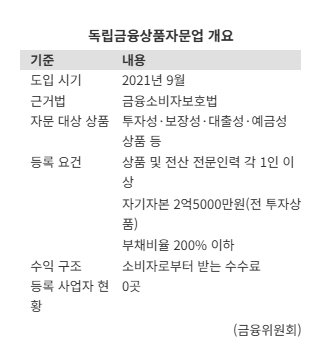
According to financial industry sources on the 20th, no business has registered under the independent financial product advisory business system, introduced in September 2021. After five years, only the framework remains, while the system itself is effectively nonfunctional.
The independent financial product advisory business is a consumer-protection system designed after the Act on the Protection of Financial Consumers took effect in 2021. It helps consumers select and receive recommendations for financial products, including deposits, installment savings, loans, funds and insurance, while also providing financial management services. It is distinct from the investment advisory business established under the Financial Investment Services and Capital Markets Act, which has no independence requirement.
Because the system was intended to prevent mis-selling and other problems seen in the Lime and Optimus incidents, advisers are required to recommend products suited to customers without having interests tied to banks, securities firms or asset managers. The registration requirements are not particularly demanding. Applicants need at least one product specialist and one information-technology specialist, equity capital of KRW 250 million based on all investment products, and a debt-to-equity ratio of no more than 200%.
The problem is the revenue model. Industry officials say it would be difficult to generate demand because fees paid by consumers for advisory services are the main source of operating funds. Securities investors already have numerous ways to obtain information, while insurance customers have access to agents.
A financial industry official said, "For this system to work, it would have to attract high-net-worth individuals, but securities firms and banks already offer Private Banker (PB) services for free. Ordinary consumers also have more diverse ways to obtain information, so they have little incentive to pay advisory fees."
As a result, the system is facing the same fate as the independent financial adviser (IFA) system, which was institutionalized in 2017. The only difference is that the IFA system is limited to investment products; it otherwise follows a model similar to the independent financial product advisory business. To date, it has no registered operators. Critics say financial authorities, despite having already witnessed the failure of the IFA system, rushed to launch the new system as a formality to coincide with the Act on the Protection of Financial Consumers, without thorough preparation or improvements.
Apart from profitability concerns, the ban under the Act on the Protection of Financial Consumers on concurrently operating financial product sales and brokerage businesses is another constraint. Naver Pay, Kakao Pay and Toss, which were among the most likely big-tech candidates to enter the market, already operate financial product comparison platforms. Their advisory activities have therefore been restricted because of potential conflicts of interest.
In 2023, the Financial Services Commission (FSC) attempted to lift the ban on concurrent business activities through a regulatory sandbox and bring these payment providers and some card issuers into the advisory market. Although the companies began internal reviews, the effort ultimately fell through because the FSC failed to advance substantive discussions, according to sources. The biggest obstacle appears to have been the difficulty of guaranteeing genuine objectivity and independence as the number and scope of financial products being brokered continue to expand.
A financial authorities official noted, "Along with the independence requirement, there may be practical reasons why it is difficult for an operator to engage in brokerage and advisory services at the same time. Some areas also overlap with the investment advisory business defined under the Financial Investment Services and Capital Markets Act."
[email protected] Kim Tae-il Reporter