United States Turns Toward Tightening... Higher Rates to Persist Next Year After Additional Hike
- Input
- 2026-09-17 06:51:18
- Updated
- 2026-09-17 06:51:18
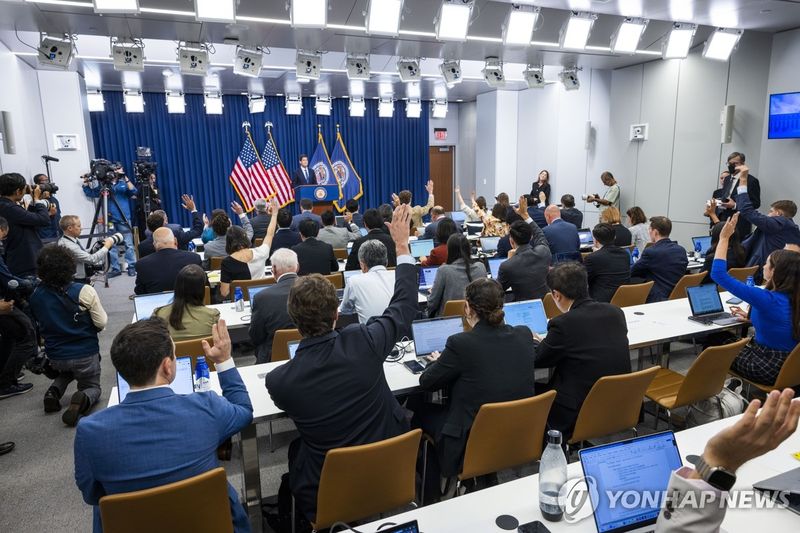
[Financial News] The Federal Reserve System (Fed) has shifted the United States and the global economy toward monetary tightening for the first time in three years and two months.
Moreover, the Fed signaled that it could raise rates once more this year rather than stopping with the latest hike, opening the possibility that its tightening stance will continue at least through next year. The high-interest-rate environment will therefore persist into next year.
Above all, attention is focused on the fact that Fed governors, led by Chair Kevin Warsh, unanimously voted to raise rates and demonstrated a strong commitment to price stability despite President Donald Trump's overt pressure to cut rates. This confirmed the Fed's firm resolve to stabilize prices.
Dot Plot Signals Additional Hikes This Year... Four Fed Officials Call for Two Hikes
Attention is now shifting to the number and timing of additional rate hikes.
In the dot plot released alongside the decision, Fed officials put the median forecast for the policy rate at the end of this year at 4.1%. That is 0.3 percentage points higher than the previous forecast of 3.8%.
Given that the target range for the policy rate rose to 3.75%–4.00% after the day's hike, the projection suggests that Fed officials expect one additional 0.25-percentage-point increase this year.
Of the 18 officials who submitted rate projections, 16 expected at least one additional hike this year, while only two expected rates to remain at the current level. Four of those 16 officials projected two additional hikes this year.
Bill Dudley, former president of the Federal Reserve Bank of New York (FRBNY), previously explained, "A 0.25-percentage-point rate hike is too small to have a meaningful impact on economic activity." He added that, because monetary policy affects the real economy with a considerable lag, the Fed tends to make policy adjustments of a meaningful size and then continue moving in the same direction until changes emerge in the economic outlook.
Sima Shah of Principal Asset Management said, "It is very unlikely that this will end with just one hike."
However, it remains uncertain whether this tightening cycle will lead to a steep series of consecutive hikes like those seen in 2022 and 2023.
The United States economy is not experiencing the broad overheating seen at that time, and rates have already remained high for a considerable period. As a result, the Fed may leave gaps between hikes while assessing future inflation and employment data.
The median dot-plot projection also showed the policy rate remaining at 4.1% at the end of 2027, indicating that the Fed expects to hold rates steady through next year after an additional hike this year.
Following the results of the two-day Federal Open Market Committee (FOMC) meeting held in Washington, D.C., the Fed raised the policy rate by 0.25 percentage points to an annual range of 3.75%–4.00%. This marked the first monetary tightening measure in three years and two months since July 2023, and all 12 FOMC members voted in favor of the increase.
At the previous meeting, only three officials had called for a rate hike. In just one meeting, the entire FOMC shifted toward raising rates.
Fed: "Inflation Remains Elevated"
The main reason the Fed turned toward tightening was its assessment that inflation risks had risen again while inflation had not slowed sufficiently to the target level.
In its statement, the Fed said that "inflation remains elevated" and newly added that it would "support a more timely return to the Committee's 2% objective."
It also emphasized, "The Committee will achieve price stability."
Recently released inflation data also pushed the Fed toward a rate hike.
The Consumer Price Index (CPI) released on the 11th showed an increase of 3.4% in August from a year earlier, while core CPI, excluding volatile energy and food prices, rose 2.4%.
At a press conference following the rate-hike decision, Fed Chair Kevin Warsh remarked, "The inflation data this summer do not show a meaningful improvement in the underlying trend."
[email protected] Lee Seok-woo, International Affairs Specialist Reporter