U.S. Fed Raises Interest Rates for First Time in Three Years, Signals ‘One More’ Increase; Markets Swing
- Input
- 2026-09-17 06:12:56
- Updated
- 2026-09-17 06:12:56
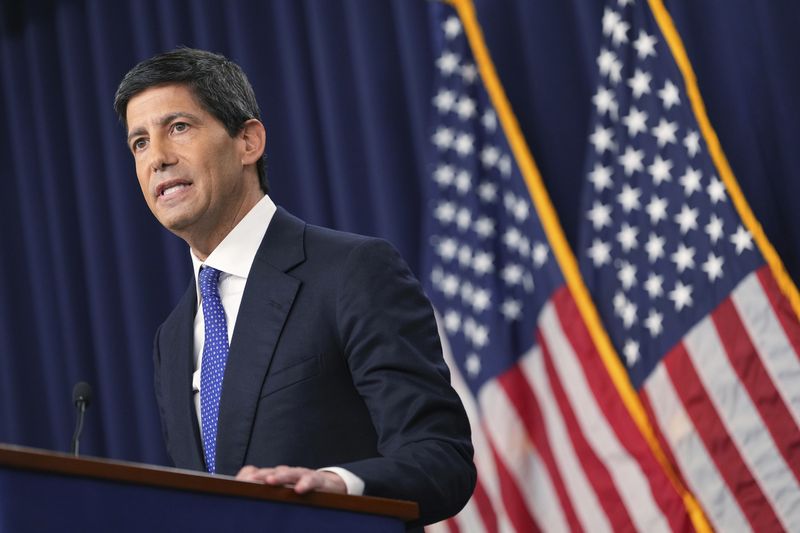
【Financial News New York = Reporter Lee Byung-chul】 The Federal Reserve System (Fed), the central bank of the United States, raised its benchmark interest rate for the first time in more than three years. The move was exactly in line with market expectations. However, regarding the future rate path—a key focus for investors—the Fed signaled that it could raise the benchmark rate once more this year. Fed Chair Kevin Warsh emphasized that price stability is the foundation of economic growth and that the Fed had taken an important step toward achieving it.
On October 16 (local time), the Fed held a regular meeting of the Federal Open Market Committee (FOMC) and unanimously raised the benchmark rate by 0.25 percentage points. This was the first rate increase since July 2023, bringing the Fed’s benchmark rate to 3.75–4.00%. Warsh said the decision reflected the conclusion that prices were rising too quickly. He said, "The clear fact is that inflation is too high and has persisted for too long."
High inflation and strong employment build case for rate hike
Recent economic indicators supported the Fed’s concerns about inflation. The U.S. Consumer Price Index (CPI) rose 0.4% in August from the previous month, a sharp acceleration from July’s 0.1% increase. It also rose 3.4% from a year earlier, well above the Fed’s 2% inflation target. In particular, international oil prices surged amid the war between the United States and Iran, pushing energy prices up 2.1% in August alone and gasoline prices up 3.9%. Energy prices jumped 16.3% from a year earlier.
As inflation began to pick up again, the labor market also proved stronger than expected. Nonfarm payrolls increased by 162,000 in August, far exceeding the market forecast of 53,000. Compared with July’s 21,000 increase, the gain was more than seven times larger. The unemployment rate remained unchanged from the previous month at 4.1%. The backdrop to the rate hike was the judgment that inflation remained above the Fed’s target, while the economy and labor market were resilient enough to withstand higher rates.
18 of 19 officials project another increase this year
The market’s focus was less on the rate hike itself than on the future path of interest rates. The Fed officials’ new rate projections, released alongside the decision, strongly suggested that the increase might not be a one-time move.
Of the 19 Fed officials who submitted projections, 18 expected the benchmark rate to be at least 0.25 percentage points higher than its current level by the end of this year. In effect, all but one official judged that another rate increase would be necessary this year. Four officials, in particular, projected an additional 0.50-percentage-point increase before year-end. This leaves open the possibility that the Fed could raise rates twice during the remaining period, by 0.25 percentage points each time.
Given that the Fed raised the rate to 3.75–4.00% on this day, most officials effectively expect the year-end benchmark rate to reach at least 4.00–4.25%. They also indicated that the high-rate environment could continue for a considerable period into next year. Although officials’ projections for 2027 varied somewhat, a majority expected the benchmark rate to remain around 4.00–4.25%.
Stocks fall and Treasury yields rise after Warsh’s hawkish remarks
Markets reacted after Warsh’s press conference. When the Fed announced the rate hike, the three major U.S. stock indexes continued to rise steadily, while Treasury yields edged down. However, after Warsh made clear his strong determination to curb inflation, stocks broadly turned lower.
The decline in the Dow Jones Industrial Average (DJIA) was particularly pronounced among the three major indexes. The DJIA fell 631.21 points, or 1.21%, from the previous session to close at 51,461.90. The Standard & Poor’s 500 Index (S&P 500 Index) dropped 33.92 points, or 0.45%, to 7,551.81, while the NASDAQ Composite slipped 3.15 points, or 0.01%, to 25,978.43. The Nasdaq-100, which comprises 100 large technology stocks, ended the session up 72.23 points, or 0.03%, at 28,945.06.
U.S. Treasury yields rose mainly on short- and medium-term maturities. The yield on 10-year Treasury notes increased 0.022 percentage points from the previous session to 5.02%. The two-year yield, which closely reflects market expectations for Fed policy, surged 0.077 percentage points to 4.74%. By contrast, the yield on 30-year Treasury bonds, a benchmark for long-term rates, fell 0.005 percentage points to 5.358%.
Kay Ha, chief investment officer for fixed income at Goldman Sachs Asset Management, told CNBC that the Fed did not appear to be anticipating an aggressive tightening cycle at this stage. He said most officials at this FOMC meeting projected one more rate increase this year, and expected the Fed to skip a hike at its October meeting, which is close to the midterm elections, before raising rates again in December.
[email protected] Reporter Lee Byung-chul Reporter