[New York Stock Exchange] Stocks Fall on ‘Rate Hike in Three Years’... NVIDIA Rises 0.8%
- Input
- 2026-09-17 05:31:19
- Updated
- 2026-09-17 05:31:19
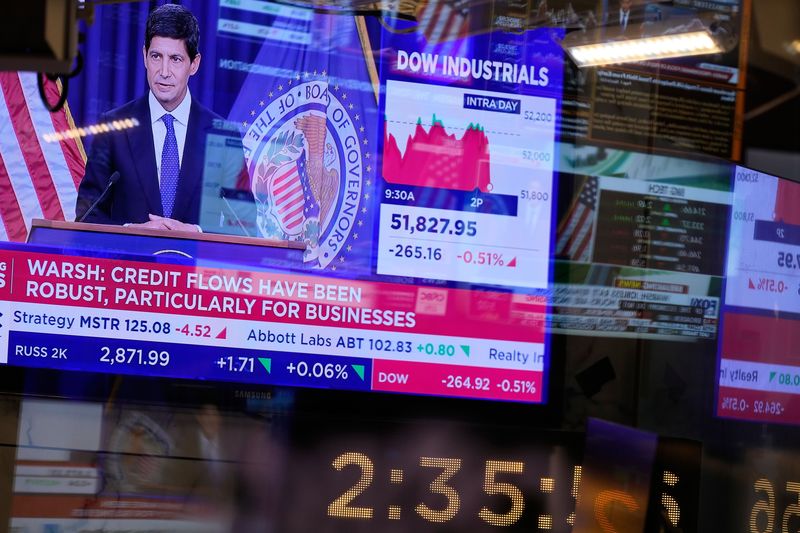
U.S. stocks closed lower for a third consecutive session on the 16th (local time).
The Federal Reserve System (Fed)’s “first rate hike in three years” weighed on investor sentiment.
Big Tech stocks, however, generally held up well. NVIDIA rose 0.8%, while Apple gained 0.3%.
Bank stocks, meanwhile, were hit particularly hard by the shock of the rate hike.
Third Straight Decline
The initial market reaction was not unfavorable after the Fed raised its policy rate by 0.25 percentage points at the conclusion of its two-day Federal Open Market Committee (FOMC) meeting. Since the hike had already been anticipated, the three major indexes moved steadily higher.
The trend changed sharply, however, after Fed Chair Kevin Warsh focused on inflation concerns during his press conference and signaled the possibility of additional rate hikes.
The indexes turned lower in unison, and their losses widened at one point late in the session. The impact on technology stocks was limited, however, as the Nasdaq briefly rebounded near the close. This appeared to be because they had already received the “rate-hike vaccine.”
Among the three major indexes, the Dow Jones Industrial Average posted the most pronounced decline. The Dow fell 631.21 points, or 1.21%, from the previous session to close at 51,461.90.
International Business Machines (IBM) fell 4.4%, while Goldman Sachs and Boeing plunged 4% and 3.7%, respectively, weighing heavily on the index.
The Standard & Poor’s 500 Index (S&P 500) fell 33.92 points, or 0.45%, to 7,551.81, while the Nasdaq slipped 3.15 points, or 0.01%, to 25,978.43.
The Nasdaq-100, which comprises 100 large technology stocks, gained 72.23 points, or 0.03%, to close at 28,945.06. The Invesco QQQ ETF, which tracks the index, rose $0.18, or 0.03%, to finish at $704.72.
The leveraged ETF ProShares UltraPro QQQ (TQQQ), which tracks three times the daily movement of the Nasdaq-100, gained $0.03, or 0.04%, to close at $67.93.
Semiconductors Generally Strong
Semiconductor stocks were generally higher.
NVIDIA rose $1.73, or 0.82%, to $213.90. Intel, which was the subject of reports that it was discussing cooperation with SK hynix, surged $3.91, or 4.03%, to $101.05.
The Philadelphia Semiconductor Index (SOX) gained 70.56 points, or 0.63%, to 11,246.11. The leveraged ETF Direxion Daily Semiconductor Bull 3X Shares (SOXL), which tracks three times the daily movement of 30 semiconductor stocks, jumped $1.65, or 1.61%, to close at $103.97.
By contrast, memory-chip leader Micron Technology fell $1.05, or 0.11%, to $926.55, while NAND flash maker SanDisk declined $10.93, or 0.71%, to close at $1,519.97.
Big Tech Holds Up
Big Tech stocks generally performed well.
Tesla rose $1.50, or 0.42%, to $358.08, while SpaceX surged $7.39, or 5.15%, to $150.88.
Palantir Technologies gained $1.78, or 1.03%, to $174.34, while Apple rose $1.07, or 0.32%, to $332.41.
Alphabet, however, fell $2.11, or 0.61%, to $342.87.
Bank Stocks Plunge
Major bank stocks recorded their worst day since February.
Goldman Sachs plunged $38.69, or 3.96%, to $937.98, while JPMorgan Chase fell $3.57, or 1.01%, to close at $348.92.
Bank of America declined $1.62, or 2.72%, to $57.90, while Wells Fargo plunged $2.67, or 2.98%, to $87.05.
Although banks can widen their net interest margins through rate hikes, they may face weaker earnings because of higher provisions for credit losses caused by an economic slowdown and weaker demand for loans.
[email protected] Song Kyung-jae Reporter