Foreign Workers Keep Northern Gyeonggi’s Production Sites Running: Without Them, Factories and Farms Would Stop
- Input
- 2026-09-17 08:44:56
- Updated
- 2026-09-17 08:44:56
Foreign workers are keeping Northern Gyeonggi’s industrial sites running as local residents leave. Amid chronic labor shortages in manufacturing, agriculture, and livestock farming, foreign workers have become essential to the regional economy rather than merely an option. Financial News examines, through field reports, statistics, and policy, why Korean workers have left and why foreign workers have filled the gap. It also explores how to coexist with these workers as they become neighbors in local communities, not just a source of labor. Editor’s note
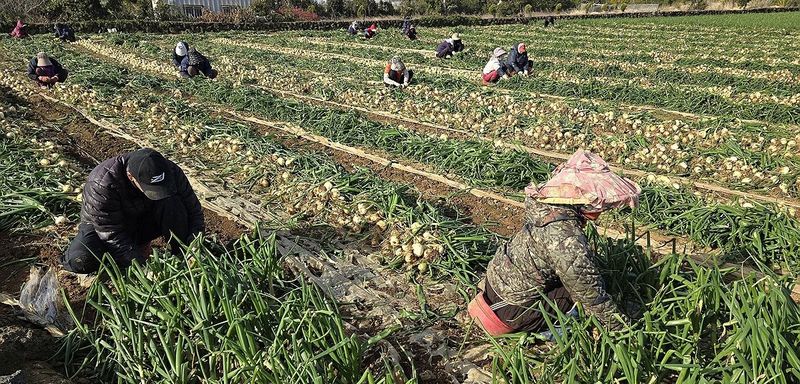
【Financial News, Gyeonggi—Reporter Kim Kyung-soo】 The labor landscape at industrial sites in Northern Gyeonggi is changing rapidly. As low birth rates and an aging population create severe labor shortages, foreign workers are quickly filling the vacancies and emerging as a pillar of regional economic growth.
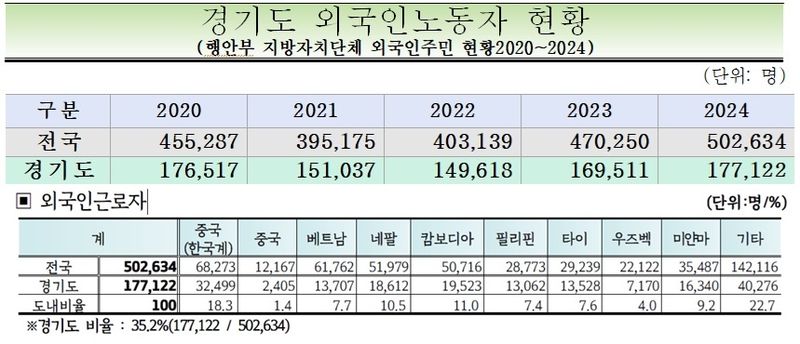
According to the Ministry of the Interior and Safety’s statistics on foreign residents in Gyeonggi Province, as of November 2024, the province had 177,122 foreign workers as of the 17th. They accounted for 35.2% of the 502,634 foreign workers nationwide.
The foreign-resident population of Gyeonggi Province has also continued to grow over the long term. According to the Ministry of Justice’s statistics on foreign residents as of June 30, 2026, 734,495 foreign residents were living in the province.
The figure has risen steadily from 655,062 in 2023 to 706,858 in 2024, 733,241 in 2025, and 746,525 in 2026. Compared with 2023, the number increased by more than 90,000 in three years. Gyeonggi Province is home to 33.9% of the nation’s 2,166,995 foreign residents.
Northern Gyeonggi is becoming increasingly dependent on foreign workers. Small and medium-sized manufacturers located in industrial complexes in Pocheon, Yangju, and Paju-si are struggling to secure production workers. Even when they post job openings, there are often no applicants. In other cases, workers hired with difficulty fail to stay for long, making foreign workers a key force in addressing labor shortages.
The situation is similar in rural areas. Farmers rely on foreign seasonal workers because labor shortages recur during every busy farming season. Agriculture requires large numbers of workers at specific times, such as planting and harvesting, so production itself becomes difficult when sufficient labor cannot be secured.
The working-age population is shrinking because of low birth rates and an aging population. Young people are leaving for Seoul and other major cities in search of jobs. Although Northern Gyeonggi is part of the Seoul metropolitan area, it lacks transportation, housing, cultural facilities, and other living infrastructure compared with Seoul. The region’s high proportion of labor-intensive industries, including manufacturing and agriculture, is also cited as a factor driving residents away.
As a result, the nature of the foreign-worker employment system is also changing. The Employment Permit System (EPS) was initially introduced to address labor shortages at small and medium-sized companies that could not find Korean workers. Over time, however, foreign workers in some manufacturing, agricultural, and livestock operations have moved beyond simply supplementing insufficient labor. They have become essential to maintaining production.
The government is also continuing to expand the supply of foreign workers in response to labor shortages at industrial sites. The Foreign Workforce Policy Committee has set the number of foreign workers to be brought in through the 2026 Employment Permit System (EPS) at 80,000.
The number of foreign seasonal workers (E-8) filling labor gaps in rural and fishing communities is also rising rapidly. The number of E-8 visas issued increased sharply from 18,938 in 2022 to 96,000 in 2025 and 109,000 in 2026.
Experts say foreign workers should no longer be viewed solely as replacements for Korean jobs. They argue that education and support must also be provided to reduce conflicts arising from language and cultural differences and to prevent industrial accidents.
Oh Kyung-seok, head of the Gyeonggi Immigration and Social Integration Support Center, analyzed the situation, saying, "The increase in foreign workers in Northern Gyeonggi is not the result of foreigners suddenly entering the labor market. Rather, it is part of the process of bridging the gap between the supply of Korean workers and the labor demand of local industries." He added, "As young people continue to leave the region and the population ages, reliance on foreign workers will inevitably grow further."
Oh continued, "As the foreign workforce grows, wage disparities must be addressed and working conditions improved." He emphasized, "Living infrastructure as a whole, including housing and transportation, must also be improved so that these workers can settle stably in local communities."
[email protected] Kim Kyung-soo Reporter