“Memory and Signal Emission at the Same Time”: Robot Moved Using a Brain-Inspired Semiconductor [Unboxing Lab]
- Input
- 2026-09-17 05:56:00
- Updated
- 2026-09-17 05:56:00
Do you remember the excitement of opening a delivery box? Even at this very moment, amazing discoveries that will change our lives are pouring out of university research labs. They are simply wrapped in the thick packaging of “papers.” In the “Unboxing Lab,” instead of complex formulas and theories, we will pick out only the essentials you want to know. So, shall we open the box? The star of today’s unboxing is this research.
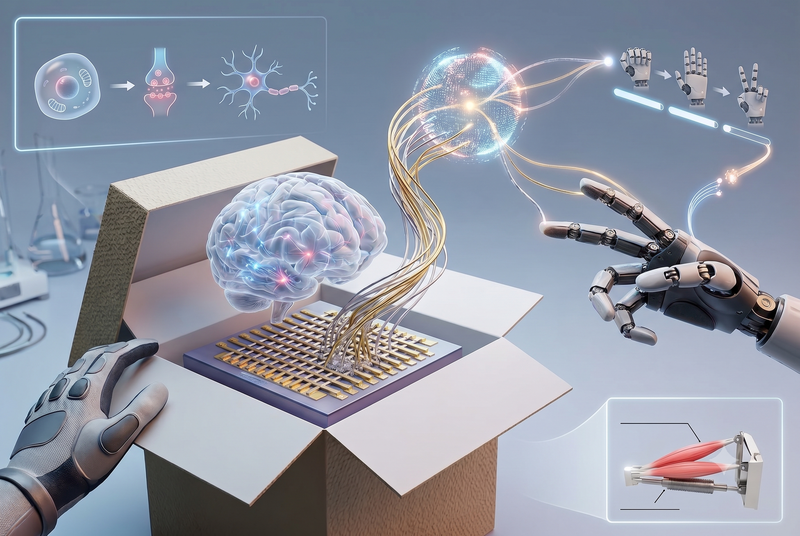
This technology could potentially be used in AI that makes decisions directly within a device without sending data to an external server. It could also be applied to robotic technology that autonomously assesses its surroundings and operates physical machinery. In particular, because a single semiconductor device can be switched between different roles as needed, it could potentially be used in a variety of AI semiconductors in the future.
■ Memory and signal functions with a single material
In the human brain, synapses that store information and neurons that generate and transmit electrical signals are interconnected. Mimicking this with semiconductors requires two functions. One is the ability to retain information even when the power is turned off. The other is the ability to return to its original state after generating an electrical signal. Previously, because these two functions had different characteristics, they were generally manufactured using different materials or components and then connected.
The research team found a way to implement both functions using a single material called vanadium oxide. By applying heat at 550 degrees Celsius for 60 minutes in an oxygen-containing environment, they created different internal structures in the upper and lower parts of the semiconductor. A hard, dense layer with sufficient oxygen bonding formed on top. On the bottom, a layer deficient in oxygen and containing fine pores was formed.
Because the upper and lower structures differed, the way they handled electricity also differed. In the porous lower layer, tiny conductive pathways formed and then broke, allowing the electrical state to be remembered. This served a role similar to that of synapses, which store information in the brain. The stored electrical state was maintained for 10,000 seconds at room temperature.
The hard upper layer allowed current to flow only when a voltage above a certain level was applied. When the voltage decreased, it returned to its original state. This served a role similar to that of neurons, which generate and transmit electrical signals in the brain. The function remained stable even after 5,000 repeated operations. The researchers also repeated 50 times an experiment in which a single device was set to perform a memory function and then switched to a signal-generating function, confirming that both functions were maintained.
■ Robot hand moved after judging rock, paper, and scissors
The research team arranged the same devices in a 16×16 array with horizontal and vertical wires crossing one another. They paired two devices, assigning one to store information and the other to generate signals. As a result, the frequency and strength of the signals emitted by one device varied according to the value stored in the other.
The researchers then tested whether AI could distinguish images of rock, paper, and scissors by applying the semiconductor’s mechanisms for storing information and generating signals. When shown photographs of hand gestures, the AI distinguished rock, paper, and scissors with an accuracy of up to 98.38%. The AI’s judgment was then transmitted to a five-fingered robotic hand. Using an actuator made of shape-memory alloy, the robotic hand produced the opposing gesture capable of defeating the input gesture.
The results of this study were published online on August 17 in the international academic journal Advanced Materials.
This study mimicked the memory and signal transmission functions of the human brain using a single semiconductor device and connected the resulting AI judgments to the actual movements of a robotic hand.
[email protected] Kim Man-gi Reporter