National Assembly Policy Forum Held to Establish a Support System for Families Bereaved by Suicide
- Input
- 2026-09-16 20:06:09
- Updated
- 2026-09-16 20:06:09
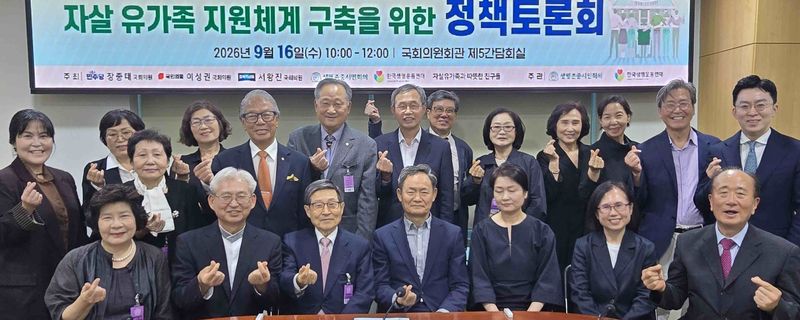
As of 2024, approximately 120,000 people became bereaved family members each year—about eight times the 14,872 suicide deaths recorded that year. The number of bereaved family members since 2000 is estimated at around 3 million. Although their suicide risk is 22 times higher than that of the general population, an adequate support system for families bereaved by suicide has yet to be established.
Kim Dae-seon, standing representative of the Life Respect Citizens’ Council, which organized the forum, called for measures in his welcoming remarks. He said that an adequate legislative and policy foundation had not been established to provide immediate support to bereaved families facing economic and administrative crises after a sudden tragedy. He emphasized that establishing multifaceted and systematic support programs to prevent families from being exposed to secondary tragedies is a natural responsibility of the state and society. He added that the forum was held to establish a rapid support system for bereaved families.
In his keynote presentation, Lim Sam-jin, co-representative of the Life Respect Citizens’ Council, proposed recognizing the experiences of families bereaved by suicide as a core form of expertise in suicide prevention policy, rather than viewing them merely as a high-risk group or a population to be managed.
Lim positively assessed the government’s National Suicide Prevention Strategy (2025) for defining suicide as a national and social-structural issue rather than solely an individual mental health problem, and for pursuing expanded one-stop services for bereaved families and stronger counseling and treatment support. However, he pointed out that the current system remains at an early stage in developing “survivor-led peer support,” in which bereaved families participate in planning, operating, and evaluating services, as well as in policy decisions, instead of leaving leadership to experts and public institutions.
According to 10 years of psychological autopsy data from the Korea Foundation for Suicide Prevention (KFSP), 99.0% of bereaved family members interviewed experienced psychological, emotional, relational, or physical difficulties after their loss, while 54.8% experienced suicidal thoughts.
More than 73.4% were unable to properly inform people around them of the deceased person’s death. By contrast, only 44 peer-support workers nationwide are listed on the foundation’s website, and many activities are carried out in a volunteer-like manner without stable compensation.
Peer support is a nonclinical service in which bereaved family members who have experienced the same pain and are recovering provide empathy, practical information, and models for recovery to those who have recently suffered a loss. In the United Kingdom, Survivors of Bereavement by Suicide (SoBS), founded by bereaved families, receives support from the government and the NHS. Australia officially recognizes personnel with lived experience within its workforce system.
In the United States, LOSS teams work with police and medical examiners to approach bereaved families soon after a death and connect them with professional counseling and local resources. Lim proposed several measures for building a Korean-style system: offering the option of peer support at the first point of contact; establishing a “national consortium led by bereaved families” and long-term public contracts; converting peer-support workers into paid personnel and providing multiyear direct grants to independent groups; and creating a real-time referral network linking peer-support organizations with police, fire departments, emergency medical services, and funeral homes.
All referrals must be based on the bereaved family’s explicit consent and the protection of personal information.
“Peer support is a turning point in suicide prevention policy that goes beyond protecting bereaved families to reducing social stigma and raising the level of public-private cooperation,” Lim said. “We must transition to a structure in which the public sector provides funding, space, training, and safety nets, while bereaved families become the leaders in planning and operations.”
A designated discussion was also held, chaired by Park Inju, standing adviser to the Life Respect Citizens’ Council. Jo Seong-rae, director of the Institutional Improvement Support Division at the Pan-Governmental Life Guardianship Promotion Headquarters under the Office for Government Policy Coordination, emphasized, “Psychological counseling and livelihood, housing, and caregiving support must continue without interruption so that families bereaved by suicide can receive the help they need in time and recover their daily lives.”
He continued, “Based on suicide prevention measures in nine areas, we will review the operation of one-stop services for bereaved families and local self-help groups. We will also work with relevant ministries to address gaps in support, drawing on the field experiences of bereaved families and peer-support workers.”
Kim Hye-jeong, representative of Warm Friends for Families Bereaved by Suicide, emphasized, “The state must provide space and operating funds so that various activities by bereaved families can operate autonomously and flourish.”
Yang Du-seok, a steering committee member of the Korea Life Movement Solidarity, said that under the current national suicide prevention policy, bereaved families are both recipients of support and suicide prevention experts. He proposed that they participate as stakeholders in the development and implementation of suicide prevention policies; that support centers for families bereaved by suicide be established in all 17 metropolitan and provincial governments and 229 local governments; that bereaved family members receive priority in hiring at suicide prevention organizations and as suicide prevention education instructors; and that bereaved families be required to participate in public-private consultative bodies operated by local governments.
National Assembly members Jang Jong-tae, Lee Seong-gwon, and Seo Wang-jin, who organized the forum, pledged that the National Assembly would actively support budgets and legislation for bereaved families to create a society where they no longer have to suffer alone in hiding and where the state reaches out first when help is needed.
[email protected] Kim Kyung-soo Reporter