President Lee Seeks Supply Chain and Infrastructure Cooperation with Five Central Asian Countries, Expanding Korean Companies’ Entry
- Input
- 2026-09-16 17:47:58
- Updated
- 2026-09-16 17:47:58
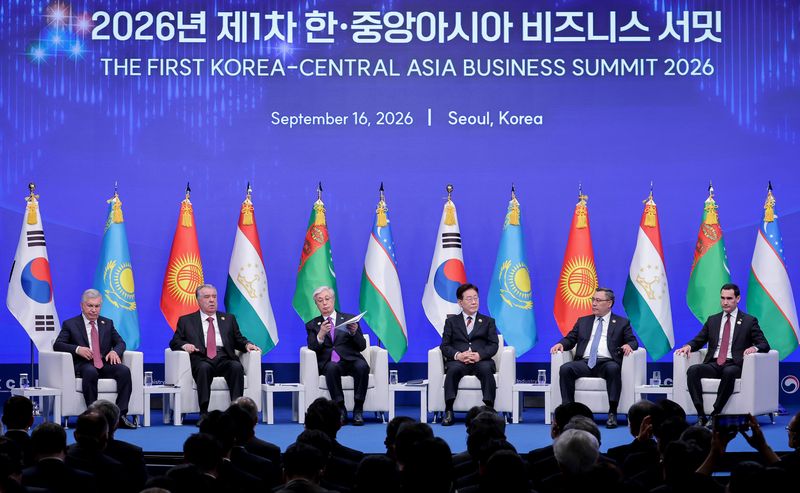
[Financial News] President Lee Jae Myung brought together the leaders and businesspeople of five Central Asian countries on the 16th to expand economic cooperation in strategic industries, including critical minerals, smart cities and plants. The event also produced concrete results for Korean companies seeking to enter Central Asian markets, with 19 memorandums of understanding (MOUs) signed between companies.
President Lee attended the first Korea–Central Asia Business Summit that afternoon at The Westin Josun Seoul, together with the leaders of five Central Asian countries, including Kazakh President Kassym-Jomart Tokayev.
The summit was the first multilateral economic event held since South Korea established diplomatic relations with the five Central Asian countries in 1992. More than 520 government officials and businesspeople from South Korea and the Central Asian countries attended.
South Korea was represented by more than 170 executives from major companies, including POSCO, LS Group, Daewoo Engineering & Construction, Shinhan Financial Group, Samsung Electronics, Hyundai Motor Company and LG CNS, along with government officials. Central Asia was represented by about 350 people, including officials from each country’s economic, industrial and energy ministries, as well as representatives of sovereign wealth funds and state-owned and private companies.
According to Sung Ki-hong, senior presidential secretary for public relations and communication at Cheong Wa Dae, trade and investment, critical-mineral supply chains, and infrastructure and logistics were presented as the three pillars of future economic cooperation. Participants shared the market potential and business opportunities in each area and discussed ways to support companies’ expansion into the region.
In his keynote speech, President Lee identified expanding trade and investment, building an end-to-end supply chain for critical minerals, and developing future infrastructure as the three main directions for Korea–Central Asia economic cooperation. He also expressed the government’s commitment to providing support.
At the business cooperation MOU signing ceremony held before the event, a total of 19 MOUs were signed in areas including critical minerals, smart cities, plants and digital technologies.
Hyundai Motor Company signed an MOU on smart-city cooperation with Caspian Korea and Caspi Group, laying the groundwork for entering Kazakhstan’s Alatau Smart City project. The Korea Institute of Industrial Technology (KITECH) also signed an MOU on industrial cooperation in rare metals with the Kazakhstan National Research Institute of Metallurgy and Ore Beneficiation. The agreement will link Kazakhstan’s local mineral resources with Korean technology to promote supply chain cooperation.
At the Korea–Central Asia Business Partnership event, a side event organized by the Korea Trade-Investment Promotion Agency (KOTRA), a contract worth $3 million was also signed.
[email protected] Choi Jong-geun Reporter