Seeking 'UAV Brains' from Civilian Collective Intelligence... Korea Aerospace University (KAU) to Hold AI Top Gun Challenge Finals on the 17th
- Input
- 2026-09-16 17:35:51
- Updated
- 2026-09-16 17:35:51
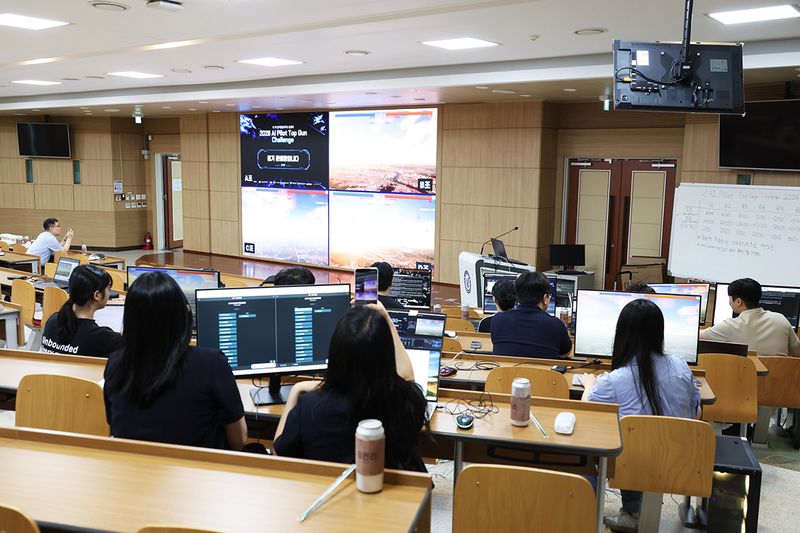
Korea Aerospace University (KAU) announced on the 16th that it will hold the finals of the 1st Korea Aerospace University (KAU) President's Cup 2026 AI Pilot Top Gun Challenge at the university's main auditorium on the 17th. Sixteen teams selected after passing through fierce preliminary rounds out of 290 teams that applied from over 80 universities nationwide will engage in one-on-one shoot-down battles.
This competition is the first nationwide event to fully open fighter jet AI piloting technology, previously handled exclusively by the military or a select few defense contractors, to civilian university students for competition. While the Defense Advanced Research Projects Agency (DARPA) has hosted similar virtual aerial combat contests in the past, those events were government-led and limited to a select few defense agencies. It is rare to find a precedent, even internationally, for civilian universities to release identical fighter jet simulation environments and rules to pit AI models from university and graduate students across the country against each other in a tournament.
Lim Sang-min, an adjunct professor at Korea Aerospace University (KAU) who planned the competition, explained that Korea chose an open civilian approach to rapidly advance next-generation aerial combat technology as a latecomer ahead of the future era of unmanned combat aircraft. The intention is to prove technological capabilities through numerous trials and errors utilizing civilian creativity and collective intelligence, rather than being limited to formulas or simple tests within closed laboratories.
The competition is conducted by placing AIs designed by participating teams onto an F-16 Fighting Falcon fighter jet simulator under identical conditions and shooting down opponents with machine guns for 200 seconds. The rules for victory and defeat are designed to induce aggression in the AIs. Points are deducted for evasive AIs that merely run away, and as time progresses, the acceptable firing angle and distance for hitting targets are gradually expanded to encourage the AIs to independently search, manage energy, and execute decisive late-game tactics. As this is a close-quarters one-on-one engagement where decisions are made in a split second, it is suitable for testing the AI's real-time situational awareness and autonomous maneuvering capabilities.
Korea Aerospace University (KAU) plans to expand this competition beyond a simple one-time event into a platform for verifying unmanned aerial vehicle (UAV) software. In the future, the university intends to broaden the scope of the competition to include hybrid manned-unmanned formation tactics involving multiple fighter jets and long-range engagements. Just as the United States installed a winning algorithm from a virtual competition onto an actual test fighter to conduct real-world flight tests against manned aircraft, the university aims to act as a bridge connecting domestically developed private-sector algorithms to actual weapon systems.
The response from the defense industry is also high. Sponsored by the Ministry of Science and ICT, the Korea AeroSpace Administration (KASA), and the Republic of Korea Air Force (ROKAF), the event is being supported by a large number of leading domestic defense and aerospace companies, including Korean Air, Korea Aerospace Industries (KAI), Hanwha Systems Co., Ltd., Hyundai Rotem Company, and LIG Defense & Aerospace. On the day of the competition, recruitment booths from these companies will be set up on-site alongside the final matches to secure practical AI talent in the field of next-generation unmanned combat aircraft. All final matches will be broadcast live on the Korea Aerospace University (KAU) official YouTube channel.
[email protected] Kim Man-gi Reporter