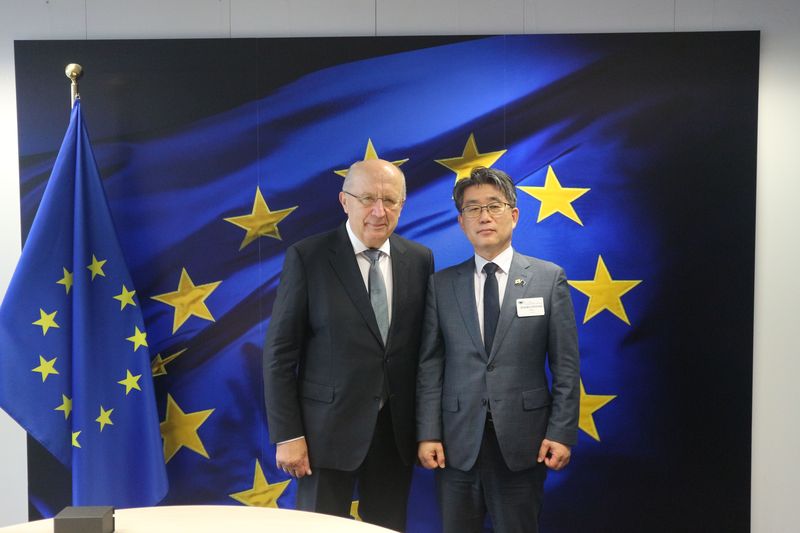
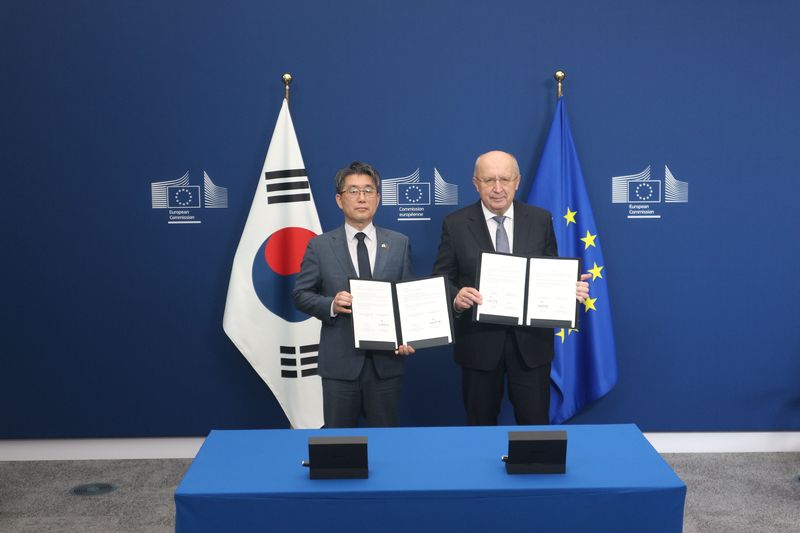
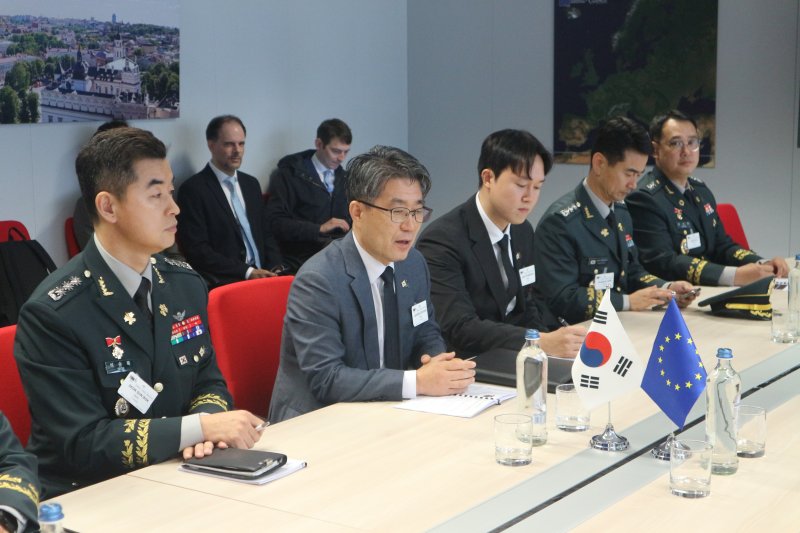
On the 17th, before the signing ceremony for an administrative arrangement at the European Union (EU) headquarters in Brussels, Belgium, Jeong Gi-young, head of the Defense Acquisition Program Administration (DAPA)'s Future Warfare Systems Program Bureau (right), poses for a commemorative photo with Andrius Kubilius, the European Commissioner for Defence Industry and Space (left). Provided by DAPA. [Financial News] On the 17th local time, the Defense Acquisition Program Administration (DAPA) signed an administrative arrangement with the European Commission's Directorate-General for Defence Industry and Space at the EU headquarters in Brussels, Belgium, to expand cooperation in low-Earth-orbit satellite communications. The agreement is expected to lay the foundation for a stable defense space communications network while advancing structural reform in national space administration to strengthen the overall competitiveness of the domestic space industry. The Republic of Korea's independent military reconnaissance and space communications assets are expanding their tactical reach onto the global stage, building on the successful completion of the 425 Project and the deployment of microsatellite constellations.
■ Korea-EU Defense Space Channel Launched; Cooperation on the IRIS2 Secure Connectivity ProgramThe administrative arrangement was signed to define cooperation between the Republic of Korea's military low-Earth-orbit satellite communications system and the EU Secure Connectivity Programme (IRIS2, or Iris Square), a multi-orbit satellite communications project that the EU is pursuing to provide defense, government, and civilian security services to its 27 member states. The two sides agreed to establish a standing working-level consultative body to facilitate joint operations and plan to expand participation to private space companies in both countries when necessary. Through the body, the South Korean military plans to share information, policies, and technology related to EU satellite assets in real time. It also aims to pursue practical cooperation that can secure tangible benefits for the national interest on the global stage by leveraging the capabilities of the domestic space industry.
■ From Completing the 425 Project to Microsatellite Constellations: South Korea's Strengthened Security StandingThe signing of the security-related administrative arrangement between South Korea and the EU was made possible by the Republic of Korea's rapidly advanced record of independently developing and fielding space capabilities. The South Korean military successfully operationalized the 425 Project, which secures independent, high-resolution medium- and large-sized reconnaissance satellites, thereby enhancing its independent Kill Chain capabilities. The military is also pursuing a separate independent research and development project to deploy a constellation of approximately 40 microsatellites in orbit by 2030, including high-performance synthetic aperture radar (SAR) satellites, to ensure continuity in its broader strategic capabilities. This dense reconnaissance and surveillance network serves as a dependable safeguard for continuously managing crisis situations on the Korean Peninsula.
■ Practical Benefits of Building a Defense Space Communications Network and Strengthening the Competitiveness of the Domestic Space IndustryThe international cooperation framework is expected to improve the completeness of a South Korean low-Earth-orbit satellite communications system while providing a strong foundation for enhancing the intangible credibility of the domestic space industry ecosystem. Under its strategy to develop the national space and aerospace industry, the South Korean government is pursuing the K-LEO project, an independent low-Earth-orbit satellite communications network that will launch between a minimum of 128 and a maximum of 512 communications satellites into space by 2035. Centered on the Low Earth Orbit Satellite Communications Industry Council, which was launched in February, the military has continued expanding international cooperation with leading global companies and relevant institutions. The latest arrangement is a tangible outcome of those domestic and international efforts.
DAPA Commissioner Lee Yong-cheol said, "The signing of this administrative arrangement is a meaningful first step toward taking a South Korean low-Earth-orbit satellite communications system to the global market." He added, "Our government is pursuing the early establishment of a low-Earth-orbit satellite communications system for the future of national security and defense. Building on this cooperation, we will continue outcome-oriented cooperation that serves the national interest."
On the 17th, following the signing of an administrative arrangement to expand cooperation in low-Earth-orbit satellite communications between DAPA and the European Commission's Directorate-General for Defence Industry and Space at the EU headquarters in Brussels, Belgium, key participants pose for a commemorative photo. (Jeong Gi-young, head of DAPA's Future Warfare Systems Program Bureau, left; Andrius Kubilius, European Commissioner for Defence Industry and Space, right.) Provided by DAPA. On the 17th (Thursday), before the signing ceremony for an administrative arrangement at the EU headquarters in Brussels, Belgium, Jeong Gi-young, head of DAPA's Future Warfare Systems Program Bureau, speaks during a conversation with Andrius Kubilius, the European Commissioner for Defence Industry and Space. (Jeong Gi-young is second from the left.) Provided by DAPA. [email protected] Lee Jong-yoon Reporter