President Lee: "A New Silk Road with Central Asia... Cooperation Across the Entire Critical Minerals Value Chain"
- Input
- 2026-09-16 16:47:53
- Updated
- 2026-09-16 16:47:53
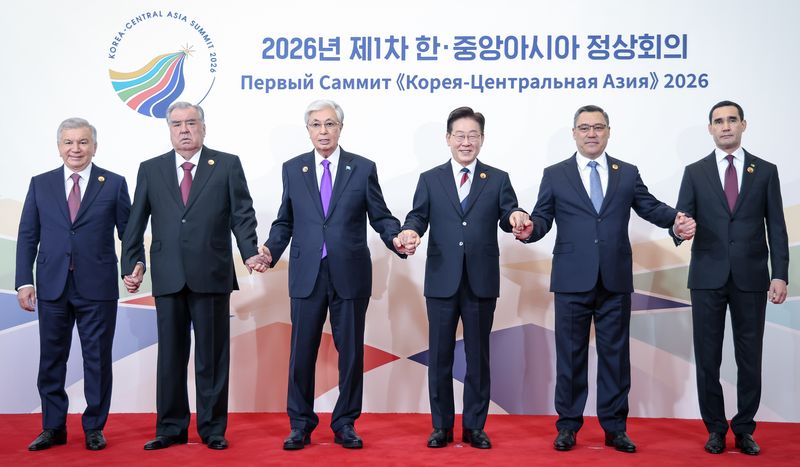
[Financial News] President Lee Jae Myung has moved to expand economic cooperation with the five Central Asian countries, focusing on critical minerals, advanced manufacturing and infrastructure. His plan is to combine Central Asia’s abundant resources with Korea’s manufacturing and technological capabilities to strengthen supply chains and industrial competitiveness while broadening cooperation into future industries. President Lee proposed using the Seoul Declaration, which sets out the direction and long-term vision for cooperation, as a shared milestone and continuing to build up new cooperative projects and achievements.
President Lee Jae Myung chaired the first Korea-Central Asia Summit and the Business Summit in Seoul on the 16th. Regarding cooperation between Korea and Central Asia, he said, "If we walk together, the road that existed 1,500 years ago will reopen as a new Silk Road."
Specifically, he proposed expanding the range of goods traded and investment areas, establishing a cooperation framework covering critical minerals and advanced manufacturing, and pursuing cooperation on future infrastructure.
The Business Summit brought together President Lee, the presidents of the five Central Asian countries—Uzbekistan, Turkmenistan, Kazakhstan, Tajikistan and Kyrgyzstan—and business delegations. From Korea, attendees included SK Group Chairman Chey Tae-won, who also chairs the Korea Chamber of Commerce and Industry (KCCI); POSCO Holdings Chairman Chang In-hwa; LG Chairman Koo Ja-eun; and Shinhan Financial Group Chairman Jin Ok-dong. Executives from Samsung Group, Hyundai Motor, LG and Lotte Group also participated. Chey said, "The business communities of the six countries have adopted a joint declaration outlining the direction of future cooperation," adding, "I hope this will mark a meaningful starting point for opening a new path of cooperation together."
President Lee also stressed the need to expand practical cooperation. At the Business Summit, he said of critical minerals, "As global supply chains are being reshaped, Central Asia is emerging as a treasure trove of critical minerals essential for electric vehicle, battery and semiconductor production." He emphasized, "If Central Asia’s abundant mineral resources, including lithium and uranium, are combined with our battery and semiconductor manufacturing capabilities, we will be able to lead global markets together."
He also said, "We must move beyond simple trade in raw materials and strengthen full-cycle cooperation in critical minerals, from exploration and refining to the processing of high-value-added materials and the production of finished goods." He added, "Using the Rare Metals Centers being established at key locations in the region as a foundation, our government will firmly support joint research and development and the training of specialized personnel so that Central Asia’s resources can generate greater added value."
On infrastructure cooperation, he said, "Korean companies, with extensive construction experience and proven technologies, are the ideal partners to join Central Asia’s infrastructure innovation." He added, "We must build together the transportation and energy arteries connecting the vast continent, along with a dense logistics network, and unlock Eurasia’s potential." Regarding trade and investment, he said, "We must broaden the scope of trade into new industries such as consumer goods, biotechnology and digital services." He also mentioned lowering nontariff barriers, dispatching trade delegations to the region and the role of the Korea Desks to be established in all five Central Asian countries.
Seong Gi-hong, chief of public relations and communications at Cheong Wa Dae, said, "At this summit, the leaders of Korea and the five Central Asian countries incorporated their agreements into the Seoul Declaration and agreed on four major cooperation visions for the two regions: institutionalizing the Korea-Central Asia partnership, moving together toward peace and stability, building a future of innovation and prosperity, and connecting through people and trust." He added, "The Seoul Declaration will serve as a new milestone for Korea and Central Asia as they open the next 30 years together."
[email protected] Choi Jong-geun Reporter