POSCO Strike Lasts 120 Hours, HD Hyundai Heavy Industries Strike 7 Hours; Disputes Over Performance-Based Pay Spread Across Manufacturing
- Input
- 2026-09-16 16:46:17
- Updated
- 2026-09-16 16:46:17
[Financial News] As performance-linked bonuses have spread, led by the semiconductor industry, labor-management disputes over wages and the distribution of performance-based compensation are intensifying across major manufacturing sectors, including steel, shipbuilding and cable manufacturing. The POSCO Labor Union began a 120-hour partial strike on the 16th, while the HD Hyundai Heavy Industries union extended its daily strike to seven hours. At LS Cable, the first strike since the union was established has begun.■ POSCO strike extended to 120 hours; LS Cable launches first labor actionAccording to industry sources, the POSCO Labor Union, affiliated with the Federation of Korean Trade Unions (FKTU) and the Federation of Korean Metalworkers’ Trade Unions (FKMTU), began a 120-hour partial strike at 7 a.m. that day at the No. 2 Hot Rolling Mill at Pohang Steelworks and the No. 4 Hot Rolling Mill at Gwangyang Steel Works. The strike is 2.5 times longer than the 48-hour partial strike held from the 9th to the 11th.
There has been no production disruption so far. POSCO is operating the plants affected by the strike by deploying available and replacement workers. Core production processes, including ironmaking and steelmaking, which account for about 70% of the overall process, are maintaining production during the strike under collective agreements covering essential work.
The union and management have offered conflicting accounts of the scale of participation. The union claims that about 240 workers took part, while management estimates that the number of workers actually able to participate was about 60 each in Pohang and Gwangyang.
The gap in wage negotiations is also wide. The union is demanding a 7.1% increase in base pay, an incentive payment equivalent to 600% of base pay, 50 company shares per employee, and a 200% holiday bonus. Management has proposed a 2.0% increase in base pay, an incentive payment of 3.5 million won, and 500,000 won in regional gift certificates. POSCO CEO Heegeun Lee met with the union chairman on the 7th and personally attended the eighth round of negotiations the previous day as the company’s representative. Lee proposed intensive negotiations through the 18th to reach a more advanced agreement, but the two sides failed to reach a deal.
“The demand for higher performance-based pay at POSCO has been building for some time,” a steel industry official said. “A 120-hour strike is quite long and could affect production.”
Labor action has also begun in the cable industry. The LS Cable union, affiliated with the FKTU’s Federation of Korean Metal Workers’ Trade Unions (FKMTU), held its first strike rally since the union was established at the company’s Gumi plant in North Gyeongsang Province that day. About 400 union members and representatives of related organizations attended. After holding the rally for one hour from 1:30 p.m., they returned to work.
The LS Cable union secured the right to strike on the 3rd after mediation by the National Labor Relations Commission, following the breakdown of the ninth wage negotiation on the 11th of last month. With the cable industry performing well amid the expansion of artificial intelligence (AI) data centers and other developments, the distribution of performance-based compensation has emerged as a key issue in labor-management negotiations.
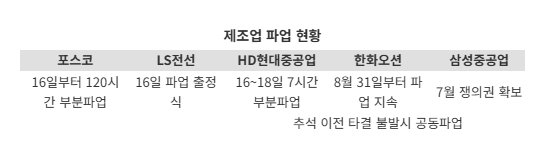
■ Shipbuilding unions raise strike intensity; base-pay increases at issueThe intensity of labor action is also rising in the shipbuilding industry. The Hyundai Heavy Industries Branch of the Korean Metal Workers’ Union began a four-hour partial strike for all union members on the 11th and continued the same action on the 14th and 15th. From that day through the 18th, it will conduct a seven-hour partial strike each day.
Management says the number of workers actually participating in the strike so far is not large enough to disrupt production. However, if the labor action continues for an extended period and expands through factors such as logistics between production processes, it could put pressure on the production schedule.
Hanwha Ocean has also continued partial and full strikes for 17 consecutive days, excluding weekends, through that day. The Samsung Heavy Industries Workers’ Council has not yet gone on strike, but it secured the right to strike in July. The Shipbuilding Industry Union Coalition has announced plans for joint action, calling for a settlement of collective wage and labor negotiations before Chuseok.
The core issues in labor-management disputes at shipbuilders are base-pay increases and the method of distributing performance-based compensation. The Hyundai Heavy Industries branch union and the Hanwha Ocean branch union are each demanding a 149,600-won increase in base pay. HD Hyundai Heavy Industries has offered an increase of 110,000 won, while Hanwha Ocean has proposed 95,000 won. The Samsung Heavy Industries Workers’ Council is also demanding a 9.3% increase in base pay.
In addition to a base-pay increase, HD Hyundai Heavy Industries has proposed an incentive payment of 10 million won plus 200%, along with gift certificates worth 500,000 won. The company maintains that the average variable compensation per union member, including performance bonuses, is about 36.5 million won. The union, however, argues that the increase in base pay should be raised rather than relying on one-time compensation.
Analysts say changes in the semiconductor industry’s compensation system are also contributing to the growing demands for performance-based compensation in recent collective wage and labor negotiations across manufacturing. Samsung Electronics and SK hynix have paid large performance bonuses linked to business results or used a certain percentage of operating profit as a source of performance bonuses. As a result, unions in other manufacturing sectors are increasingly calling for improved business performance to be reflected in wages.
Some observers, however, caution against viewing this as the direct cause of strikes in the steel, shipbuilding and cable industries. The business conditions differ by sector: steelmakers are facing profitability pressures from global oversupply and stronger protectionism, while shipbuilders and cable manufacturers continue to benefit from strong orders. In actual collective wage and labor negotiations, the overall wage structure—including base pay, bonuses and lump-sum payments, as well as performance bonuses—has become a central issue.
“The high performance bonuses in the semiconductor industry do affect workers’ expectations for compensation in other sectors, but it is difficult to compare them on the same basis because business results and wage systems differ by industry,” an industry official said. “Ultimately, the key issue in this year’s collective wage and labor negotiations across manufacturing is how to reflect improvements in a company’s performance in base pay and performance-based compensation.”
[email protected] Kim Mi-hee, Kim Yun-ho, Park So-hyun Reporter