A 100-Meter Runway Is Enough: Hanwha’s ‘Mohave STOL’ Successfully Completes Combat Flight
- Input
- 2026-09-16 16:57:58
- Updated
- 2026-09-16 16:57:58
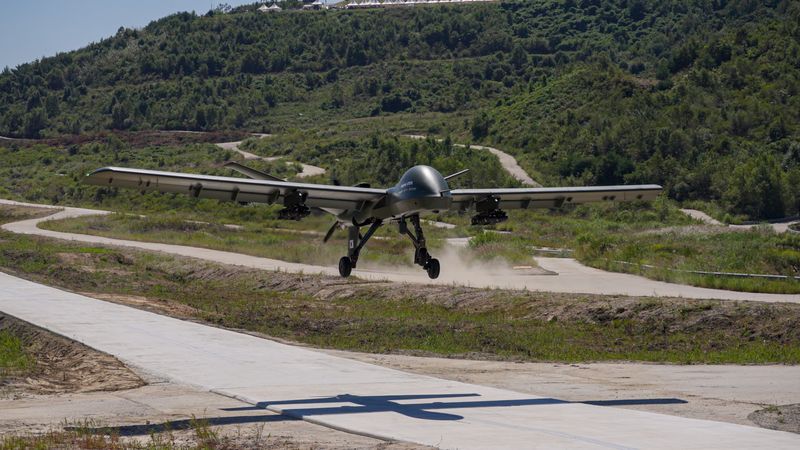
Hanwha Aerospace announced on the 16th that the Mohave STOL had successfully completed a simulated combat-flight demonstration at the 2026 Defense Drone Technology Exhibition held in Pocheon-si, Gyeonggi Province. This was the Mohave’s second flight in South Korea.
At the event, organized by the Ministry of National Defense, the Mohave took off from the Army 513th Aviation Battalion airfield and landed on a narrow tank maneuver route rather than a conventional runway. It then took off again from the same location and returned to the 513th Aviation Battalion along its scheduled route.
The Mohave is a short-takeoff-and-landing (STOL) unmanned aircraft that Hanwha Aerospace and GA-ASI have been jointly developing since last year. While comparable unmanned aircraft typically require runways of at least 1 kilometer, the Mohave is equipped with high-lift devices and a roughly 450-horsepower turboprop engine, allowing it to take off and land on runways measuring approximately 100 to 300 meters.
In the latest demonstration, the takeoff distance was less than 200 meters, while the landing distance was in the 100-meter range. During a combat test conducted on the flight deck of the Dokdo, a large naval transport ship, in November 2024, the aircraft successfully took off within a distance of less than 100 meters.
Hanwha Aerospace expects the Mohave’s short-takeoff-and-landing capability to be useful in South Korea’s operational environment, which includes extensive mountainous terrain.
The aircraft’s mission flexibility is also considered a key strength. Excluding the weight of the airframe and fuel, the Mohave can carry up to 1 ton of equipment required for missions. Depending on its payload, it can perform a range of missions, including ground attacks, surveillance and reconnaissance, logistics transport, and communications relay. The U.S. military is also pursuing a program to introduce STOL unmanned aircraft. Hanwha Aerospace explained that it incorporated the U.S. military’s requirements for diverse operational environments into the Mohave’s development, improving its short-takeoff-and-landing and mission-payload capabilities.
Hanwha Aerospace also plans to establish domestic research and development (R&D) and production infrastructure in line with the Mohave’s development and mass production. During mass production, it intends to raise the share of domestic production to more than 70% of total output. To that end, the company will invite participants from South Korea’s unmanned-aircraft industry to a “Industry-Academia-Research Mutual Cooperation Agreement Ceremony” on the 21st at its Changwon 1 Plant in Changwon City. The plan is to identify domestic partners in various component and materials fields, expand the scope of collaboration, and build a domestic unmanned-aircraft industry ecosystem.
A Hanwha Aerospace official said, "By developing and mass-producing the Mohave through mutual cooperation with GA-ASI and domestic companies, we will lead the global unmanned-aircraft market."
[email protected] Jung Won-il Reporter