"Stop Money Laundering"—Why the Government Introduced Five Strategies
- Input
- 2026-09-16 17:19:46
- Updated
- 2026-09-16 17:19:46
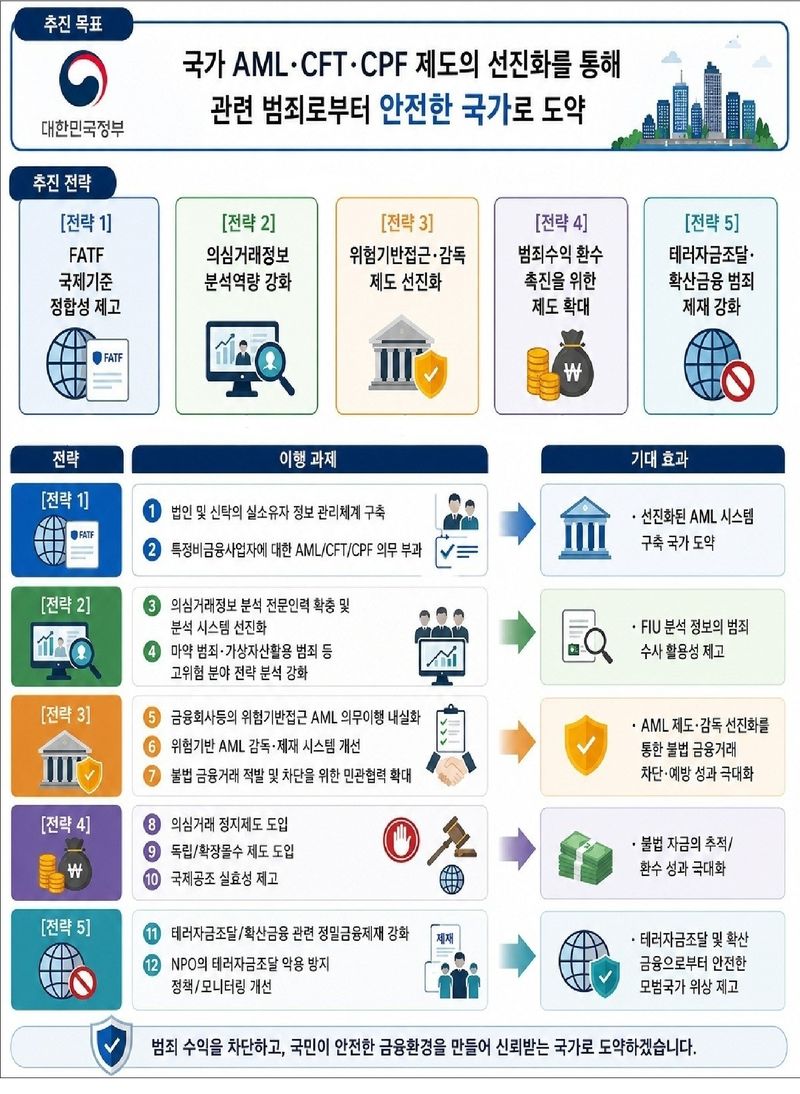
According to financial-sector sources on the 16th, the FIU’s “National Strategy and Policy Direction for Preventing Money Laundering, Terrorist Financing, and Proliferation Financing” was reported to and approved by the 23rd National Counter-Terrorism Commission meeting, chaired by the Prime Minister.
Failure to stop money laundering could create export and import risks
Under the policy direction, the FIU will advance the national framework for Anti-Money Laundering (AML), Countering the Financing of Terrorism (CFT), and Countering the Financing of Proliferation (CPF). The goal is to make the country safer from money laundering and related crimes. The strategy was developed by taking into account the results of last year’s national risk assessment, recent domestic and international trends in money-laundering crimes, and discussions on FATF international standards.
Lee Hyeong-ju, FIU Commissioner, explained, "Preventing money laundering, terrorist financing, and proliferation financing is a key government-wide task for protecting the national economic order and the public’s assets. If Korea’s AML system fails to operate effectively in the FATF evaluation, people could face substantial inconvenience in accessing financial services."
Prime Minister Han Seong-sook also urged cooperation, saying, "Failure to implement international standards could constrain the international activities of individuals and businesses. I ask each ministry to work together."
Korea’s environment surrounding money laundering and terrorist-financing crimes has changed rapidly. The number of foreigners staying in Korea continues to rise, while finance is rapidly becoming more digital and mobile. Money-laundering methods involving virtual assets such as stablecoins, as well as the use of cash in casinos, are also becoming more diverse and sophisticated. As crimes affecting people’s daily lives—including fraud, tax evasion, and drug offenses—increase and crime becomes more organized and transnational, tracing and recovering illicit funds is becoming increasingly difficult.
The FATF is also continuously strengthening its international standards in response to changes such as technological advances and the spread of virtual assets. Taking into account the national risk assessment, the changing crime environment, and FATF international standards, the government established five strategies and 12 implementation tasks.
Aligning with international standards and strengthening capabilities through AI
The first strategy is to improve alignment with FATF international standards. It includes establishing a system to manage beneficial ownership information for corporations and trusts, as well as revising AML obligations for Designated Non-Financial Businesses and Professions (DNFBPs).
The second strategy is to strengthen the FIU’s ability to analyze suspicious transaction information. In addition to expanding its pool of specialists, the government will upgrade its analysis systems and strengthen Artificial Intelligence (AI)-based analysis and virtual-asset analysis and tracking capabilities.
The third strategy is to advance the risk-based approach and the supervision and sanctions system. It includes improving risk-assessment and supervisory systems and enhancing the effectiveness of sanctions so that financial institutions and others can fulfill their AML and CFT obligations in proportion to money-laundering risks. The government also plans to expand information sharing and cooperation between the public and private sectors.
The fourth strategy is to promote the recovery of criminal proceeds. It includes introducing a system to suspend suspicious transactions, establishing independent and extended confiscation systems, and strengthening cooperation with foreign FIUs and judicial authorities. The fifth strategy is to strengthen responses to terrorist financing and proliferation financing. Measures include reinforcing the implementation system for targeted financial sanctions and improving the risk-based management and monitoring system for Non-Profit Organisations (NPOs).
An FSC official said, "Because these strategies and policy tasks are directly linked to the country’s financial credibility and external credit standing, we plan to specify detailed implementation tasks for each relevant ministry and agency, led by the Government Task Force for the FATF Mutual Evaluation launched in March. We will also continue to monitor implementation in each area through eight working groups."
[email protected] Park Moon-soo Reporter