Jeju Second Airport's September Launch of Conflict Consultative Body Falls Through... First Setback in Residents' Opinion-Gathering Schedule
- Input
- 2026-09-16 16:39:05
- Updated
- 2026-09-16 16:39:05
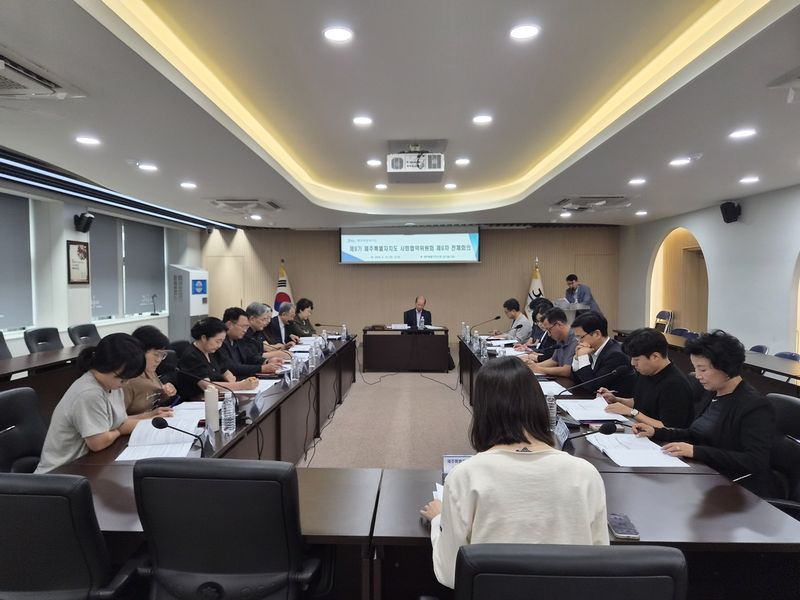
[Financial News Jeju = Reporter Jeong Yong-bok] The process of gathering residents' opinions on the 5.4532 trillion-won Jeju Second Airport has encountered a schedule adjustment at its very first stage. As the operational plan for the Conflict Mediation Council, which was scheduled to launch at the end of this month, failed to pass deliberation, the formation of the council has been postponed until after October.
According to Jeju Special Self-Governing Province and others on the 16th, the Provincial Social Agreement Committee deliberated on the "Plan for the Composition and Operation of the Tentatively Named Jeju Second Airport Conflict Mediation Council" at its 11th plenary meeting the previous day, but unanimously postponed the deliberation. The committee determined that further persuasion and opinion gathering were needed to enable stakeholders from both the pro- and anti-airport sides to participate in the consultative body.
The Social Agreement Committee and the council's preparatory subcommittee plan to hold additional consultations with stakeholders for about four weeks and then reconsider the operational plan in mid-October. As recently as the 8th, Jeju Special Self-Governing Province had set a goal of completing the formation of the consultative body by the end of September. Just one week after that announcement, the launch schedule has effectively been pushed back by about a month.
The Conflict Mediation Council is not a body that legally decides whether to construct the airport. It is a consultative body that discusses how to gather residents' opinions from among various options, including joint investigations, public deliberation surveys, opinion polls, and referendums, while verifying and mediating the issues raised by both sides. The results of the opinion-gathering process will be conveyed to the Ministry of Land, Infrastructure and Transport (MOLIT), which holds the authority to make the final policy decision on Jeju Second Airport.
Therefore, the postponement of this deliberation does not halt statutory project procedures being carried out by the Ministry of Land, Infrastructure and Transport (MOLIT), such as the design and environmental impact assessment for Jeju Second Airport. The affected areas are the conflict mediation and residents' opinion-gathering schedules being pursued separately by Jeju Special Self-Governing Province.
Jeju Special Self-Governing Province is pursuing a three-pronged policy combining environmental verification and residents' opinion gathering to resolve the conflict over Jeju Second Airport. Once the draft environmental impact assessment is submitted, Jeju Second Airport will be designated as a priority evaluation project, and the number of environmental review agencies will be increased from the current two to at least four for cross-verification. The plan is to complete a separate process of gathering residents' opinions before the Jeju Special Self-Governing Provincial Council approves the environmental impact assessment.
This is also why the launch of the consultative body is important. Jeju Special Self-Governing Province has set a schedule to determine the method of gathering residents' opinions by January next year and complete the actual opinion-gathering process in the first half of next year. Jeju Governor Wi Seong-gon also reaffirmed on the 16th that he would continue pursuing the process of gathering residents' opinions by persuading stakeholders, even if difficulties arise in forming the consultative body.
According to the Jeju Special Self-Governing Provincial Council, the draft environmental impact assessment for Jeju Second Airport is expected to be submitted in late October, while the final assessment is expected to be filed around July 2027. If the launch of the consultative body is delayed further, the timetable for coordinating environmental impact assessment verification with residents' opinion gathering could become tight.
The direct reason for the delayed launch is the difference in views between the proponents and opponents over the composition and role of the consultative body.
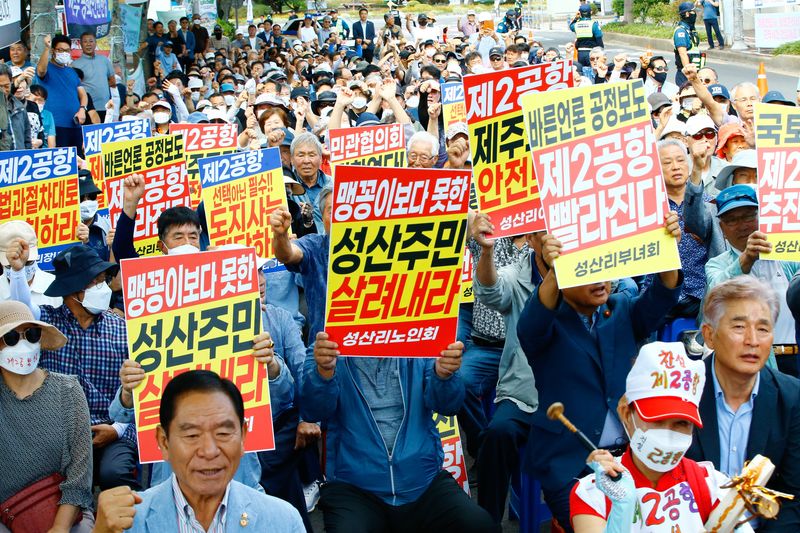
Proponents, including the Jeju Second Airport Pan-Provincial Promotion Committee, Jeju Chamber of Commerce and Industry, Jeju Employers Federation, and the tourism and construction industries, held a rally on the 9th and opposed the formation of the Conflict Mediation Council. They argued that, as Jeju Second Airport is a national project whose master plan has already been officially announced, it should proceed in accordance with statutory procedures such as the environmental impact assessment. Their position is that the consultative body must not become an organization that reconsiders whether the project should proceed.
The opposing side, the Emergency Citizens' Council to Block the Forced Construction of Jeju Second Airport, welcomed Jeju Special Self-Governing Province's policy of gathering residents' opinions and is calling for a decision through a referendum. Regarding the same consultative body, one side is concerned about the possibility of delaying the project, while the other is demanding a process through which residents can make the decision.
Controversy over the legal basis also remains. Questions have been raised, including at the provincial council, over whether the Conflict Mediation Council promoted by Jeju Special Self-Governing Province can address conflicts surrounding Jeju Second Airport, a national project, and whether a single consultative body can take on the conflict mediation function separately operated during the environmental impact assessment process.
Jeju Special Self-Governing Province maintains that there are no legal problems with the composition and role of the consultative body, but has commissioned an advisory attorney to conduct a legal review in order to resolve the controversy. The Social Agreement Committee itself is a body established under Article 458 of the Special Act on Jeju to offer opinions on resolving social conflicts.
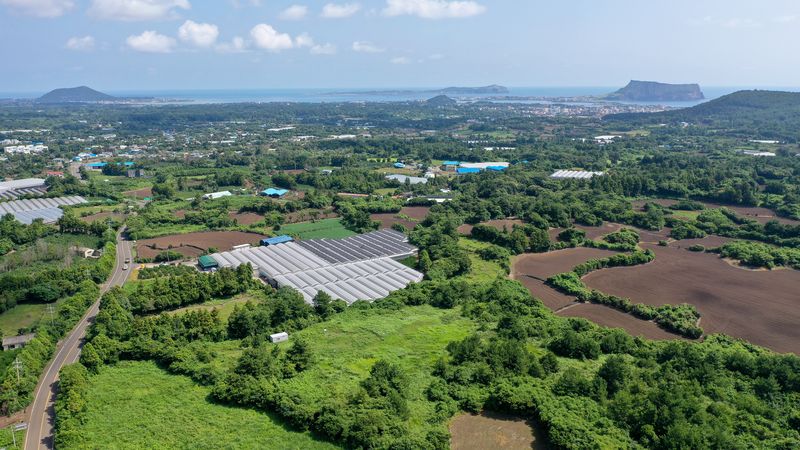
Jeju Second Airport has remained a core source of conflict in Jeju society for 11 years since the Ministry of Land, Infrastructure and Transport (MOLIT) announced Seongsan-eup in November 2015 as the candidate site. MOLIT officially announced the master plan in September 2024. The total Phase 1 project cost is 5.4532 trillion won, covering construction of a 3,200-meter-long, 45-meter-wide runway and passenger and cargo terminals on approximately 5.51 million square meters in Seongsan-eup. Follow-up procedures, including design and environmental impact assessment, are currently under way.
Koh, Seung Hahn, chairman of the Jeju Special Self-Governing Province Social Agreement Committee, said, "We determined that more time and a process of persuasion were needed so that stakeholders could participate together and reach an agreement," adding, "We will listen to opinions for another four weeks and discuss the matter again."
Even if the consultative body lays the groundwork for its launch during the October reconsideration, challenges will remain. A structure in which both proponents and opponents participate must be established, and the body's authority and scope must be clearly defined for the schedule to gather residents' opinions in the first half of next year to proceed as planned.
[email protected] Jeong Yong-bok Reporter