Delivery Riders Must Work 10 Hours a Day to Get By... “A Minimum Compensation System Is Needed”
- Input
- 2026-09-17 05:00:00
- Updated
- 2026-09-17 05:00:00
[Financial News] Calls have emerged for the introduction of a “minimum compensation system” similar to the safety freight-rate system for cargo workers to reduce industrial accidents among delivery riders. Critics say that because riders earn more as they complete more deliveries, the system encourages long working hours and speeding. They argue that guaranteeing a minimum rate could ease pressure to meet performance targets.
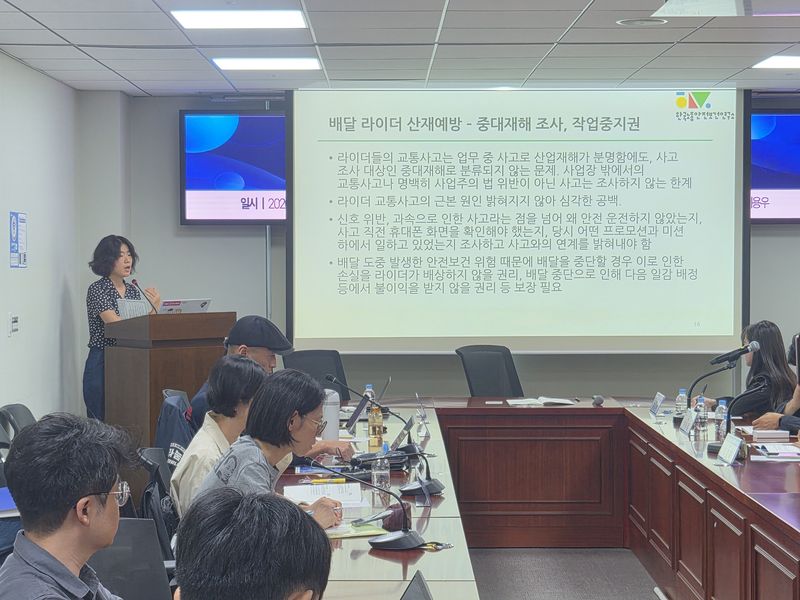
According to industry sources on the 17th, the forum on platform companies’ responsibility for preventing industrial accidents among delivery riders and introducing a minimum compensation system was held at the National Assembly of the Republic of Korea on the 16th. Organized by the Korean Public Service and Transport Workers' Union (KPTU) and the Rider Union branch, the forum discussed introducing a minimum compensation system and strengthening platform companies’ responsibility for preventing industrial accidents.
Gu Gyo-hyun, head of the Rider Union branch, argued, “Regardless of whether they qualify as workers under the Labor Standards Act, minimum compensation standards must be established for all delivery workers.” He added, “The compensation system should reflect the actual travel distance as well as the volume and weight of the cargo.”
The proposal aims to guarantee delivery riders a minimum rate, similar to the safety freight-rate system for cargo workers, and thereby ease excessive competition among riders.
Delivery riders in fact work long hours and travel considerable distances. According to the Ministry of Land, Infrastructure and Transport’s “2025 Survey on Living Logistics Conditions,” riders worked an average of 24.5 days per month and 10.6 hours per day. They completed an average of 42.7 deliveries and traveled 109.9 km per day.
The number of fatal industrial accidents among quick-service delivery drivers, a category that includes delivery riders, rose from 38 in 2023 and 32 in 2024 to 40 last year. Of the 1,950 persons providing labor whose industrial accidents were approved from January through July last year, 1,470 were quick-service delivery drivers, accounting for approximately 75%.
There were also calls to strengthen platform companies’ responsibility for preventing industrial accidents. Yu Cheonghui, executive committee member of KILSH, noted, “Delivery-focused platforms have ranked among the highest in industrial-accident cases for three consecutive years.” Yu added, “There are limits to eliminating and preventing risks arising from promotions and delivery-fee policies.”
Yu continued, “When riders stop making deliveries because of occupational safety and health risks, their right not to be held liable for compensation and their right not to suffer disadvantages in subsequent work assignments must be guaranteed.”
Meanwhile, participants at the forum also called for the government to strengthen investigations into the causes of fatal accidents involving delivery riders.
Park Da-hye, an attorney at Goren Law Office, emphasized, “Although industrial accidents involving delivery riders are increasing, the situation in which fatal accidents involving delivery riders are excluded from the scope of accident investigations must be improved.” Park added, “The government must investigate and analyze the causes of accidents, identify their structural causes, and establish measures to prevent recurrence.”
[email protected] Lee Dong-hyuk Reporter