Ruling Party Pushes to Include Domestically Produced Electric Vehicles in a 'Korean Version of the IRA'
- Input
- 2026-09-16 16:26:34
- Updated
- 2026-09-16 16:26:34
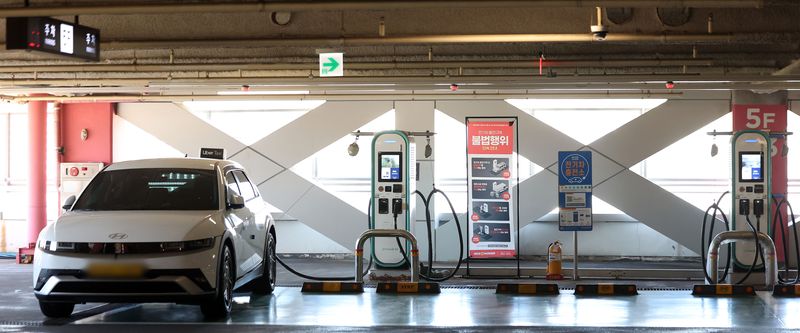
Lee Un-ju, a lawmaker from the Democratic Party of Korea, held a policy forum at the National Assembly on the 16th titled 'Policy Forum on Domestic-Production Tax Credits for Electric Vehicles and the Introduction of a Korean Version of the IRA.' She stressed, "To protect our battery industry, we must also protect our electric vehicles." Earlier this month, Lee also introduced a bill to revise the Restriction of Special Taxation Act, proposing a tax credit of up to KRW 4 million per domestically produced electric vehicle.
In August, the Ministry of Economy and Finance announced a tax reform plan that introduced domestic-production tax credits for six strategic industries: solar power, wind power, secondary batteries, semiconductors, key materials, and artificial-intelligence robot components. Electric vehicles were also reviewed following recommendations from MOTIE and the industry, but were ultimately excluded. An official from the Ministry of Economy and Finance explained to this newspaper, "Electric vehicles are produced by large domestic companies, and the domestic share still exceeds 50%." The official added that, compared with the other sectors selected, the vulnerability of the production base and the need for support were assessed as relatively low.
MOTIE, however, is focusing on the sharp decline in the market share of domestically produced electric vehicles. According to MOTIE, the share of domestically produced vehicles among electric vehicles sold in Korea fell from 70.5% in 2023 to 57.3% last year, a 13.2-percentage-point drop in two years. MOTIE attributes the decline to the burden that price competition with China is placing on domestic companies.
Lim Chae-wook, director of MOTIE's Automobile Division, said, "Whenever I meet industry officials, I hear that there is at least a 30% difference when comparing the unit prices of parts from China and those from our parts industry." He appealed, "This is an important time to give our companies time to endure through production tax credits." He further noted, "The purchase subsidy program for electric vehicles aimed at consumers is gradually declining," adding, "The support previously provided to consumers should naturally transition into production tax credits."
[email protected] Song Ji-won Reporter