"Mom, let's look together": A special art museum outing for a person with dementia and their family [Reportage]
- Input
- 2026-09-16 15:49:45
- Updated
- 2026-09-16 15:49:45
The daughter captured her mother looking at the artwork on her cellphone. It was an ordinary scene of a mother and daughter walking through the exhibition hall together, explaining the works and taking photos. However, the place they visited that day was an art museum, not a hospital or dementia care center.
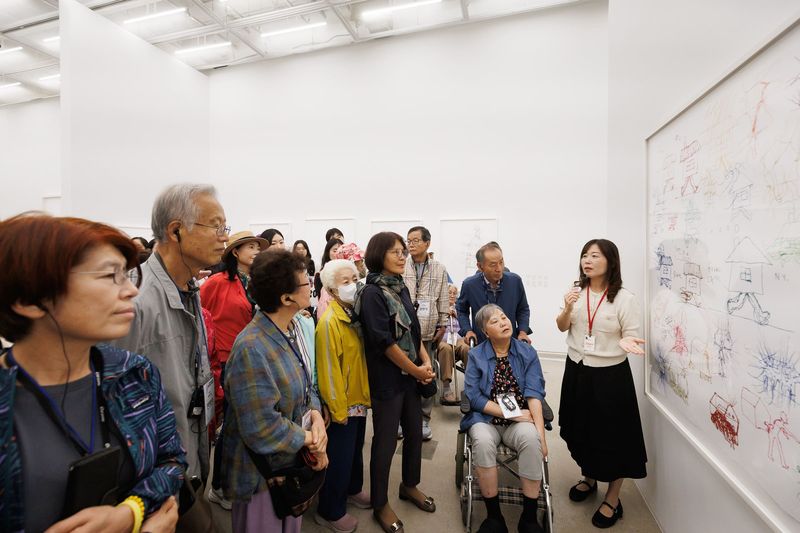
That day, 10 people with dementia and 10 caregivers from the Gwangjin-gu Dementia Care Center in Seoul visited the National Museum of Modern and Contemporary Art, Korea (MMCA). It was the first day of the '2026 Praise of Daily Life—Creating a Museum Together' program organized by the Korean Dementia Association and the National Museum of Modern and Contemporary Art, Korea (MMCA).
This year's program includes approximately 150 participants aged 60 or older with dementia, their caregivers and center staff recruited through dementia care centers in Seoul and Gyeonggi Province. It will be held in six sessions from the 15th through October 1.
Participants toured Do Ho Suh's solo exhibition, 'Do Ho Suh,' for about an hour. This year's program theme is 'Home and Memory.' Participants recall spaces from their own memories while viewing the works of Do Ho Suh, whose art explores migration and habitation, as well as the individual and the community.
After viewing the artworks, participants used a multisensory educational kit called 'The House in My Memory' to express the spaces they remembered. They then walked through the museum and the courtyard of Jongchinbu, expanding the memories and stories that arose in the exhibition to the surrounding spaces and nature.
Kang Sung-woo, a professor at Hanyang University Medical Center (HUMC) and a member of the Korean Dementia Association, toured the site with the participants that day and emphasized the importance of nonpharmacological approaches to dementia treatment.
Professor Kang said, "It is important to enhance brain plasticity through nonpharmacological treatment as well as medication," adding, "Unlike approaches such as digital therapy that provide stimulation through a screen, activities involving direct observation, touch and hands-on experience can offer a different kind of help."
Brain plasticity refers to the brain's ability to change functionally and adapt in response to external stimuli or experiences. Professor Kang said the participants were relatively young and had comparatively mild symptoms, explaining, "With dementia, it is important not only to treat symptoms that have already appeared but also to manage the condition so that it does not worsen."
The day's schedule at the museum did not end with viewing the exhibition. After the hands-on activities, participants ate together and took a plant tour near the museum. In the open space on the museum's second floor, they talked with one another while looking toward Inwangsan. They looked less like people with dementia and their caregivers than like a family out on a picnic together for the first time in a long while.
Dementia is not merely a problem of memory loss. Gradually becoming distanced from familiar daily routines and social relationships is another difficulty faced by people with dementia and their families. The program is meaningful because it provides participants with new stimulation while giving caregivers an opportunity to experience everyday life together with them.
'Praise of Daily Life' is a campaign the Korean Dementia Association has conducted since 2012. Since 2015, it has operated museum programs in cooperation with the National Museum of Modern and Contemporary Art, Korea (MMCA). Rather than simply showing artworks, the program combines art appreciation, expressive activities, conversation and experiences of space and nature.
The program is also expanding beyond the museum. The Korean Dementia Association and the National Museum of Modern and Contemporary Art, Korea (MMCA) plan to hold 'Praise of Daily Life Facilitator Training' twice in November and December for practitioners, including occupational therapists at dementia care centers nationwide. The aim is to enable people who have difficulty visiting a museum to participate in the program at local dementia care centers.
In 2022, the two organizations also jointly developed art education materials that people with dementia and their caregivers can use at local dementia care centers. The materials were designed so that the main elements of the museum program—from viewing artworks to expressive activities and sharing stories—could be used in local settings.
Park Ki-hyung, chairman of the Korean Dementia Association, said, "It is important to create an environment that helps people with dementia continue activities they are capable of and maintain an emotionally stable daily life," adding, "I hope this will be a time to share memories and emotions through art and gain new vitality in everyday life."
[email protected] Jeong Sang-hee Reporter