"KRW 7.2 Trillion Increase in Education Grants Is an Illusion... Actual Net Increase Only 0.3%"
- Input
- 2026-09-16 14:30:00
- Updated
- 2026-09-16 14:30:00
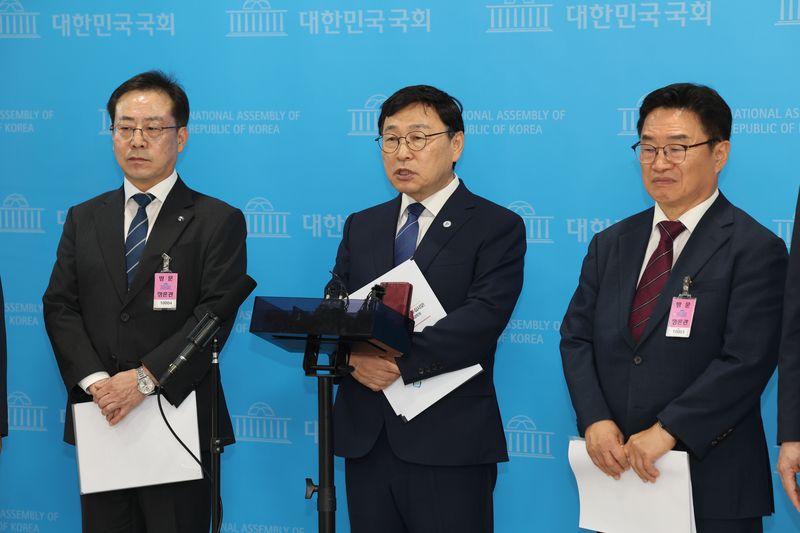
[Financial News] "The government says Local Education Subsidy Grants will increase by KRW 7.2 trillion, but we should not look only at that figure. We need to examine how much education-office finances will actually change compared with the amount they would receive under current law."
Geun-sik Chung, superintendent of the Seoul Metropolitan Office of Education and chair of the Korean Council of Superintendents of Education, called at a National Assembly press conference on the 16th for the government’s proposed reform of the grants system to undergo National Assembly scrutiny and broader social discussion. His point was that the bill’s actual fiscal impact should be assessed against the funding that would be secured under current law, rather than by looking only at the increase presented by the government.
The government says the grants would increase by KRW 7.2 trillion under the proposed reform. Chung, however, argued, "Compared with the actual grant amount after reflecting this year’s supplementary budget, the increase is KRW 2.4 trillion. After accounting for local education taxes, the end of compensatory funding, and reduced central-government support for free high-school education, the effective net increase is only KRW 225.9 billion, or 0.3%."
The council held the press conference at the National Assembly to call for scrutiny of the bill on the grants reform submitted by the government on the 3rd. The government proposal would abolish the system linking grants to domestic tax revenue, which has been in place for 55 years, and calculate grants based on economic growth and the school-age population.
Superintendents argued that the education finances needed in the future must be considered alongside the size of the grants. Fixed costs, including personnel expenses for teachers and staff and costs associated with national policy programs, are estimated to increase by at least KRW 3.1441 trillion. As a result, education offices may not have sufficient fiscal capacity even if the grants increase in nominal terms.
They also questioned using the decline in the school-age population as a key criterion for reducing grants. The cost of maintaining schools and classes does not fall at the same rate as the number of students, they said. The council explained that demand is also growing for improvements to aging school facilities, childcare, special education, basic academic support, and student mental-health services.
According to data from the council, Seoul’s student population fell by 9.8% over the past five years, while the number of classes increased by 1.9%, the number of teachers by 5.0%, and the number of schools by 1.5%. The number of students eligible for special education rose 37.3%, from 87,950 in 2016 to 120,735 in 2025.
The starting point for the new grant calculation method was also raised as an issue. The council claimed that the funding serving as the starting point for the new method was set at KRW 75.6901 trillion, creating a gap of about KRW 747.9 billion compared with the actual 2026 grant amount of KRW 76.4381 trillion. Because the new formula would be applied based on the previous year’s funding, the council explained, the difference at the starting point could affect grants in subsequent years as well.
At a press briefing held at the Seoul Metropolitan Office of Education on the previous day, the 15th, Superintendent Chung also emphasized that the grants reform was not simply a matter of increasing or reducing the budget. He said, "This is not simply a question of how much to increase the budget; it is a question of whether we will advance educational autonomy."
Although the government says it will establish a Future Response Fund to address the grants reform, Chung also pointed out that the fund’s specific uses and operating methods remain unclear.
He explained, "It is uncertain whether we will be able to fully cover increases in personnel expenses for public officials and education-sector public employees, and we also need funding to improve aging school facilities that are more than 40 years old." He added, "Budgets are already tight, and if education spending is squeezed further, the difficulties felt in the education field will only grow."
The Korean Council of Superintendents of Education called on the National Assembly to verify the difference between funding under current law and funding under the proposed reform and to disclose the fiscal impact on each of the 16 metropolitan cities and provinces. It also urged lawmakers to include adjustment mechanisms in the bill that reflect not only the school-age population but also wages, school operating costs, and growing education demand.
The relevant bill was submitted to the National Assembly by the government on the 3rd, but the Education Committee’s bill-review subcommittee has not yet been formed. The council said the National Assembly should review the bill thoroughly and allow sufficient time because the issue involves education finances, local government finances, and national finances together.
[email protected] Man-gi Kim Reporter