K-water to Reduce Pollution from Farmland Upstream of Dams Through Biochar Demonstration
- Input
- 2026-09-16 14:08:26
- Updated
- 2026-09-16 14:08:26
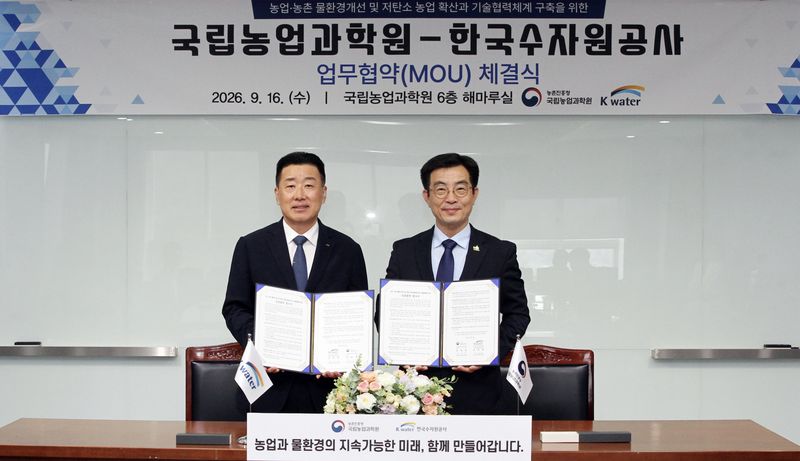
K-water announced on the 16th that it had signed a memorandum of understanding at the National Institute of Agricultural Sciences in Wanju County, North Jeolla Province, on improving agricultural and rural water environments, expanding low-carbon agriculture, and establishing a technology cooperation framework.
Under the agreement, K-water’s dam-basin management capabilities will be combined with the National Institute of Agricultural Sciences’ agricultural-environment research expertise. The two organizations will identify agricultural technologies that can improve both soil and water environments and jointly verify their effectiveness in upstream dam areas.
As a first step, biochar will be distributed to farmland upstream of Soyang Dam. Biochar is a carbon-rich material produced by pyrolyzing biomass such as wood at temperatures above 350 degrees Celsius in an environment with very little oxygen. It has the ability to adsorb pollutants such as nitrogen and phosphorus in farmland.
The demonstration project will analyze biochar’s effects on nutrient runoff, water quality, and greenhouse-gas emissions. Based on the findings, the organizations plan to establish guidelines for the appropriate amount of biochar to apply to farmland upstream of dams.
Since 2020, K-water has gradually introduced agricultural best management practices (BMPs), including water-level control devices and surface cover, to areas upstream of major dams such as Yeongju Dam and Daecheong Dam.
The two organizations agreed to establish a working-level consultative body by October and hold regular meetings every six months. They plan to share field-application results and cooperate to expand verified technologies into water-quality management projects in dam basins.
[email protected] Choi Ga-young Reporter