KORAIL Launches EMU-370 Project, Opening the Seoul–Busan Route to the One-Hour Range
- Input
- 2026-09-16 13:58:03
- Updated
- 2026-09-16 13:58:03
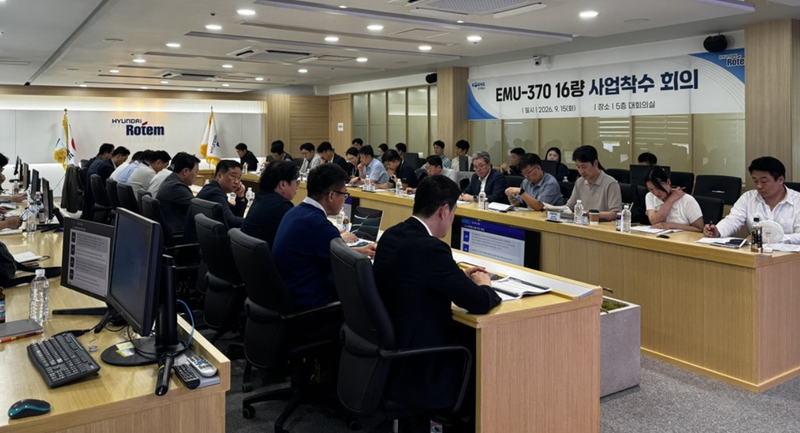
Korea Railroad Corporation (KORAIL) announced on the afternoon of the 15th that it held a project launch meeting for the 16-car EMU-370 at Hyundai Rotem Company’s Changwon plant and began the full-scale development and production schedule for the next-generation high-speed train.
About 40 officials from KORAIL and Hyundai Rotem Company, the train manufacturer, attended the meeting. They discussed the train production schedule, the status of manufacturing facilities, the project organization, design direction, and measures to ensure quality.
The project is being pursued to implement the government’s national agenda of introducing next-generation high-speed rail capable of speeds of around 400 km/h and to secure competitiveness in future railway industries, including high-speed rail operations and maintenance technologies.
The newly introduced EMU-370 is a large distributed-power high-speed train consisting of one 16-car trainset. It will have a maximum commercial operating speed of 370 km/h and a design speed of 400 km/h, making it the fastest train in South Korea’s railway history when introduced. In particular, the Intelligent Energy Optimization System (IEOS), which automatically controls trains according to optimal operating patterns for each track, will be applied for the first time. The system is expected to maximize operating efficiency and significantly reduce energy consumption.
The train will also incorporate the latest safety and maintenance technologies, including stricter ride-comfort standards, operating conditions for extreme weather, and Condition-Based Maintenance (CBM) equipment. Its interior and exterior designs will be revamped with aerodynamic structures in mind. Passenger convenience will also be improved by expanding dedicated first-class cars and luggage storage areas.
Once the next-generation high-speed train is fully introduced, travel time between Seoul and Busan is expected to be reduced to the latter part of the one-hour range, while travel between Seoul and Gwangju will take the early part of the one-hour range. The project is expected to help ease concentration in the Seoul metropolitan area and promote business and personal exchanges among regional economic zones, including Chungcheong, Yeongnam, and Honam, thereby contributing to balanced regional development.
Cha Jae-hwan, head of KORAIL’s rolling stock division, said, "This is a highly important project as we prepare for the era of the fastest high-speed rail service in South Korea. We will thoroughly manage the entire production process so that safe and convenient high-speed trains can be introduced on schedule."
[email protected] Kim Won-jun Reporter