Gap in Share of Current Students and Graduates Achieving Grade 2 or Higher on Last Year’s CSAT Smallest in Five Years
- Input
- 2026-09-16 13:51:32
- Updated
- 2026-09-16 13:51:32

[Financial News] In the 2026 College Scholastic Ability Test (CSAT), held last November, graduates’ average standardized scores in Korean and mathematics were 13.3 points and 12.1 points higher, respectively, than those of current high school seniors. In English, which uses criterion-referenced grading, 4.8% of graduates earned Grade 1, twice the 2.4% share among current students. However, an analysis found that the gap between current students and graduates in the share of top-performing examinees had narrowed to its smallest level since the integrated CSAT combining humanities and science tracks was introduced.
According to the 2026 CSAT score analysis released by the Korea Institute for Curriculum and Evaluation (KICE) on the 16th, graduates recorded average standardized scores of 109.4 in Korean and 108.6 in mathematics. Current students scored 96.1 and 96.5, respectively—13.3 and 12.1 points lower.
A standardized score reflects the difficulty of the test and the distribution of examinees’ scores. The overall average standardized score among all 2026 CSAT examinees was 100 in both Korean and mathematics. Graduates scored more than eight points above the overall average in both subjects, while current students scored about four points below it.
Graduates also clearly outperformed current students in the top grades. In Korean, 8.0% of graduates earned Grade 1, 2.4 times the 3.3% share among current students. When Grades 1 and 2 were combined, the figures were 18.9% for graduates and 8.1% for current students, a gap of 10.8 percentage points.
In mathematics, the Grade 1 shares were 8.7% for graduates and 2.9% for current students, a gap of roughly threefold. The combined shares for Grades 1 and 2 were 22.3% and 9.5%, respectively, a difference of 12.8 percentage points.
English, which is graded on an absolute scale, showed a similar pattern. Graduates’ Grade 1 share was 4.8%, twice the 2.4% share among current students. For Grades 1 and 2 combined, the figures were 25.3% and 14.2%, respectively, a gap of 11.1 percentage points. By contrast, current students accounted for a larger share of the lower-middle performance bands. In Korean, 13.7% of current students were in Grades 8 or 9, compared with just 2.9% of graduates. The corresponding figures were 10.4% and 4.0% in mathematics, and 6.3% and 1.2% in English.
The analysis covered a total of 493,896 examinees, including 333,102 current students, 141,539 graduates and 19,255 examinees who had obtained an equivalent qualification through the GED system.
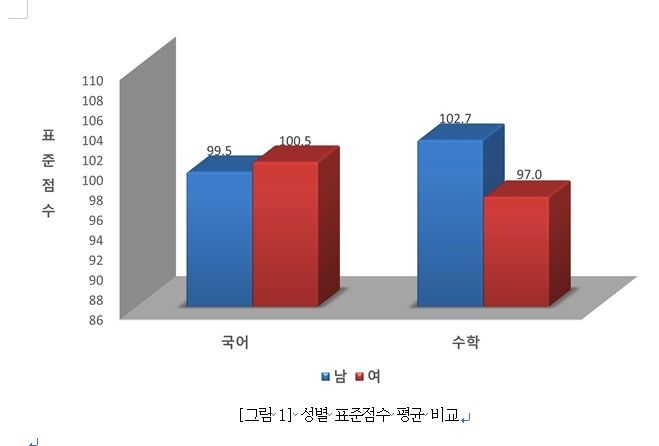
By region, students at schools in Seoul had the highest average standardized scores in Korean and mathematics. Seoul recorded 102.4 in Korean and 102.3 in mathematics, exceeding 100 in both subjects. It was the only region where the averages for both Korean and mathematics surpassed 100.
Graduates have continued to outperform current students since the integrated CSAT was introduced for the 2022 academic year. However, the analysis found that the gap between graduates and current students among top performers had narrowed from previous years.
An analysis of KICE data by Jongno Academy found that the gap between graduates and current students in the share achieving Grade 2 or higher was 10.8 percentage points in Korean, 12.8 percentage points in mathematics and 11.1 percentage points in English. In all three subjects, these were the smallest gaps since the integrated CSAT was introduced. Graduates still led current students in average scores and the share earning top grades, but the gap among high performers itself has been narrowing.
Jongno Academy analyzed that this may have been influenced by the relatively larger share of middle- and lower-performing students among those who retook the exam, as high-performing current students entered universities through early or regular admissions.
Lim Seong Ho, head of Jongno Academy, advised, "Although the number of repeat test-takers is increasing, high school seniors should not feel excessive pressure. Rather, they should clearly recognize that their scores can improve depending on the effort they put in and approach their CSAT studies accordingly. Graduates, meanwhile, need to understand that they should not be overly confident that they will have an advantage over high school seniors, unlike in the past."
[email protected] Lee Bo-mi Reporter